


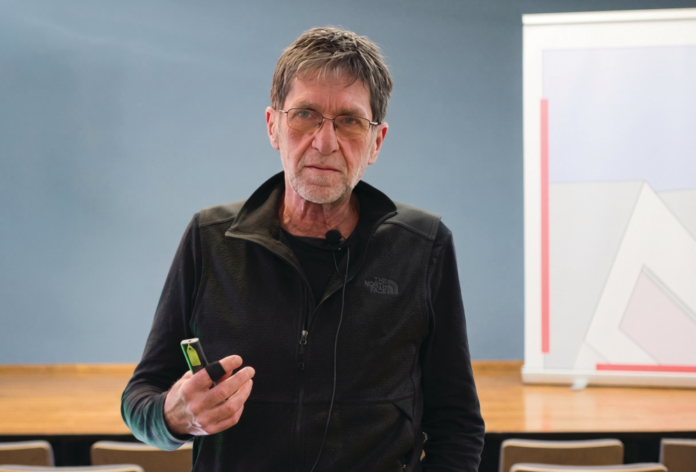
The last time I was in touch with him was over WhatsApp. I asked him for an interview for MedScriptum. Within a few minutes, he called back on video. Before I could even get through my news, he turned the camera around and, with that signature, boyish grin of his, said: “Why do you want to interview me? Interview Salome instead.”
That was how he introduced me to Salome Ghvinepadze a student at the University of Rochester, who was staying with him in California at the time. This was Tsotne Javakhishvili: a world-class scientist, and my closest friend. Right there, I promised that Salome and I wouldn’t just record an interview together – we would work together, full stop. Within two minutes, he had created a Facebook chat, added both of us, and sent a short message: “Salome / Ana, contact…”
He seemed unusually tired that day. I assumed he was simply exhausted. In recent months, he had been flying between the U.S. and Georgia every two or three months. He had grand, era-defining plans on both sides: here, and there too, where he was running ongoing global research and had an enormous workload. I also created a chat with Marika Sparsiashvili and Eka Saria so we could quickly agree on a time for the interview. He sent a separate message: “I’ll get back to you shortly. But tell them to drop the ‘sir’…”
He never had the chance to reply in the group chat. That turned out to be our last conversation. Exactly two days later, his small Cessna, which had taken off from Ramona Airport, lost contact and disappeared from radar. His flight ended over the Pacific Ocean.
This article is about a tragedy, but not only the personal, searing nightmare that followed Tsotne’s disappearance. It is also about a great tragedy for our country. We now have to come to terms with who we have lost: an extraordinary person reaching the highest frontiers of science, who in recent months seemed to be compressing time itself. He was trying, through his own unique knowledge and experience, to create a genuine global competitive advantage for Georgia.
Part I: Mentor and Source of Inspiration — “Interview Salome”
As we had agreed with Tsotne, we begin this story with Salome. Today, Salome Ghvinepadze is a student at the University of Rochester School of Medicine.
Salome, how did you meet Tsotne Javakhishvili, and what was your first emotional impression of him? I first saw Tsotne at the Agricultural University, when he was invited to give a lecture to biology students during one of his visits to Tbilisi. He made an indelible impression on me immediately. We sat there, breathless, captivated, listening to this Georgian biologist who had come from the U.S., telling us about his latest research with such genuine passion. I didn’t meet Tsotne personally that day, but hearing him speak became, for me, an enormous professional motivation.
The COVID-19 pandemic had been underway for a few months when my classmate Anastasia told me that a new molecular diagnostics laboratory was opening and was looking for biologists. I happily agreed. It soon became clear that one of the scientific and spiritual leaders of this entirely new ecosystem, Genomics, was none other than Tsotne. Our first official interview took place over a Facebook video call. He immediately forbade me from calling him ‘Mr. Tsotne.’ The call, which I had been preparing for quite anxiously, barely lasted two or three minutes. He told me later: in the first ten seconds, he learns everything he needs to know about a person.
A few months after that video call, Tsotne arrived in Tbilisi. I expected we’d be formally introduced and I’d say, “Hello, I’m Salome…” I was working an evening shift at Genomics, waiting for some test results. Suddenly Tsotne walked down the corridor, glanced into our room, waved at me and grinned: “Hey, Salo!” as if we’d known each other our whole lives, as if we were old friends. After that came the small internal seminars, private lessons just for us, experiments outside the standard workload, and deep scientific discussions. Sometimes, at the end of the day, he would leave us with some particularly difficult problem or riddle in molecular biology, and we’d compete with childlike enthusiasm to see who could answer first. When he wasn’t in Tbilisi, he would wake up at three or four in the morning to join our lab meetings or presentations remotely from San Diego.
What did you feel in that moment, during our video call, when he said with a smile: “Interview Salome”? I was standing off to the side, and when I heard my own name, I couldn’t help laughing. It wasn’t the first time Tsotne had unconditionally championed my peers and me as we stepped into the professional spotlight. I always get nervous before interviews, but that kind of attitude from Tsotne was, for me, the highest possible compliment and recognition; it meant I was doing something right and living up to his hopes.
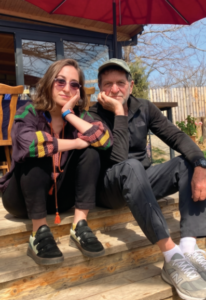
As a student at the University of Rochester School of Medicine now, what mark did Tsotne leave on your professional and personal outlook? The time I spent at Genomics played an enormous role in shaping the direction of my career in biomedical science. From Tsotne, I learned what a real leader looks like, how to listen to your team, and how to explain the most complex biological questions in the simplest, most human terms. He always repeated the same thing to us: “What matters is showing what you’re capable of doing now, not what you’ve done up to this point.” That advice remains my central anchor to this day.
As a scientist, he had a remarkable instinct; he always knew, without fail, what the next big thing would be. He saw science and global progress as one inseparable whole. He was constantly pointing us towards new methods we should master, towards where we should be looking next. It always felt as if he were several steps ahead of every new development emerging anywhere in the world.
I was extraordinarily lucky to have, in him, an irreplaceable teacher and friend. He was always genuinely interested in what young people thought, and from the very beginning, here in Tbilisi, he entrusted my fellow students and me with work on a grand scale. That, combined with the experience itself, gave us an enormous boost in self-belief. He was the perfect example of what mentorship should look like. When I decided to continue my studies in the U.S., no one was more in my corner than he was. After I arrived here, I visited him twice, and I’m left with countless memories that will stay with me for the rest of my life: flying lessons, aviation terminology, driving along the Pacific coastline, and his unbelievable stories… It was impossible to be bored with him. We talked about everything: science, Georgia, films, and literature. He showed me his old workplaces and his favourite spots in California, and every single one of them came with its own particular Tsotne-flavoured story. Spending time with him never felt like a dry lecture, but after every conversation, you came away feeling you’d learned something completely new about the world, and about yourself.
“Tsotne’s Children” — From the Genetic Code to “The Knight in the Panther’s Skin”
Salome wasn’t the only one. At the Genomics laboratory he founded in Georgia, he had gathered around him an entire team of students and young scientists, with whom he kept up daily, live, remote contact. This is how I came to know the ‘Genomics kids’: Tsotne wanted to launch educational biotechnology projects in Georgia. When the US Embassy’s alumni grants competition was announced, I offered to help prepare a project application. There were only three or four days left before the deadline. We drafted the concept for a summer camp for students, but we weren’t able to finalise all the technical details in time and had to postpone the submission. The teaching module, however, is fully drafted, and we will absolutely carry these plans through together with his team.
I went to Genomics to document their stories, but the meeting was so emotional that we couldn’t do the interviews in person, so they sent their answers in writing instead.
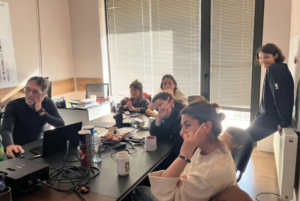
Mariam Gachechiladze, Researcher at Genomics: These past days, I’ve been racking my brain, trying to remember exactly how I met Tsotne. I can’t recall any moment of formal introductions, handshakes, or that kind of familiarity-establishing ritual, which, frankly, he found rather irritating anyway. My first memory begins in the Genomics lobby, with our wide eyes and his unstoppable urge to awaken, grow and set loose whatever motivation, love of science and curiosity already existed in us. For years, it went on like this: we’d sit in a circle, and Tsotne would give us puzzles whose answers often didn’t exist anywhere in the world. He did this so that we’d see a given question from every possible angle, and grapple with the kinds of questions science itself had been grappling with for decades. Or simply so that we’d see the beauty of it all, the elegance of life, from the genetic code all the way to the lines of the Vepkhistkaosani (The Knight in the Panther’s Skin, a Georgian medieval epic poem).
Tsotne was always irritated by official holidays, because he genuinely couldn’t understand what anyone might need rest from. I will probably never meet anyone in my life who is harder-working than he was, but the everyday process of working with him was the lightest, freest, and most joyful thing imaginable: full of science, laughter, geopolitics, mountaineering, nautical miles, future plans, and unconditional support.
The most important thing he left us as a legacy is a love for biology as life itself, and for one another. What mattered most to him, in the end, was freedom and humanity in the sky, on a hike, in science, in relationships, in art. As he himself used to say, for him “Genomics” was never a physical building or institution; it was the people. That’s why he saw this space’s future in our individual successes, which would one day come together reliably. He was constantly trying to build a path so that the desire for science could be born in a Georgian student, and so there would be somewhere for that talent to be realised.
I was always astonished at how Tsotne saw us with such an elevated view of who we were. I think the greatest motivation for my own development as a scientist is precisely this: to somehow manage to become, even slightly, the person I was in his eyes. Continuing what he started is inevitable. Everyone who knew Tsotne carries the same charge: not one of his ideas should be left unfinished.
Irina Mamporia, Researcher at Genomics: Tsotne was a special person, and he loved his work in a different, ardent way, and that love was instantly contagious. Whatever difficulties we ran into, we always felt his steady support behind us. When I first met him, I wasn’t working in my field. The moment he found out I was studying biology, he was overjoyed; he talked to me endlessly about science and my interests, and he made me attend every one of his seminars and meetings. Soon, I started working in the lab. He did everything he could to deepen my interest in biology.
I don’t think he stopped working or thinking for a single moment. One day, at three in the afternoon Tbilisi time, I got a message from him: “There was a champion skier, Jean-Claude Killy. He had one rule: be the first down the slope and the last to leave it. Everything else is Mother Nature…” It would have been four in the morning for him, in San Diego. He once told us, “You should be happy about your days off, because that’s when you have more time to read and to learn.”
He would gather us in the conference room, run a seminar, and then assign us presentation topics. The day before, he’d somehow find time for an individual consultation with each of us, one by one. We had a soft red ball, and he’d joke that if you got something wrong, you got hit with the ball. I don’t remember anyone ever actually being hit (even though we did get things wrong), quite the opposite: he’d give us a thumbs-up from across the room to encourage us. And when we finished, he’d praise us warmly: “Iro, that’s brilliant…” – and another thumbs-up.
I’ll always remember his words: “What is an experiment? It’s a question you put to nature. The important thing is to ask that question correctly, so that you get a truthful answer.” Outside of work, he had a few favourite spots for lunch. We always brought pencils and felt-tip pens with us. He’d ask permission, and we’d start writing, drawing, and working through formulas directly on the menus. Afterwards, we’d take home our “scribbles,” as he called them. Once, at some restaurant, they told us not to draw on the menus; they’d give us a blank sheet instead, and we never went back. At those lunches, sometimes we’d listen to music, sometimes talk about The Knight in the Panther’s Skin, sometimes about Darwin, or Vazha-Pshavela, or Johan Cruyff, or DNA and proteins. That’s how he raised us – both professionally and personally.
Once we were working on a scientific poster, the topic was “Luminescent proteins and synthetic biology”, and he was thrilled about it. We were under enormous time pressure; it had to be sent off for printing. Maki and I, exhausted, started fooling around, joking, laughing. He was laughing too, but he told us a few times, “Now is not the time for that.” We still didn’t settle down. Finally, with a stern face, he said: “Enough of the monkey business, do you want me to actually act like a real boss now?” Maki looked at him calmly and said, “Tsotne, now is not the time for that!” He burst out laughing, loved that line so much that he filmed us saying it, just to remember it.
He built the strongest team of young, early-career Georgian scientists. It’s so hard for me to write about Tsotne in the past tense. Tsotne will always be.
Part II: Plans for Georgia — “I Want to Come Back”
“After the 9th of April, I left, and I knew Georgia was independent. I can’t stay here any longer now. I have to come back.” This great desire took on an entirely concrete institutional form through collaboration with the University of Georgia, which led to the founding of the country’s Institute of Synthetic Biology. His primary strategic goal was to secure Georgia a leading position on the global biotechnology map.
Merab Topuria, Director of the School of Science and Technology, University of Georgia: “Our acquaintance began way back in childhood; we lived in the same old Tbilisi courtyard, in the Italian yard. And you know what street it was on? Louis Pasteur Street. He was six years younger than me, but we often played together. He was an extraordinarily interesting child. Later, his family moved, and I didn’t see him again for a long time. By the time we connected again, the university already had institutes of immunology and haematology, as well as of molecular biology and gene editing. It was logical that all of this scientific infrastructure should converge into an Institute of Synthetic Biology. I first met Tsotne again at the university. He had interesting ideas, and then I came back to him with a specific proposal, and that’s how this hugely important project began.
The global wave of biotechnology has been building since the 2010s, and this entire direction was essentially created by two people: Peter Schultz and, alongside him, Tsotne Javakhishvili. For our country’s development, this institute and Tsotne’s legacy hold limitless potential to switch off a malignant tumour cell, to create artificial DNA, to bring a new living organism into existence, to develop an innovative drug, and to offer this unique knowledge to the world. He was at the forefront. He created a new science.
As for his involvement, we handled the construction of the physical space, but the real project was in Tsotne’s head. He’d come, personally check the tiles, the colour of the walls, change details on the spot, and tell us exactly how things should be done. He was an extraordinary person; it felt as if he left a part of himself in everyone he interacted with. Unassuming, that’s probably the word that captures him best; simple in his relationships, and infinitely deep. Profoundly respectful, and profoundly humble. He was not made of ordinary material; a different kind of blood seemed to run through him.”
Anastasia Guraspashvili, Researcher: “I met Tsotne seven years ago, when I was in my second year at the Agricultural University. Whenever he came to Tbilisi, our lecturers who were friends of his would invite him to give lectures. At one such talk, where he was discussing his research and a recently published paper, I asked a fairly specific question. He really liked it. After the lecture, he kept me back and said: ‘That’s the kind of question our lab spent a whole year trying to answer.’ We talked for almost an hour. Not long afterwards, during COVID, the Genomics laboratory was founded; Tsotne got in touch with me and said I should come work with him. I was part of Genomics for four years. I left in December, and from February onwards, Tsotne was already in touch about a new institute. He hired me as the institute’s first employee and then signed his own contract. Over these seven years, wherever his professional path led, he took me along.
Every step he took had a single goal: getting young people as involved as possible. He was as happy as a child when the latest piece of equipment, a Nanopore sequencer, arrived at the lab. The work we’re now laying the foundations for has no equivalent anywhere in the region. This technology is patented; access to it is restricted; even leading countries in the world don’t have it; and Tsotne was a critically important co-author of it all. With the capabilities created here, the world itself could genuinely learn something.
To me, he was like a parent; he created an almost unreal sense of protection and support, especially when it came to education. He’d stay up all night to make sure that if you had something to finish, you finished it properly. There was never any sense of an age gap or a difference in stature between us. Setting aside the financial side of things entirely when you make something accessible and convince people that here, in Georgia, you can genuinely do work that’s in the running for a Nobel Prize makes it tangible. It restores your faith.
This year, I enrolled at the University of Sheffield in the UK. Tsotne told me, ‘Right now, I want you to go more than anything, and at the same time, I don’t want you to go at all.’ He was my own referee. What I actually did was write to the university, defer my place for a year, and tell Tsotne my language certificate had expired. I stayed, because this institute needs to be built exactly the way he wanted it. Normally, if you go abroad to study in this field, you stay there because if you come back, the prospects of working in your profession are basically zero. This institute is exactly what creates that prospect. I will give everything I have to make sure this work is carried through to the end.
When he was in touch from San Diego, he jokingly called us ‘wolves, beasts and predators.’ Tsotne was, in practice, an extraordinary feminist every display of a woman’s strength delighted him, and he became your unconditional supporter in showing the fullest version of yourself. Then, when he disappeared… For a week, I either couldn’t sleep or I was running. While running, I kept plotting rescue routes in my head; I dreamed I was pulling him out of the water. He always loved Robinson Crusoe stories. He was like that himself. Part of me still believes that somewhere, on some distant island, he’s smoking a Cuban cigar and drinking tequila right now. I think that unreasonable hope will probably stay with me forever, because I never saw him again, never found him. I have a mission now: whatever else happens, this institute’s work has to be carried through to the end.”
Lika Chkonia, Founder of Genomics: “It was during the early days of COVID that we decided to lay the foundations for a molecular biology institute, and we invited Tsotne to be its scientific director. We brought in young biologists, and he mentored them and taught molecular biology at such a level that our ‘kids’ were accepted without any difficulty into master’s and doctoral programmes at leading universities worldwide. Nothing in those laboratories was unfamiliar to them. We wanted Georgia to develop a biotechnology institute that worked on both the educational and the scientific fronts. At the time, due to a lack of significant funding, we weren’t able to take it all the way, but the knowledge he embedded endures today, and a great deal of research continues at Genomics. He was involved in the process every single day. Early in the morning, Tbilisi time, he would run seminars for the molecular biologists, set them tasks, and listen to their reports. His physical absence, on the other side of the ocean, was simply not noticeable.
Tsotne was so humble that I only came to understand the true scale of who he was after he disappeared. When I met his closest friend, the legendary world scientist Peter Schultz, he told me: ‘I’m not the important one here, the revolution that happened in synthetic biology was entirely Tsotne’s initiatives and ideas.’ We had no idea of the scale of this reality, because he himself never talked about it out loud. He would look directly at a genome sequence, the kind that’s normally decoded with specialist software, and read it like ordinary text. His former classmates say they would study themselves into exhaustion, while he would just glance over the material and always be the best. A mountaineer, a pilot, a scientist, the best at everything, and ferociously demanding of himself.
I witnessed two deeply symbolic, contrasting flights of his: his very first practice flight, and the day we drove him to the airfield for his last, unfinished journey. On that first flight, he was still learning. They gave me headphones that turned out to be broken. I have a vestibular disorder. That exact day, he happened to be practising emergency landings in the air. He looked over, asked if I was OK, and, seeing my condition, we landed immediately.
That last day was very strange. My daughter Sopo and I went to the airport with Tsotne in one car, he was driving. There had been some problem with a car rental, and he’d asked if we could come along. He was a true artist, he loved setting off fireworks, and he wanted to share that feeling with us, to experience it together. Nothing out of the ordinary happened; we just took some photos. Sopo wouldn’t let me go alone, so we both came back together. Two hours passed, and he never reappeared on the radar… He vanished over the ocean. And the full nightmare began.
It’s extremely difficult for me to talk about this; a huge part of my life is now completely empty. I still haven’t come out the other side of this overwhelming stress. His unique gift was that he made everyone feel as though they had their own, personal Tsotne. He gave the same strength, in equal measure, to his American colleagues and to the most junior members of the lab, to become great scientists in their own right.”
Part III: Freedom at the Controls – A Friend
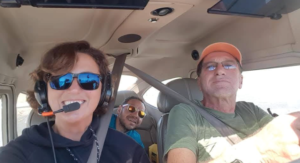
Flying was his greatest passion, one he shared with friends with particular joy. In his plane, you felt a sense of cosmic freedom take shape.
Giorgi Gotsiridze: “Our first flight together happened around ten or eleven years ago. For work, I have to go to San Diego once every two years. I’d known for a long time before that a brilliant Georgian scientist was working there. We were in touch on Facebook, and I wrote to him. We met in Coronado and went straight to the airport. We took our very first flight together to Catalina Island, and honestly, all my memories of him centre on that day. In Catalina, in the town of Avalon, he told me this amazing story about bison: how, at some point, a number of bison had been brought there for a shoot, how they stayed, multiplied, and became part of the island’s cultural heritage. Half the island is now a protected nature reserve, while the other half sells you bison burgers and souvenir caps. On the way, we watched blue whales in the Pacific from the air. The kind of bold, free and safe interaction with civil aviation that exists in the U.S. was, for me, a genuine revelation.
Tsotne, the U.S., liberal institutions, and absolute human freedom, that’s what that day left in me. It was a real masterclass in changing your perspective, packed into a single flight. He was my guide, my ‘gateway’ into the free world.
When I think of Tsotne today, one story keeps circling in my mind: his mountaineering trips in Svaneti, and that heavy episode in Zugdidi involving Napoleon Papava, which ended so dramatically. From where I stand, his greatest legacy is rooted in an extraordinary philosophy. When a child enters a school in England, regardless of their background, they’re placed on a particular kind of foundation. The desks or the furniture aren’t what matters; the child is told, directly: ‘You can change the world for the better, and you can be the best there is.’ Soviet and post-Soviet Georgia never had that kind of free ideology. Tsotne was, precisely, a person of that ideology. He couldn’t bear the rigidity of the environment here, but rather than flee it, he built his own formidable structure within it, where he became the best in the world in his field. By his own example, Tsotne, a citizen of modern Georgia, was the number one person in the world, in science, in humanity, in freedom. His life story is exactly what should be taught in schools. A man who carved his own path through sheer genius, and who, in the end, died with such mystery that even there, he remained number one.
His loss is unbearable to his friends, but Georgia, through his unfinished flight, has lost something that society will now have to struggle to recover on its own. Had he lived, he would have created exactly the kind of academic, university-based lens through which modern statehood is genuinely born. Where does a national statehood idea come from? It was born in academia. This would have been precisely the kind of historical starting point that Ivane Javakhishvili created in his time by founding the university. Tsotne would have brought together 500 of the best, freest citizens of Georgia, who would speak a transformative word in global science. His greatest genius lay precisely in his absolute simplicity; grandeur and simplicity stood remarkably close together in him.”
Epilogue
I met Tsotne Javakhishvili through Kakha Bendukidze. He was supposed to give a lecture at the Agricultural University, and fifteen minutes before it was due to start, he messaged to say he couldn’t make it. I don’t even remember who fell out with whom over it, or how we got through it but the fact is, that became the beginning of a particular friendship for me.
I am not a biologist, and not a scientist I am Tsotne’s friend. What I miss most is flying with him, the out-of-nowhere messages “Come on, want to go to Tierra del Fuego?!”, “Will you come with me to look for gold?”, and “Quantum of Solace, how are you?”
Understanding him as a scientist is difficult. It will take time to properly assess what he gave humanity, working with the codes of both worlds the cell and the sky. But one thing is clear: his unfinished flight has become a challenge for everyone who knew him and for science itself. And perhaps, in the very process of coming to terms with his legacy, a path of development will open up that matters enormously for our country.
By Ana Kvanchilashvili
