


Stroke remains one of the most serious challenges of modern medicine, ranking among the leading causes of death and long-term disability worldwide. Every year, millions of people suffer a stroke, and a large portion of survivors continue to live with varying degrees of neurological deficit. Impairment of upper limb motor function is particularly common, depriving patients of the ability to eat, dress, perform hygiene procedures, and carry out other daily activities independently. Although significant progress has been made in the treatment of acute stroke in recent years, the management of chronic motor deficits remains one of the most difficult problems in neurology and rehabilitation.
For this very reason, a new study published in the journal Nature Medicine generated great interest. The authors evaluated whether epidural spinal cord electrical stimulation could improve upper limb movement in patients who were several years post-stroke. The results indicate that the capabilities of the nervous system are far greater than previously thought, and even in cases of chronic stroke, it is possible to activate neural networks that had been functionally “silent” for a long time.
Stroke and the Study
Following a left-sided stroke, the damaged areas of the brain can no longer transmit normal motor impulses to the spinal cord. As a result, the arm and fingers lose strength, movement precision, and coordination. Although the lower motor networks of the spinal cord are anatomically preserved in most cases, they do not receive sufficient signals from the damaged brain. The new method is based exactly on this principle: if a weak signal sent by the brain can be amplified at the spinal cord level, the patient might be able to perform voluntary movements again.
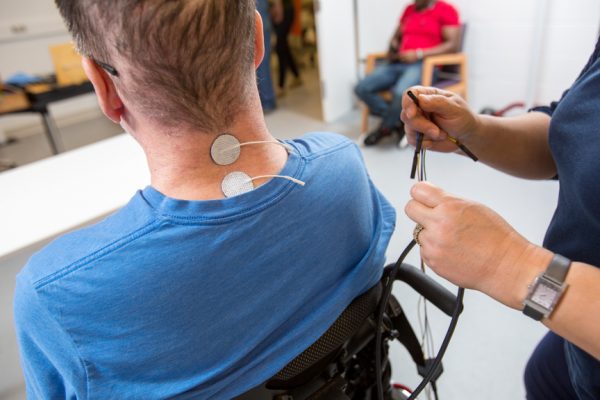
The study was conducted at the University of Pittsburgh in the United States. Scientists studied seven patients who were several years post-stroke and exhibited severe upper limb hemiparesis. All of them were implanted with two thin epidural electrodes in the spinal cord at the cervical segment level. The electrodes were positioned to deliver electrical stimulation precisely to the nerve roots that control shoulder, elbow, wrist, and finger movements.
It is particularly noteworthy that the method used does not attempt to “repair” damaged neurons. Instead, the electrical stimulation increases the excitability of motor neurons in the spinal cord. As a result, the weak but still existing impulses coming from the brain reach the muscles more effectively. Put simply, the system acts as a neural signal amplifier, allowing the patient to utilize the residual neural connections that remain preserved after the stroke.
The results of the study exceeded expectations. When the electrical stimulation was turned on, upper limb muscle strength increased by an average of 32%. The coordination of shoulder, elbow, and wrist movements improved significantly, and some participants were able to perform actions that had been impossible for many years following their stroke. Especially interesting was the fact that three patients, who had partially preserved corticospinal tract function, were again able to move their fingers and hands, which plays a crucial role in daily life.
The improvement was not limited to muscle strength alone. All participants experienced a reduction in spasticity, which is one of the most difficult complications of stroke to manage. Reduced spasticity means the limb moves more freely, pain is decreased, and the patient’s level of independence increases. It is also fascinating that during the study, the participants performed a total of only about 8.6 hours of active motor training, which is far less than the intensive rehabilitation typically required to achieve similar results. Despite this, the average improvement on the Fugl-Meyer motor assessment scale was 6.6 points, which is considered a clinically significant change.
The results in terms of safety are also encouraging. During the four-week study, none of the participants developed serious adverse events directly related to the electrical stimulation. This is particularly important because epidural spinal cord stimulation has been used for many years to treat chronic pain, creating a solid track record of the technology’s safety. Consequently, the new approach is not based on a completely unknown platform but rather finds a new application for a well-established neurosurgical technology.
Despite the impressive results, the study has certain limitations. It involved only seven patients, and the primary goal of the study was not the definitive confirmation of efficacy, but rather the evaluation of safety and feasibility. Therefore, large-scale, randomized clinical trials involving hundreds of patients are still needed. Only then will it be possible to determine how widely this method can be implemented in daily clinical practice. However, the very fact that medicine is developing in this direction and delivering hopeful—even if slow—news to patients is highly commendable.
