



The history of treating genetic diseases is a constant endeavor to decipher the biological code of life. While this process was initially quite crude, CRISPR technology introduced unprecedented precision, granting us the ability to manipulate virtually any segment of DNA. However, alongside the in-depth study of the genome, one thing became clear: “cutting” DNA is not always the most effective or safest path.
For this reason, scientific focus is gradually shifting toward epigenetics – the natural mechanism that controls the conditions and intensity under which a specific gene operates.
Epigenetic editing is precisely an attempt to transform this mechanism into a therapeutic tool. In this approach, there is no permanent modification of the genetic code; rather, we regulate cellular activity through chemical “switches.” As a result, certain genes are left “turned on” and others “turned off.”
Although methods based on this technology are currently used only for research purposes and a long road remains before they enter daily medical practice, the field has clearly moved past a purely experimental stage and entered the phase of initial safety-assessing clinical trials.
Today marks a turning point for epigenetic editing: the technology is leaving the laboratory walls and beginning its first, baseline clinical testings for several specific diseases, allowing scientists to evaluate its potential and possible risks.
Why is Epigenetics So Important?
To fully grasp the potential of epigenetic editing, it is essential to examine the epigenetic mechanisms themselves.
Every cell in the human body is genetically identical and carries a DNA sequence of approximately three billion base pairs, encompassing up to 20,000 protein-coding genes. Why then does a liver cell behave radically differently than a neuron or a muscle cell? The reason lies precisely in epigenetic regulation. This is a kind of internal regulatory system that decides which gene should be “turned on” and which “turned off” at any given moment.
The best-studied of these mechanisms is DNA methylation. Simply put, this is a biochemical process that regulates gene expression. When special chemical compounds called methyl groups accumulate on a regulatory region of DNA known as the “promoter,” it blocks the gene’s activity. Crucially, methylation is not static or unchangeable; it is constantly remodeled under the influence of development and environmental factors. Flaws in this regulatory process are, in many cases, the root cause of disease development.
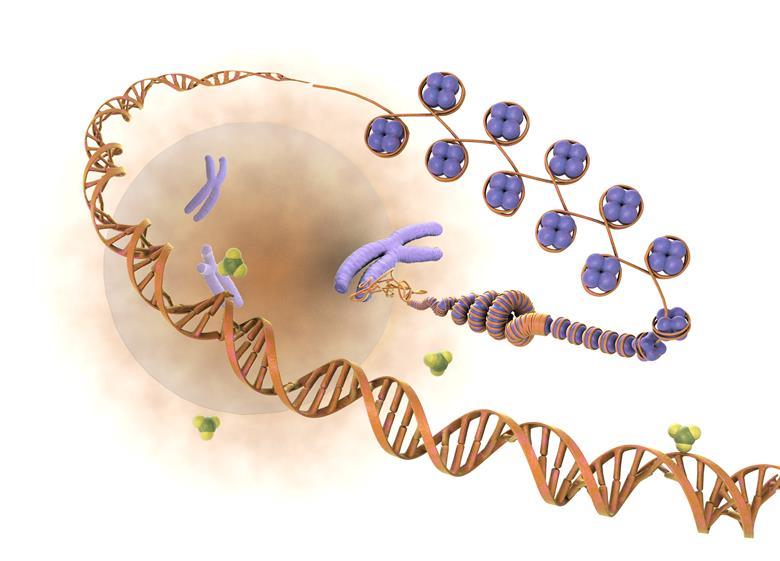
Current medications that affect epigenetic processes often work “blindly”—they influence the entire genome rather than a specific gene. Epigenetic editing, however, offers a completely different, targeted approach. This technology allows us to implement changes in only one specific gene while leaving the rest of the cell untouched.
The CRISPR Platform: A New Approach
Many epigenetic editing systems are conceptually based on CRISPR technology, yet an essential difference exists between them. In conventional CRISPR-Cas9 editing, the Cas9 enzyme uses a “guide RNA” to locate a precise spot on the DNA and cuts it. This forces the cell to excise the gene or, if necessary, insert new genetic material.
To avoid damaging the DNA, scientists created a catalytically inactive version of Cas9, known as “dead Cas9” or dCas9. This molecule still finds and binds to the target site on the DNA, but it no longer cuts it. This makes it an ideal “delivery platform”: dCas9 can carry special proteins to a specific gene to alter its activity—either its transcription or its epigenetic state.
Ultimately, the system operates with three components:
The guide RNA provides the address.
The dead Cas9 establishes the necessary base.
The attached regulatory protein performs the actual biological work.
Currently, some research groups are attempting to use more compact proteins that are technically easier to introduce into the body. However, the field is still in its early stages of development, and each company is developing its own proprietary platforms. In the race to turn these technologies into clinical therapies, delivering them efficiently to cells remains one of the primary challenges.
Why is This Approach Promising?
One of the main advantages of epigenetic editing is that it does not damage the DNA strand. This is highly important because cutting DNA—if the cell fails to “repair” it exactly as needed—can trigger unintended mutations or genomic instability.
Another intriguing aspect is its theoretical “reversibility.” In theory, epigenetic changes are more easily controlled and modifiable if necessary than permanently rewriting the genetic code itself. However, there is an important nuance here: the potential for reversibility should not be overestimated. Although a change can be “reversed,” once an epigenetic mark is established, it often becomes highly stable and durable. It is precisely this durability that guarantees a long-term therapeutic outcome.
Even though we are not cutting the DNA, risks still exist. Turning a gene’s activity “on” or “off” requires caution; if we stabilize the wrong gene, it could trigger a chain reaction, particularly with genes responsible for immunity or tumor suppression. For this reason, the primary task for scientists in this field is to balance maximum precision, therapeutic durability, and safety.
First Steps in Clinical Trials
Currently, research into epigenetic editing is moving most actively toward rare pathologies where scientists have already thoroughly studied the biological foundations of the disease. A prominent example is Facioscapulohumeral Muscular Dystrophy (FSHD) – a disease that causes progressive muscle weakening. Its primary cause is a disruption in the functioning of the DUX4 gene.
In FSHD, the cell loses the ability to “silence” the DUX4 gene, which should normally be passive. As a result, this gene activates at the wrong time and becomes toxic to muscle cells. This disease is an ideal target for epigenetic therapy: if the cause of the condition is the activation of a specific gene, then the task of epigenetic editing is clear—we must restore the natural mechanism that “silences” this gene.
Several companies are already pursuing this path. For instance, one of the most prominent programs—Epicrispr’s EPI-321 – aims precisely to restore the silencing of the region associated with the disease. The company has already announced the results of its first human trials, but caution is essential: the data so far are limited and involve a very small group of participants. Therefore, we view these early results merely as confirmation of a scientific hypothesis rather than final approval of a treatment.
This distinction is highly fundamental. In clinical trials, early biological signals frequently give us hope, but the road from an exciting laboratory discovery to a widely available, effective therapy for patients remains long.
Beyond Rare Diseases: New Horizons
The potential of epigenetic editing is not limited to rare diseases. Its main appeal is that it is useful anywhere the root problem is a gene “malfunctioning” rather than a damaged DNA code. This perspective leads scientists to believe the technology could be used to treat common conditions such as high cholesterol or chronic viral infections.
Take cholesterol, for example: we already know that the PCSK9 protein plays a key role in regulating cholesterol levels. Companies are now researching whether epigenetically “silencing” this protein can reliably and permanently lower LDL cholesterol levels. Initial trials in animals have shown that this approach is feasible, but human evidence remains scarce, and more time and research are needed to draw definitive conclusions.
Another important area is chronic Hepatitis B. The main challenge here is that current antiviral drugs only stop the virus from replicating but cannot fully eliminate it from the body—the viral material “hides” inside cells, making a cure difficult. Scientists hope that epigenetic silencing will suppress the activity of viral genes more effectively and permanently. However, this work is still in its early stages, and maximum caution is required when evaluating the results.
Long-Term Effects and Perspectives
One of the most impressive aspects of epigenetic editing is its potential to achieve a long-lasting effect. If a therapy can stably and reliably reprogram gene expression, for the patient, it means a reduced or completely eliminated need for repeated, lifelong dosing.
This approach is doubly attractive: for the patient, a one-time (or few-time) treatment is far more convenient than chronic drug therapy. On the other hand, for developers, stability makes the therapy more clinically effective and commercially viable.
However, such stability also places a heavy responsibility on scientists. If our goal is a long-lasting and beneficial effect, we must not forget that an unintended side effect could prove to be just as “durable.” This is why long-term monitoring is an absolute prerequisite—especially now, as these platforms transition from rare diseases to broader patient cohorts and complex pathologies.
Where Are We Today?
Epigenetic editing is still an emerging field, and it would be premature to refer to it as a “ready” clinical technology. However, it is also a fact that the field has moved out of the realm of purely theoretical research. Today, we are seeing credible preclinical programs, the first practical steps in translational medicine, and even initial human trials.
Now the most critical stage begins: determining how robust these early optimistic signals truly are. Scientists face several fundamental questions:
Can we deliver the therapy to cells precisely, efficiently, and selectively?
Will the resulting effect possess sufficient duration to justify such a complex approach?
Can we keep the regulation of non-target genes at a minimal, safe level?
And most importantly, will the success seen in small studies be validated in large-scale clinical trials?
These questions are not merely minor technical hurdles. They are the boundary line that separates a simply “exciting scientific finding” from a real, effective, and safe therapeutic achievement.
Source: nature
