


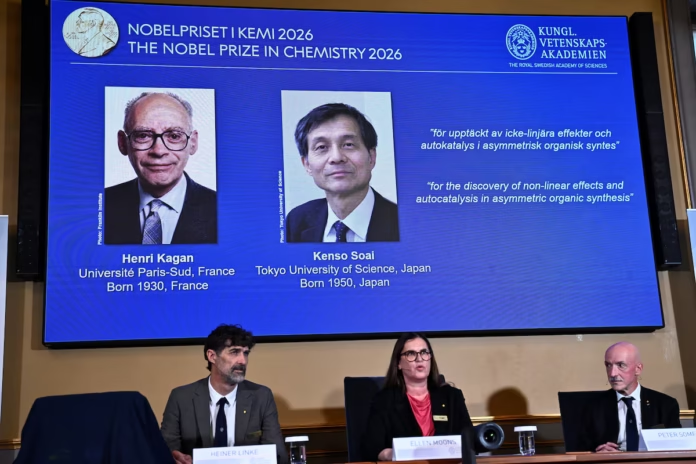
The 2026 Nobel Prize in Chemistry has been awarded to scientists Henri Kagan of France and Kenso Soai of Japan.
“This is the most exciting day of my life. I am delighted to share this honor with Professor Henri Kagan,” said Kenso Soai. The Japanese scientist noted that he learned of the victory while out shopping.
According to Heiner Linke, Chair of the Nobel Committee for Chemistry, this year’s award honors “fundamental chemistry.” Many molecules essential to life exist in nature in two mirror-image forms—much like right and left hands. However, living organisms almost always utilize only one version. This phenomenon, which puzzled chemists for more than a century, is known as “homochirality.”
This discovery has proved transformative for the pharmaceutical industry, as many drug molecules exist in nature in two mirror-image (right-handed and left-handed) forms—one may cure an illness, while the other can prove toxic to the human body. The findings of Henri Kagan and Kenso Soai gave chemists the unique ability to deliberately control chemical reactions and synthesize only the desired, safe form of a molecule, making modern drug production substantially safer, more precise, and more effective.
The laureates will share the prize sum of 12 million Swedish kronor (approximately $1.2 million USD). In accordance with tradition, they will receive their medals from King Carl XVI Gustaf of Sweden at a ceremony in Stockholm on December 10, the anniversary of Alfred Nobel’s death.
