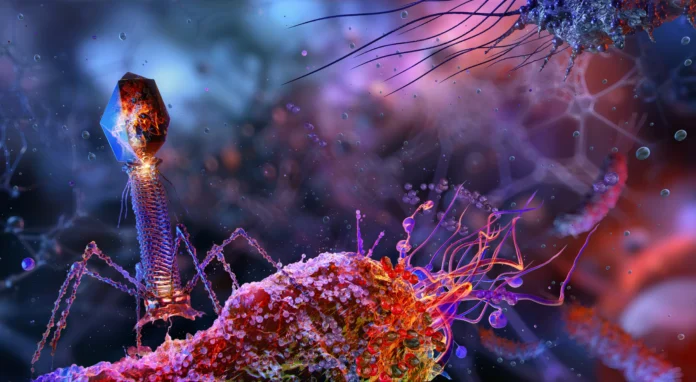
According to the biotechnology startup Radical Numerics, scientists have, for the first time in history, used artificial intelligence (AI)-designed viruses—bacteriophages—to treat a patient with a severe bacterial infection.
The company published a technical report of the study on its website, but the paper has not yet undergone peer review and has not been published in an academic journal. Citing privacy requirements, the startup is not disclosing information about the patient or the treating physicians, although company representatives state that the clinical trial was approved by the U.S. Food and Drug Administration (FDA).
“We take patient privacy and maintaining the trust of our clinical partners with the utmost responsibility. We plan to publish our scientific findings in a peer-reviewed journal, while clinical details will only be disclosed following appropriate consent,” stated Eric Nguyen, CEO of Radical Numerics.
Why was it necessary to create viruses using artificial intelligence?
Bacteriophage treatment dates back over a century and is regaining relevance globally alongside the rise in antibiotic resistance. However, unlike taking standard antibiotics, phage therapy is a much more complex process: each type of phage infects only strictly defined strains of bacteria, and finding and testing a natural virus tailored to a patient’s specific infection takes a significant amount of time.
To overcome this barrier, instead of searching for new species in soil and water, scientists decided to create patient-specific phages with the help of artificial intelligence.
Radical Numerics was founded by former researchers from the Arc Institute in California. Back in 2025, this team created the AI model Evo 2, which generated 700,000 viral genomes based on the study of millions of DNA sequences. From these, scientists synthesized the DNA molecules of 285 genomes in the laboratory, introduced them into bacteria, and obtained 16 viable viruses.
In June of this year, the startup introduced a new generation model—Omnii, which, in addition to DNA, studies protein structures and the molecules that regulate gene activation and deactivation.
How did Omnii design the new bacteriophage?
As part of the clinical trial, researchers modified the T7 bacteriophage, which exclusively attacks E. coli. The virus resembles a microscopic spaceship—a round protein shell containing DNA, supported by six leg-like appendages. To infect the bacteria, T7 uses these appendages to attach to its surface and injects its DNA into the cell.
In collaboration with physicians, the startup treated a patient who had a severe E. coli infection. The bacterium turned out to be resistant not only to antibiotics but also to all available bacteriophages.
The scientists provided Omnii with data on the resistant strain and tasked it with designing T7 phages whose “legs” would have an altered shape to attach to this specific bacterium. Based on the genomes generated by the AI, the researchers created the corresponding DNA molecules and introduced them into bacteria. As a result, new T7 phages were produced that successfully infected and destroyed the resistant microbes. After passing safety tests, the preparation was used to treat the patient.
Scientific Assessment and Skepticism
Independent specialists are greeting the news with interest, but caution. Michael Baym, a microbiologist at Harvard University, notes that the success of the experiment will open an entirely new avenue for the use of artificial intelligence in medicine, but he maintains a skeptical stance until the final results are published. According to him, it is essential to determine how genuinely new and unique the viruses created by the company actually are.
Brandon Berryhill, an evolutionary microbiologist at Uppsala University in Sweden, emphasizes that laboratory efficacy does not guarantee the defeat of the infection in the patient’s body.
“We cannot measure anything in the lab in a way that tells us in advance how effectively the virus will control a real infection. Even if the treatment proves successful, simply creating phages with the help of artificial intelligence will not explain to us what determines the success or failure of phage therapy—there is still too much we do not know about the rules of the game,” explains Berryhill.
How successful the treatment with phages created by Omnii will turn out to be will become clear later: phage therapy lasts from several days to weeks, while doctors monitor the patient for months to rule out the re-development of the infection.