


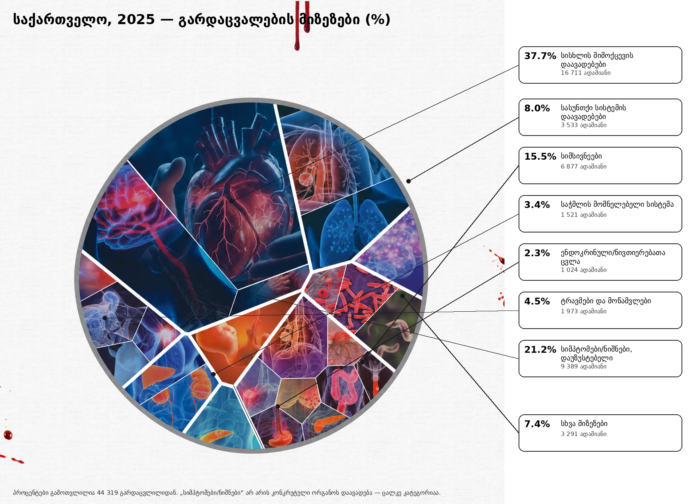
Over the past decade, Georgia has practically been hurtling toward a demographic catastrophe. While many have been sounding the alarm for years, things are only getting worse. To really understand what’s going on, we need to look past the charts and look at the medical reality: what is actually killing thousands of our citizens every year? According to Geostat, 44,319 people died in 2025—which is 348 more than the previous year. At first glance, it looks like a small bump. But when the death toll rises year after year, and has outpaced births by thousands for 12 straight years, this isn’t just a minor detail. It’s a massive red flag. This isn’t about numbers; it’s about our people’s health, how we live, whether we can afford a doctor, and how bad our preventative care really is.
Cardiovascular Diseases – 37.7%
The number one killer in Georgia is circulatory system diseases. In 2025 alone, heart problems, strokes, and complications from high blood pressure took 16,711 lives. That is a staggering 37.7% of all deaths. It proves that heart disease is arguably the heaviest public health crisis the country faces.
There are three main reasons behind this nightmare:
-
Lifestyle: Terrible diet, way too much salt, fatty foods, barely any physical activity, heavy smoking, and constant stress.
-
Too Little, Too Late: People only go to the doctor when things are already critical. By then, even with treatment, getting back to a normal life is barely realistic.
-
No Culture of Prevention: Checking blood pressure regularly, monitoring cholesterol, and catching heart issues early could save countless lives. But the truth is, most people ignore their health until the symptoms become unbearable. Why? Because medical care in Georgia is still tied to massive bills. The harsh socioeconomic reality makes people terrified of even thinking about going to a doctor.
Unclassified Causes – 21.1%
The second largest category is officially labeled as “Symptoms, signs, and abnormal clinical/laboratory findings, not elsewhere classified.” In 2025, 9,389 people died under this vague umbrella. This doesn’t mean a specific disease; it means nearly 10,000 deaths—more than one-fifth of the entire country’s death toll—were never properly diagnosed or classified.
This should make us ask some serious questions: How accurately are we actually recording why people die? What are we missing? If we don’t even know what’s killing our people, how can we build a proper healthcare policy? How do we know where to pump resources—into cardiology, oncology, emergency care, or clinics? This isn’t just a statistical glitch; it’s proof that our diagnostics and data collection are broken.
Oncological Diseases – 15.5%
Cancer is the third leading cause of death. In 2025, it claimed 6,877 lives in Georgia—15.5% of the total. Every single year, thousands of families are devastated by this disease. The high cancer rate shows that this isn’t just a medical issue; it’s a social and economic disaster. Treatment is incredibly expensive, diagnoses are often late, botched, or missed entirely, and the concept of regular screening is still barely understood by the public.
With cancer, time is everything. Caught early, the survival rate changes drastically. But early on, cancer doesn’t scream; its symptoms are quiet or invisible. That’s why screening is a matter of life and death. If the state and society prioritized early detection, awareness, and making treatments accessible, we could stop this bleeding. A strong healthcare system starts before the disease takes over, not after the damage is done.
We also can’t talk about prevention without talking about our toxic environment and terrible air quality, which directly drive up cancer risks. The cancer numbers are visibly higher in industrial zones like Chiatura, Zestafoni, Tkibuli, and Rustavi because of the horrific ecological conditions. Sadly, precise public data for these specific regions is almost impossible to dig up.
Respiratory System Diseases – 8%
Fourth on the list are respiratory illnesses, taking 3,533 lives in 2025. This covers severe lung and airway diseases. The biggest culprit here is smoking, which destroys lung capacity, followed by heavy air pollution, chronic respiratory conditions, and infections that spiral out of control, especially in the elderly or those already dealing with other chronic health issues. This is directly tied to the cancer problem—polluted air kills, whether through lung disease or tumors.
This is a massive environmental issue. The air we breathe, our living conditions, workplaces, and toxic habits are destroying our lungs. If we only focus on treating people when they are already gasping for air, we will always be too late. We need real tobacco control so that smoking stops being a “cool” social status for kids, we need cleaner air, better monitoring of chronic patients, and a real culture of vaccination.
Injuries, Poisonings, and External Causes – 4.5%
This is one of the most heartbreaking sections: traumas, poisonings, and accidents. In 2025, 1,973 people died this way. Unlike the other categories, this isn’t about chronic illness. It’s about car crashes, workplace safety violations, poisonings, drug overdoses, and violence. For young people aged 5 to 39, this is the number one cause of death.
Losing someone so young is a double tragedy. A life is cut short, and the country loses its future, its workforce, and its families. The worst part? Most of these deaths—from car wrecks to overdoses—are entirely preventable. These are lives thrown away for nothing, and it reflects much deeper, darker systemic issues in Georgia. Road safety, labor laws, alcohol control, drug policy, and building a basic culture of safety could instantly save hundreds of lives.
To put a face on the numbers: just last year, 469 young people died in car crashes, and 71 were killed by drug overdoses.
Digestive System Diseases – 3.4%
Sixth place goes to digestive illnesses, which killed 1,521 people in 2025. These are usually tied to poor diet, liver disease, chronic inflammation, infections, alcohol abuse, and waiting too long to see a doctor. It might look smaller than heart disease or cancer, but 1,521 people dead is still a massive loss.
Once again, it comes down to education and early diagnosis. Too many people brush off stomach or liver pain as “just a little discomfort” and put off the doctor until the disease hits a point of no return. Healthy eating, cutting back on alcohol, treating infections early, and regular check-ups are the only way out.
Endocrine Disorders – 2.3%
In seventh place are endocrine and metabolic disorders, killing 1,024 people in 2025—with diabetes and its brutal complications taking the lead. These issues are directly fueled by modern life: obesity, junk food, lack of movement, and high stress. Left unmanaged, they quietly destroy the heart, kidneys, and blood vessels.
The big picture is blindingly obvious: the main reasons people are dying in Georgia are things we could actually fight with prevention, early diagnosis, and a smart healthcare system. Heart disease, cancer, lung issues, and diabetes aren’t just individual tragedies—they are a collective public health failure tied to education, poverty, a ruined environment, inaccessible healthcare, and bad daily habits.
We haven’t seen population growth in 12 years. Last year, deaths outnumbered births by 6,452, and that gap is widening every year. On top of that, around 30,000 young, capable, and educated people leave the country annually. It is time to wake up and look deeply at these issues. Georgians are a small nation. If we don’t start respecting our own health and the health of those around us, if we don’t protect the very environment we live in and breathe, absolutely no one is going to do it for us.
