


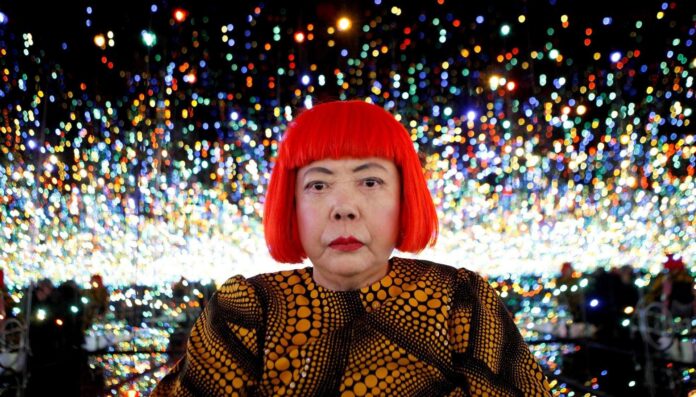
At the age of 97, legendary Japanese avant-garde artist Yayoi Kusama has died. Her name and body of work, known around the world for infinity mirror rooms and polka-dotted figures, are inextricably linked to her mental health and neurodiversity. By openly sharing her struggles with mental health, Kusama also paved the way for other neurodivergent artists.
The artist’s unique vision has its roots in traumatic experiences during her childhood. At the age of 10, she began experiencing intense visual and auditory hallucinations — seeing flashes of light, auras and endless fields of dots that, as she described them, covered entire rooms, her body and the world around her. This overwhelming sensory experience, which she referred to as “self-obliteration,” became the driving force behind the creative obsession that would later become her artistic trademark.
For Kusama, art was her primary tool for survival. She said that she battled pain, anxiety and fear every day, while the creative process became the only method that eased her illness and gave her the strength to continue living. In one interview, she even acknowledged that without art, she would have taken her own life long ago.
During her years in New York in the 1960s, she became one of the leading figures of American Pop Art and the avant-garde movement, influencing artists such as Andy Warhol. However, while in the United States, her physical and mental health deteriorated significantly. After returning to Japan, Kusama voluntarily admitted herself to a psychiatric hospital in Tokyo in 1977, where she has lived ever since, working tirelessly every day in a studio located nearby.
“I battle pain, anxiety and fear every day. The only method that has eased my illness is the continuous creation of art — without art, I would have taken my own life long ago.”
Despite her isolation, her popularity grew to unprecedented levels around the world. From Tate Modern in London to the National Gallery of Victoria in Melbourne, Kusama’s installations attract record numbers of visitors. Her mirror rooms and play of light transform the concept of sensory overload into a magical and mesmerizing experience, allowing visitors to see the world, even if only for a moment, through Kusama’s eyes.
The Japanese artist leaves behind a world that is now far more open and tolerant toward mental health and neurodiversity. Kusama’s openness showed the art world that the unique diversity of the human brain can also produce masterpieces. Experts say that her openness helped pave the way for the recognition of artists with disabilities or on the autism spectrum, such as Turner Prize winner Njena Kalu.
Yayoi Kusama’s life and work are a striking testament to how obsessive thoughts, hallucinations and mental crises can be transformed into extraordinary forms of artistic expression. Although neurodivergent artists still face numerous barriers today, Kusama’s artistic legacy remains one of the most powerful symbols of the complexity of human perception and the struggle to survive.
