


Scientists have developed an innovative spinal imaging method that is poised to provide serious competition to traditional Computed Tomography (CT) and Magnetic Resonance Imaging (MRI). Led by Stanford University researchers Katherine Ferrara and Byung-Chul Yoon, this new ultrasound system provides real-time, panoramic, and radiation-free scanning of the spine.
Until now, detailed examination of the spine relied on CT (for bone structures) or MRI (for soft tissues). However, these methods have two major drawbacks:
-
Static Nature: The patient must remain completely still during the scan. Since the spine is a flexible structure, a static image often fails to capture problems that only manifest during movement.
-
Radiation and Accessibility: CT scans involve exposure to radiation, and both machines are expensive and lack mobility.
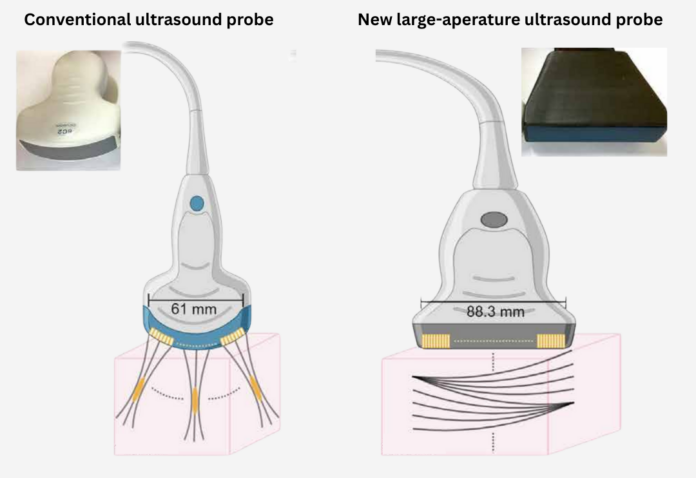
Traditional ultrasound has always struggled to produce clear images of the spine because dense bone structures block and interfere with the propagation of sound waves. To overcome this barrier, scientists created a specialized probe that is 9 centimeters wide and consists of 384 elements. This device is placed directly over the spine and covers a much larger area compared to standard equipment.
This innovative device utilizes a technology called “Diverging Wave Compounding.” Through this technique, sound waves are sent in multiple directions simultaneously, allowing for the creation of a full panoramic view of the spine in real-time. The results of this technological breakthrough are truly impressive: the system can fully visualize several vertebrae of the lower back in just 5 seconds.
The new method is suitable not only for diagnostics but also for managing complex medical procedures. Experiments have shown that doctors can view the needle insertion process into the spinal canal in real-time.
Researchers plan for this system to become a primary tool for monitoring scoliosis, stenosis, and other complex pathologies in the future—especially in emergency departments, where speed and mobility are of decisive importance.
