


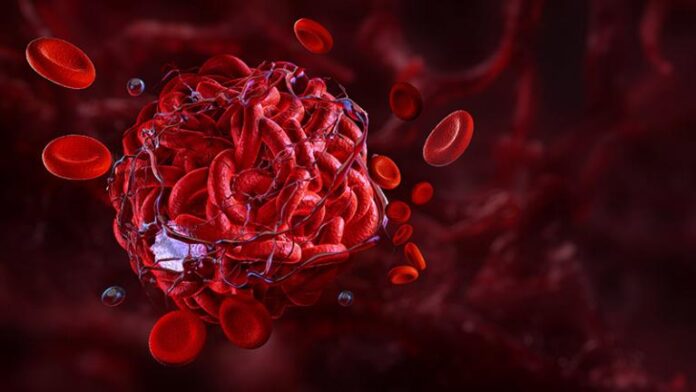
Antiplatelet drugs help prevent dangerous clots, but they can also increase bleeding risk. This is especially important in acute ischemic stroke, where patients may require thrombolysis or thrombectomy and are vulnerable to intracranial bleeding.
Researchers at University Hospital Würzburg and EMFRET Analytics are exploring a different strategy: partially reducing the activity of a platelet receptor called glycoprotein VI, or GPVI. In mouse models, this approach reduced arterial thrombosis and thrombo-inflammatory injury while preserving measured hemostatic function.
The strategy remains preclinical. It has not yet been shown to be safe or effective in patients.
Why GPVI matters
GPVI is found mainly on platelets and megakaryocytes, the bone-marrow cells that produce platelets. It helps platelets respond to exposed collagen at sites of vessel injury, an important step in platelet activation and clot formation.
That function is useful for stopping bleeding, but excessive GPVI signaling can also contribute to pathological arterial thrombosis and thrombo-inflammation—a process in which platelet activation and inflammation reinforce one another.
GPVI is therefore an attractive target. Earlier animal studies found that blocking or removing GPVI reduced thrombosis and ischemic brain injury without major bleeding in the specific experimental models used. However, complete GPVI depletion can increase bleeding, particularly when combined with other antiplatelet drugs such as high-dose aspirin.pubmed.ncbi.nlm.nih+1
A partial “switch-off”
The new study examined whether GPVI could be reduced rather than completely eliminated.
High-affinity antibodies produced near-complete GPVI depletion. A low-affinity antibody, JAQ1, reduced human GPVI levels by approximately half in humanized mice. The resulting platelets—described as GPVI-low—retained the ability to adhere to collagen but showed markedly impaired GPVI-dependent activation, aggregation, thrombus formation, and procoagulant phosphatidylserine exposure.
Their response to thrombin, which activates platelets through a different pathway, remained intact.
This distinction between adhesion and signaling is central to the findings. Residual GPVI-mediated adhesion may help preserve vascular integrity, while stronger GPVI signaling appears to contribute more directly to pathological thrombus growth and platelet-driven inflammation.
Findings in mice
In a model of abdominal-aortic injury, approximately 64% of mice with GPVI-low platelets were protected from stable vessel occlusion, compared with none of the control animals. When occlusions occurred, they were less stable and more likely to recanalize.
The researchers also tested lipopolysaccharide-induced acute lung injury, an experimental model of pulmonary thrombo-inflammation. GPVI-low treatment reduced platelet and neutrophil accumulation, neutrophil migration into the alveolar space, and blood leakage in the lungs.
In tail-bleeding experiments, GPVI-low mice had bleeding times similar to controls. By contrast, complete GPVI depletion combined with high-dose aspirin caused severe bleeding in many animals.
These results suggest that partial GPVI downregulation may preserve hemostasis more effectively than complete receptor depletion. However, mouse tail-bleeding tests cannot predict the full bleeding risk of a treatment in humans.
Potential relevance to stroke
The research is particularly relevant to acute ischemic stroke. Even after a blocked vessel is reopened, platelet activation and inflammation may continue to damage previously ischemic brain tissue.
Earlier work with the GPVI inhibitor EMA601 reduced infarct growth and improved neurological outcomes in mouse models without increasing bleeding in those experiments. A related GPVI-targeting agent, glenzocimab, has also undergone early clinical testing and was reported to be well tolerated in patients with acute ischemic stroke. Those studies do not establish the effectiveness of EMA601 or of partial GPVI downregulation, however.pubmed.ncbi.nlm.nih+2
The current study concerns a different strategy: sustained, antibody-mediated reduction of GPVI rather than short-lived pharmacological blockade.
What remains unknown
Before this approach can be considered for clinical use, researchers will need to determine:
Whether partial GPVI downregulation is safe in humans.
How long the effect lasts and how quickly it can be reversed.
Whether the initial transient thrombocytopenia can be prevented or minimized.
How the treatment interacts with aspirin, P2Y₁₂ inhibitors, anticoagulants, thrombolysis, and thrombectomy.
Whether it reduces stroke-related disability, infarct growth, or mortality.
Whether it remains safe during infection, trauma, cancer, or other inflammatory states.
Human platelets can undergo GPVI downregulation in experimental models, but this does not substitute for clinical pharmacology and safety trials.
Source: idw-informationsdienst Wissenschaft; Signal Transduction and Targeted Therapy
