


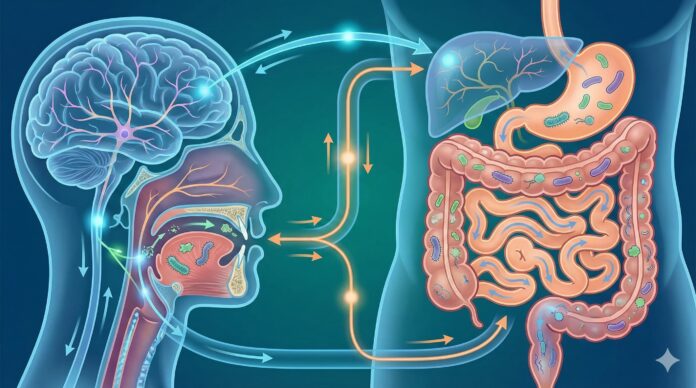
Gastric and colorectal cancers are often difficult to detect before symptoms develop, creating demand for accurate, low-burden screening tools. A new study examines an unexpected potential source of information: the overlap between bacteria found in a person’s mouth and those detected in their stool.
The researchers found greater mouth-to-gut microbial overlap in participants with gastric or colorectal cancer than in healthy controls. The association is not proof of causation, but it may offer a new direction for noninvasive cancer-risk assessment.
Tracking mouth-to-gut overlap
The mouth and intestine host different microbial ecosystems. Although oral bacteria are swallowed constantly, most do not persist in the gut because of gastric acid, immune defenses, and competition from resident intestinal microbes.
Researchers at Yonsei University examined whether this separation is altered in gastrointestinal cancer. They collected paired oral and fecal samples from 507 people:
129 healthy controls
215 people with metabolic disorders
77 people with gastric cancer
86 people with colorectal cancer
Cancer samples were collected before treatment began.
Using 16S ribosomal-RNA sequencing, the team identified bacterial sequence variants in each participant’s mouth and stool. They developed a mouth-to-feces, or MF, index: the proportion of bacterial sequence variants in stool that were also found in that individual’s oral sample.
The index is a measure of microbial overlap. It does not prove that a specific bacterium traveled from the mouth and colonized the gut.
A stronger signal in cancer
The MF index was significantly higher in people with gastric or colorectal cancer than in healthy controls:
Healthy controls: 1.19
Gastric cancer: 3.63
Colorectal cancer: 3.09
This represented roughly a 2.6- to 3.0-fold increase in oral–gut microbial overlap in the cancer groups. The index was not significantly elevated in people with metabolic disorders, suggesting that the finding was not simply a general marker of metabolic ill health.pubmed.ncbi.nlm.nih+1
The microbial patterns also differed by cancer type. Gastric cancer was more strongly associated with changes in oral microbial communities, whereas colorectal cancer showed clearer changes in stool.
In colorectal cancer, shared mouth-to-gut features included bacteria previously linked with the disease, including Fusobacterium, Parvimonas, and Peptostreptococcus species.
Could oral samples detect cancer?
The researchers used machine-learning models to distinguish cancer cases from healthy controls using mouth-to-feces microbial features.
Within the study dataset, model performance was strongest for colorectal cancer:
Colorectal cancer: AUC 0.82 with oral samples and 0.82 with fecal samples
Gastric cancer: AUC 0.66 with oral samples and 0.73 with fecal samples
An AUC of 0.5 indicates no discriminatory ability, while 1.0 represents perfect separation.
Performance was generally better for late-stage than early-stage cancers. That is a major limitation for screening, because an effective screening test must reliably identify early cancers and precancerous lesions.
The models were also tested in several external datasets. Results remained more consistent for colorectal cancer than gastric cancer. Importantly, oral-sample performance depended on highly detailed sequence-level analysis, meaning that less precise bacterial classification could lose relevant diagnostic information.
What remains unknown
Several major questions remain:
Does increased mouth-to-gut microbial overlap contribute to cancer, result from cancer-related changes in the gastrointestinal tract, or both?
Can the approach identify early cancer and advanced precancerous lesions reliably?
Will it perform consistently across different populations, diets, oral-health conditions, medications, and sequencing methods?
Can it add useful information to established screening tests?
The sequencing method also cannot prove strain-level identity or direction of transmission. Finding the same bacterial sequence variant in the mouth and stool does not prove that the same bacterial strain moved from the mouth into the gut.
Source: Cell Host & Microbiome
