


The new EAACI guideline reframes pollen-induced allergic rhinitis and asthma as environmentally driven diseases requiring more than medication alone. Its main update is not a single new treatment, but a structured framework linking pollen exposure, real-time monitoring, personal mitigation, biomarkers, climate change, air pollution, and healthcare preparedness.
The guideline uses GRADE methodology and concludes that the certainty of evidence ranges from moderate to very low. As a result, its recommendations are predominantly conditional rather than strong or universal. The guideline is intended to guide clinicians, patients, researchers, policymakers, and public-health systems, with a planned update in 2030.
Pollen avoidance is now addressed more explicitly
The guideline moves beyond the general observation that pollen is associated with allergic symptoms. It recommends reducing or avoiding pollen exposure to reduce the risk of severe asthma exacerbations, particularly in relation to grass and tree pollen.
This recommendation is based mainly on observational evidence showing associations between increased pollen concentrations and emergency-department visits, hospitalizations, or severe attacks. The association was strongest and most consistent for grass pollen, especially in children, with effects often occurring within the preceding two to three days.
However, the guideline explicitly recognizes an important limitation: an association between high pollen levels and asthma exacerbations does not by itself prove that an intervention that lowers exposure will prevent those exacerbations. Direct intervention studies remain limited. The recommendation therefore should not be interpreted as evidence that every avoidance measure has been proven to prevent asthma attacks.
The updated message is best understood as: pollen reduction is a reasonable component of prevention, especially for susceptible patients during high-exposure periods, but it does not replace guideline-based asthma treatment.
Pollen information is treated as a potential management tool
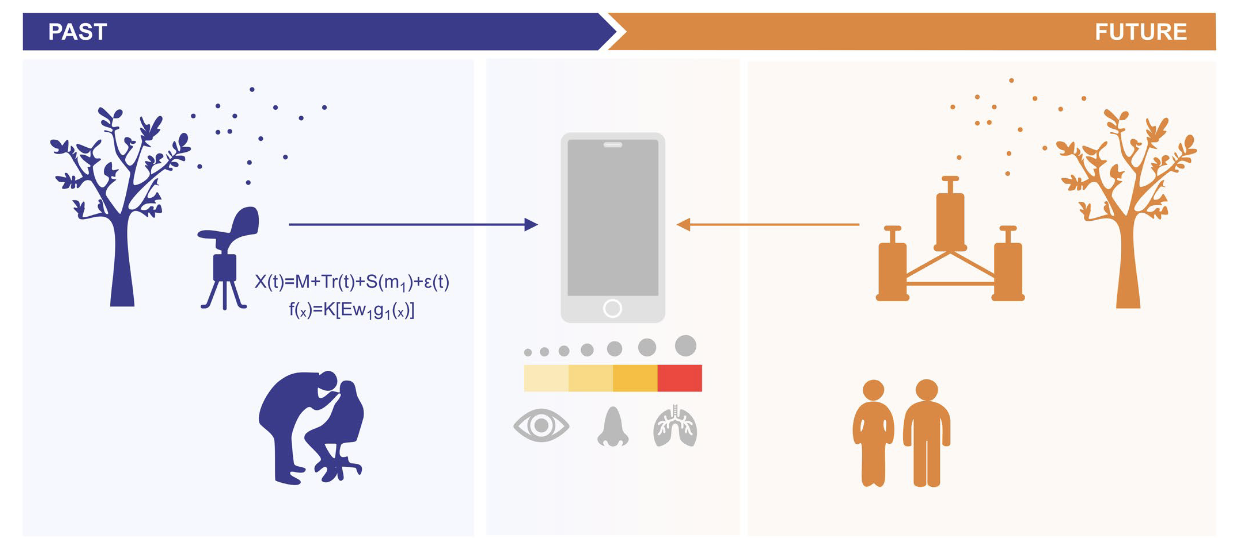
A major focus of the guideline is the role of pollen monitoring, forecasting, and patient information systems.
The guideline distinguishes among:
Traditional pollen calendars.
Measured pollen concentrations.
Real-time automated pollen monitoring.
Short-term pollen forecasts.
Dispersion models.
Apps that combine pollen, symptoms, weather, and air-pollution information.
The guidance is more favorable toward local, real-time pollen data and concentration-based forecasts than toward static pollen calendars. Calendars may still be useful where monitoring is not available, but they cannot account well for year-to-year variation in the timing and intensity of pollen seasons.
The guideline identifies SILAM and ICON-ART as important atmospheric-dispersion systems, but it does not present either model as universally accurate or clinically validated. Forecast performance varies by pollen type, location, weather input, and model configuration. The guideline also notes that many commercial apps may not be based on measured local pollen data, so the existence of an app should not automatically be equated with reliable exposure information.
Pollen information may help patients anticipate exposure, adapt behavior, and discuss seasonal treatment planning with clinicians. But the guideline does not establish that forecasts independently reduce medication use, symptoms, hospitalizations, or asthma exacerbations. Evidence on clinical benefit remains limited, heterogeneous, and generally low or very low certainty.
New emphasis on the exposome
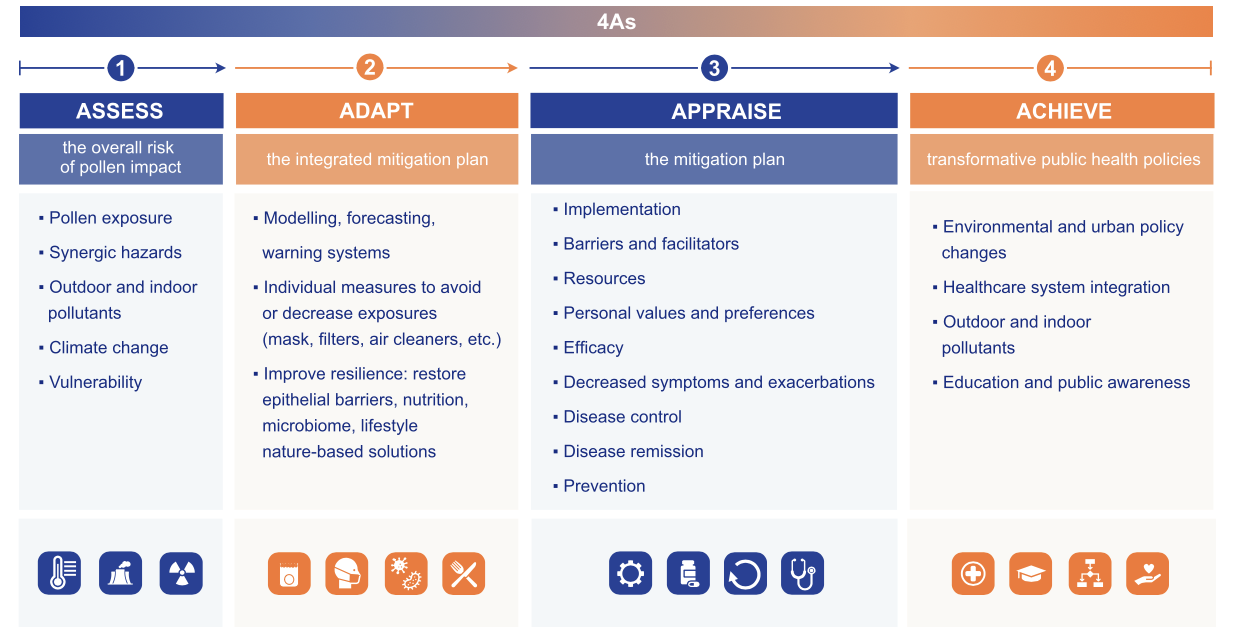
The guideline places pollen within the broader exposome: the combined environmental exposures experienced across the life course.
This is an important conceptual update because pollen does not act in isolation. Its effects may be modified by:
Temperature and humidity.
Wind and storm conditions.
Outdoor air pollution.
Indoor pollutants.
Infectious agents.
Urban vegetation.
Climate-driven changes in plant distribution.
Individual sensitization and disease severity.
The guideline therefore supports adding pollutant information to pollen systems and developing combined weather–pollen–pollution forecasts. This does not mean that every combined forecasting system has demonstrated clinical effectiveness. Rather, the guideline identifies integration of these data streams as a promising and potentially important direction for prevention and public-health planning.
This approach also changes how “pollen exposure” is interpreted. A station-based pollen count is considered a useful population-level proxy, but it may not accurately represent the exposure of a particular individual. Personal exposure depends on location, time spent outdoors, building characteristics, ventilation, travel, activity, and susceptibility.
Biomarkers: promising, not established
The guideline newly addresses whether biomarkers can monitor or predict pollen-induced asthma exacerbations.
It identifies two possible signals:
A decrease in lung function, particularly FEV₁.
An increase in fractional exhaled nitric oxide, or FeNO.
The guideline says these changes may be predictive of pollen-induced exacerbations, but the evidence is low quality. The findings are not sufficient to recommend routine serial FEV₁ or FeNO monitoring for every pollen-allergic patient solely because pollen counts are high.
This distinction matters. FEV₁ and FeNO already have roles in asthma assessment and phenotype characterization, but the guideline does not establish them as validated pollen-specific warning biomarkers. Their interpretation should remain part of individualized asthma assessment and should not replace symptom evaluation, an asthma action plan, or established treatment.
A more nuanced approach to mitigation devices
The guideline discusses several personal and indoor measures, including:
FFP2 or similar masks.
Nasal filters.
Pollen-blocking creams.
Keeping windows closed.
Changing clothes after outdoor exposure.
Avoiding outdoor clothes-drying during peak pollen periods.
Air cleaners.
Car filtration.
More complex combinations of staying indoors, window closure, and pollen barriers.
The update is that these measures are considered within a graded, personalized mitigation strategy, rather than as universally effective rules.
Evidence is more supportive for some measures in allergic-rhinitis symptoms than for asthma outcomes. For example, masks and nasal filters may reduce nasal or conjunctival symptoms in specific settings, including allergen-exposure chambers or natural pollen exposure. But evidence that they prevent asthma exacerbations is less direct.
The guideline also acknowledges feasibility and adherence problems. Strict avoidance can interfere with daily life, and combined measures may be difficult to maintain. The evidence generally does not establish the independent contribution of each measure when several are used together.
Air cleaners may reduce indoor airborne particles and pollen, and the guideline considers them potentially useful for pollen-induced asthma. But the recommendation is partly extrapolated from particle-removal performance and controlled experimental findings. A device’s technical filtration rating should not automatically be interpreted as proof of improved clinical outcomes in everyday life.
Thunderstorm asthma becomes a public-health priority
The guideline gives greater prominence to thunderstorm asthma as a situation requiring coordinated forecasting and healthcare preparedness.
It recommends or supports:
Warning systems that combine pollen and meteorological information.
Consideration of additional risk factors, including high aeroallergen levels and the size of the sensitized population.
Strengthening emergency-department and asthma-related services during relevant pollen seasons and thunderstorm-risk events.
Coordination among clinicians, public-health authorities, meteorological services, and healthcare systems.
The recommendation to strengthen emergency services is limited primarily to seasons dominated by grass, ragweed, and birch pollen, and to regions where these allergens are prevalent. Some case series and experimental studies implicate other pollens, such as wall pellitory and olive, but the evidence is less established.
The guideline does not claim that warning systems have been proven in dedicated trials to prevent thunderstorm-asthma events. Their recommendation is supported by the known risk pattern, the importance of timely information, and the feasibility of preparedness measures, but the direct evidence for clinical impact remains low certainty.
Climate change and urban planning are integrated into prevention
Another important update is the shift from individual advice toward environmental and policy action.
The guideline notes that climate change may lengthen pollen seasons, alter plant distribution, increase pollen production or allergenic potential, and expand exposure into new regions. It also warns that urban “green” infrastructure can have unintended effects if highly allergenic species are selected or if planting decisions ignore future climate conditions.
The recommended direction is not indiscriminate removal of trees or reduction of biodiversity. Instead, the guideline supports:
Careful selection of lower-allergen or locally appropriate species.
Consideration of allergenicity in urban planning.
Control of invasive allergenic plants such as ragweed.
Coordination between allergists, aerobiologists, ecologists, meteorologists, and public-health authorities.
Evaluation of climate adaptation measures for possible allergy consequences.
The guideline emphasizes that removing allergenic trees from existing green spaces is not generally appropriate because of biodiversity, ecosystem, and climate-adaptation considerations. Prevention therefore requires planning and species selection rather than simplistic removal policies.
What the guideline does not change
The guideline should not be interpreted as changing several core principles of allergy and asthma care:
Pollen avoidance does not replace controller therapy or a personalized asthma action plan.
A high pollen count does not automatically require medication changes for every patient.
Pollen forecasts are not yet proven substitutes for clinical assessment.
Biomarker changes do not independently diagnose a pollen-induced exacerbation.
A technical filter rating does not guarantee a clinical benefit.
Public-health warning systems do not eliminate the risk of thunderstorm asthma.
Environmental measures should not be used to imply that medication is unnecessary.
Evidence of association does not necessarily establish that a specific exposure-reduction intervention prevents disease.
The document is therefore an update in emphasis and organization rather than a declaration that environmental interventions have become definitively effective.
How clinicians might apply the update
A practical approach is to combine standard disease control with individualized environmental planning.
For a patient with pollen-induced allergic rhinitis:
 Identify the relevant pollen through history and, when appropriate, allergy testing.
Use reliable regional pollen information when available.
Relate reported symptoms to pollen levels, weather, and air pollution rather than relying on a generic calendar alone.
Consider feasible measures such as limiting exposure during peak periods, changing clothes after outdoor activity, using appropriate barriers, and maintaining prescribed treatment.
Review whether seasonal medication needs adjustment according to established clinical guidance.
For a patient with pollen-induced asthma:
Confirm that baseline asthma control and inhaled treatment are optimized.
Identify the pollen season and exposure pattern associated with worsening.
Use pollen and thunderstorm warnings as part of—not instead of—an asthma action plan.
Pay attention to worsening symptoms and, where clinically indicated, changes in lung function or FeNO.
Ensure the patient knows when to escalate treatment and seek urgent care.
The guideline’s central clinical message is personalization. Risk depends not only on pollen concentration but also on pollen type, individual sensitivity, coexposures, disease control, age, geography, and vulnerability.
You can find the full guidelines at the following link: Wiley Online Library
