


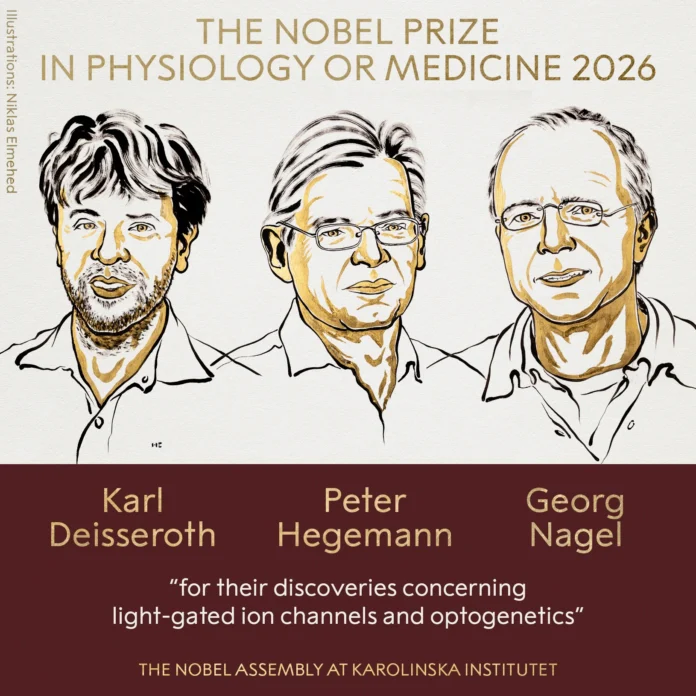
Karl Deisseroth, Peter Hegemann, and Georg Nagel have been awarded the Nobel Prize for their discovery of light-gated ion channels and the development of optogenetics. This breakthrough provided researchers with unprecedented precision in studying the brain’s complex neural networks.
A Longstanding Challenge in Neuroscience
The human brain comprises billions of neurons that establish countless interconnected pathways. To understand how memory operates or why specific neurological conditions arise—such as Parkinson’s disease or depression—scientists needed a way to selectively activate or inhibit targeted cells.
For decades, electrodes served as the standard tool for neural stimulation. However, this approach lacked cell-type selectivity: electrical currents indiscriminately stimulated all surrounding cells, making it difficult to pinpoint the exact functions of individual neural circuits.
From Algae to the Mammalian Brain
The solution emerged from single-celled green algae (Chlamydomonas reinhardtii). German scientists Peter Hegemann and Georg Nagel were investigating how this organism navigates toward light. They identified specialized proteins—light-gated ion channels. Upon exposure to light, these channels open, permitting an influx of ions into the cell and generating an electrical signal.
The Emergence of Optogenetics
The technology reached fruition when American scientist Karl Deisseroth applied this mechanism to the mammalian brain. Utilizing genetic engineering—specifically engineered viral vectors—Deisseroth delivered the algal light-sensitive proteins into specific subsets of neurons in laboratory mice.
As a result, brain cells could be controlled directly using pulses of light. For instance, illumination with blue light instantly activated the target neuron, which promptly returned to its baseline state once the light was turned off. This integration of optics and genetics became known as optogenetics.
Impact on Research and Medicine
Optogenetics has fundamentally expanded the toolkit of neuroscience. Researchers can now manipulate specific neurons in animal models that regulate fundamental behaviors such as hunger, fear, aggression, and sleep.
The approach has opened significant avenues in clinical medicine as well. Grounded in optogenetic principles, ongoing studies aim to deepen the understanding of conditions such as Parkinson’s disease and epilepsy while informing novel therapeutic strategies. Notably, clinical trials have demonstrated that introducing light-sensitive proteins directly into retinal cells can partially restore visual function in patients with vision loss.
This Nobel Prize underscores the path of discovery that began with basic biology—identifying a single algal protein—and culminated in a transformative framework for probing the brain. Today, optogenetics stands as a cornerstone technology driving insights into neurological and psychiatric disorders and paving the way for targeted treatments.
