Determining biological sex is only a fraction of the impact cellular processes exert on overall human health. While medicine has long attributed sex-based differences primarily to hormonal profiles, recent scientific discoveries reveal an entirely different scale.
A new review published in the journal Science sheds light on a dimension of human biology often treated as mere background noise in research – the direct influence of the X and Y chromosomes on aging, disease vulnerability, and therapeutic response. The study’s authors, Dan Theodorescu of the University of Arizona Cancer Center and Dena B. Dubal of the University of California, San Francisco, point out that hormones alone cannot account for these disparities in health.
A comprehensive synthesis of genomic data, animal studies, and clinical trials confirms that these chromosomes actively shape vital biological processes, including immune response, metabolic reactions, age-related brain changes, cardiovascular health, and oncological pathways. Naturally, this is not an isolated factor: chromosomal activity constantly intersects and interacts with hormones, age, cell type, and environmental conditions—weaving a unique, intricate picture of human health.
Why the second X matters
In cells with two X chromosomes, one X is largely inactivated early in development. This process, known as X-chromosome inactivation, is not complete: an estimated 15% to 30% of genes on the inactive X escape silencing in humans. As a result, some genes can be expressed from both X chromosomes, creating differences in gene dosage between XX and XY cells.
The inactive X can also become partly reactivated with age, while cells may increasingly favor either the maternal or paternal X chromosome. These processes may help explain why people with two X chromosomes can show different patterns of resilience or vulnerability during aging.

The review highlights the X-linked gene KDM6A, which is expressed at higher levels in XX brains and has been associated with cognitive resilience in Alzheimer’s disease. In mouse models, increasing KDM6A activity improved cellular and cognitive impairments, suggesting that mechanisms connected with X-chromosome biology could eventually point toward treatments relevant to both women and men. These findings remain largely experimental and should not be interpreted as an available therapy.
The aging Y chromosome
One of the most studied age-related changes in men is mosaic loss of the Y chromosome, or mLOY. This occurs when some cells—most often blood cells—lose the Y chromosome while other cells retain it. mLOY is the most common acquired chromosomal alteration observed in aging men and becomes increasingly frequent later in life.
Smoking is the strongest known environmental risk factor for mLOY, while inherited susceptibility, DNA-damaging exposures and genomic instability may also contribute. The alteration frequently occurs alongside clonal hematopoiesis, an age-related expansion of blood-cell clones carrying genetic changes.
mLOY has been associated with cancer, cardiovascular disease, severe infection, Alzheimer’s disease and increased mortality. However, the review emphasizes that association does not always establish causation. In some conditions, mLOY may contribute directly to disease; in others, it may act as a marker of biological aging or of broader genomic instability. More longitudinal research is needed to determine when it is a cause, a consequence or both.
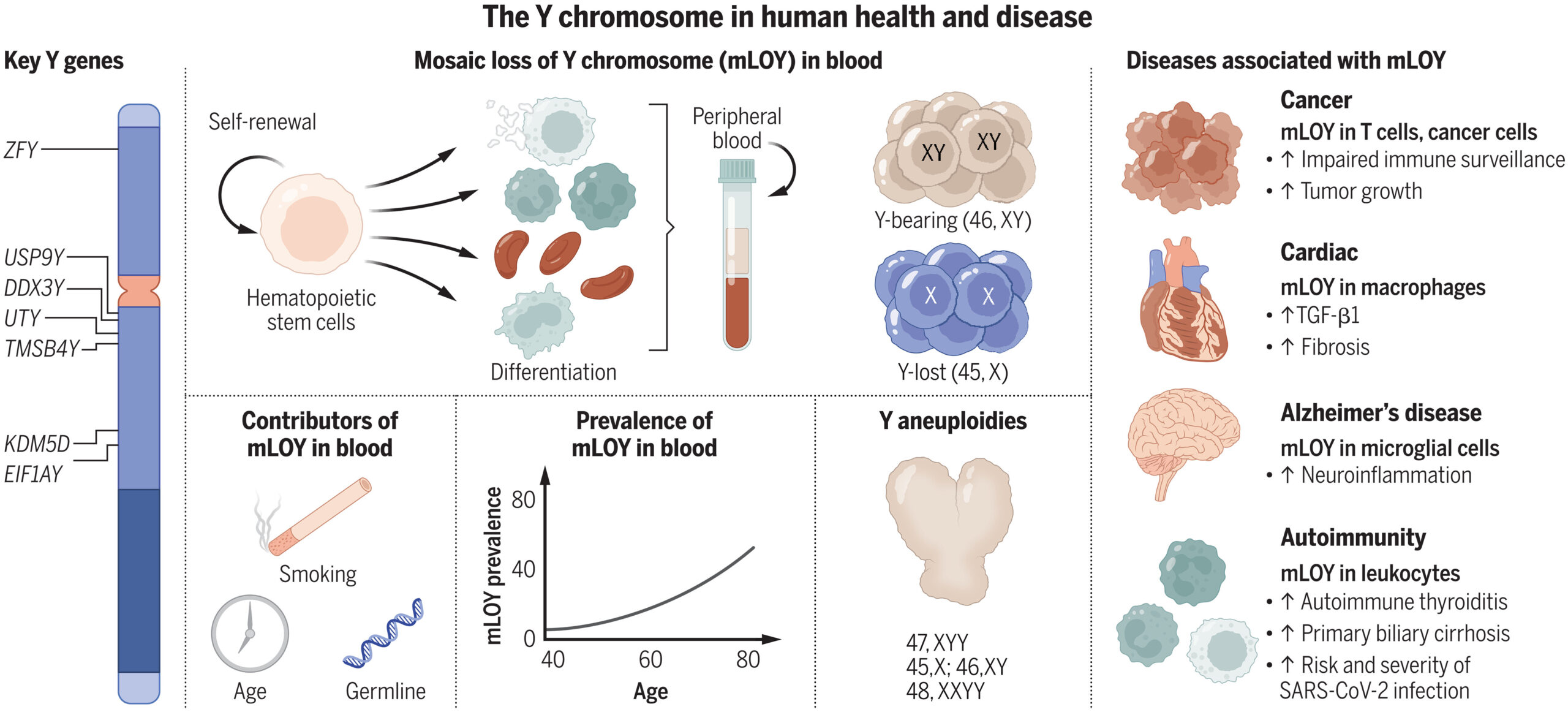
Experimental findings support a possible causal role in some diseases. In mouse models, Y-chromosome loss in blood-forming cells accelerated cardiac disease through changes involving macrophages and cardiac fibrosis. In tumors, loss of Y-linked genes can alter the immune microenvironment and promote exhaustion of CD8-positive T cells. At the same time, some Y-deficient tumors have shown greater sensitivity to immune checkpoint inhibitors, suggesting that Y-chromosome status might eventually help guide immunotherapy decisions.
Different diseases, different effects
The review presents sex-chromosome biology as highly context-dependent. In the brain, X-linked mechanisms may support cognitive resilience in some stages of aging and neurodegenerative disease, while other X-linked genes may contribute to pathology in later stages of Alzheimer’s disease.
The immune system provides another example. People with two X chromosomes generally mount stronger immune responses, which can improve responses to infections and vaccines but may also increase susceptibility to autoimmune diseases such as lupus, rheumatoid arthritis and multiple sclerosis. X-linked immune genes, including TLR7 and FOXP3, are among the pathways being studied to understand these differences.
Cancer biology is similarly complex. Men have higher incidence or mortality for many cancers even after behavioral factors are considered, but the mechanisms vary by cancer type. X-linked genes such as KDM6A can function as tumor suppressors in some tissues, while Y-linked genes and mLOY can influence tumor progression and immune response. The effect of losing or retaining a particular gene therefore depends on the tissue and disease context.
Cardiovascular and metabolic disease also involve both hormonal and chromosomal influences. Studies in genetically modified mice suggest that XX chromosome complement can affect cardiac injury, adiposity, fatty liver, lipid levels and insulin regulation independently of gonadal sex. In humans, mLOY has been associated with cardiomyopathy, cardiac fibrosis and cardiovascular mortality, although the precise clinical implications remain under investigation.
Implications for precision medicine
The authors argue that future precision medicine should record more than a patient’s chromosomal sex. Researchers may need to examine the status of particular X- and Y-linked genes, X-chromosome inactivation patterns, X-skew, X-chromosome loss and mLOY, alongside hormone levels, immune profiles and environmental exposures.
In oncology, this could eventually include measuring mLOY or mutations in genes such as KDM6A when assessing prognosis or selecting immunotherapy. But these biomarkers are not yet ready for routine use across all diseases. The review calls for standardized tests, agreed detection thresholds, prospective validation and evidence that such measurements improve prediction beyond established clinical risk factors.
The authors also call for clinical trials to be designed to detect sex-by-treatment interactions rather than simply adjusting for sex as a demographic variable. Cell lines, tissue banks and genomic databases should record donor sex and chromosomal status, enabling researchers to determine whether a treatment works differently in XX and XY cells or in tissues with acquired chromosomal changes.
Source: Science