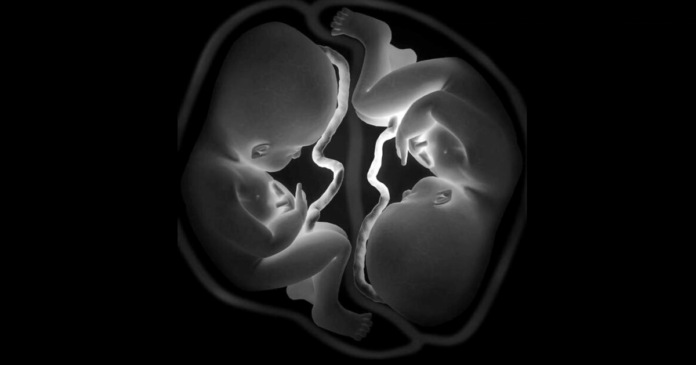
According to a new study published in the journal Nature Communications, cancer cells were transmitted from one fetus to the other in utero in a pair of identical twins. By analyzing unique DNA markers, scientists reconstructed how the disease developed and spread months before tumors were clinically detected.
The twin sisters, Amelia and Amaya, died shortly after birth. Their clinical history began at 33 weeks of gestation with an MRI scan revealing a mass on the face of one of the infants. A week later, during premature delivery, tumor tissue was detected in both infants. With family consent and at the mother’s request, the authors dedicated the study to the memory of the two girls.
Because both infants presented with identical tumors, a fundamental question arose: did the disease originate independently in each twin, or did malignant cells spread from one to the other prior to birth? To investigate, researchers from the Wellcome Sanger Institute, Great Ormond Street Hospital, and the University of Cambridge traced the cellular genetic lineages preserved in the infants’ tissues.
The condition was identified as undifferentiated sarcoma, a malignancy arising in soft tissues, including muscle, fat, and supporting structures. Investigators determined that tumor samples from both twins harbored an identical fusion of two specific genes—MN1 and ZNF341—though this finding alone was insufficient to pinpoint the precise origin of the disease.
To resolve the lineage, researchers leveraged a biological paradox: while identical twins originate from a single fertilized egg, they are not 100% genetically identical copies. As cells divide, subtle somatic mutations accumulate in the DNA, providing an endogenous molecular clock that allows scientists to reconstruct cell lineage trees and distinguish one sister’s cells from the other’s.
Following the genomic sequencing of dozens of tumor, normal, and placental tissue samples, the team determined that the sarcoma arose in one twin first. Definitive proof emerged from the second infant’s tumor: its malignant cells carried the distinct somatic mutations belonging to her sister.
The paper notes that the malignant cells likely crossed through their shared placenta. Based on the rate of somatic mutation accumulation, researchers estimate that the tumor initiated toward the end of the first trimester, with a single transplacental transmission event occurring late in the second trimester. The primary lesion was almost certainly the facial mass observed in the first twin.
The analysis revealed another unexpected finding: normal cells traversed in the opposite direction. Approximately 75% of the cells analyzed in the first infant’s spleen originated from the second twin, demonstrating extensive reciprocal hematologic exchange between the fetuses.
Despite these unique findings, the authors emphasize that this transmission route represents an exceptionally rare clinical phenomenon. The study does not imply that cancer arising in one twin will inevitably metastasize to the other; researchers underscore that such transmission is an extraordinary exception rather than an inevitable outcome of shared prenatal gestation.