Researchers at Dartmouth College have described an unusual case of a rare neurological disorder in the scientific journal Cortex. A 28-year-old man who underwent brain surgery now sees his own cat’s eyes and facial features superimposed on other people’s faces.
Two years ago, the patient, identified as Carl, underwent surgery to remove part of his right temporal lobe. The procedure was necessary because of an arteriovenous malformation — an abnormal tangle of blood vessels connecting arteries and veins that could cause a hemorrhage if left untreated. Since the right temporal lobe plays a critical role in facial recognition and processing, Carl developed a form of visual distortion known as prosopometamorphopsia (PMO) following the surgery. This is a rare condition in which details of a previously seen object carry over into subsequent visual perception, causing facial distortions.
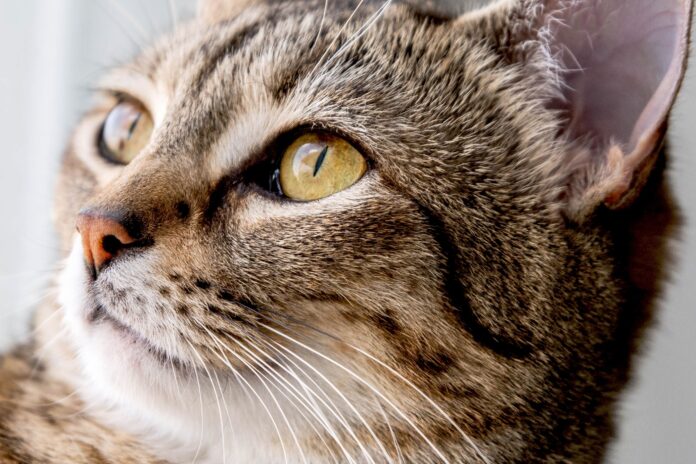
The way Carl experiences the condition depends on whom or what he sees immediately after waking up. If his eyes first fall on his pet cat, Luna, in the morning, he sees almond-shaped cat eyes, enlarged pupils, and stripes on people’s faces throughout the day, both in person and during online meetings. Conversely, if he sees a person first after waking up, he later notices that person’s facial features superimposed on other people and even on his own cat.
“This case clearly demonstrates that the brain can retrieve specific details from memory and alter ongoing visual perception,” says the study’s author, Brad Duchaine, a professor of psychology and brain sciences at Dartmouth College.
To accurately illustrate Carl’s visual experiences, the researchers used artificial intelligence. Professor Duchaine uploaded a hand-drawn sketch to a large language model and, through continuous feedback from the patient, generated photorealistic images. This approach can help people with similar disorders show doctors and family members exactly how they perceive the world.
More than 250 people experiencing facial perception distortions have contacted Duchaine’s laboratory. According to the researcher, these individuals are often misdiagnosed with psychiatric conditions and may even be prescribed antipsychotic medications, when their condition is entirely visual and neurological in nature.