


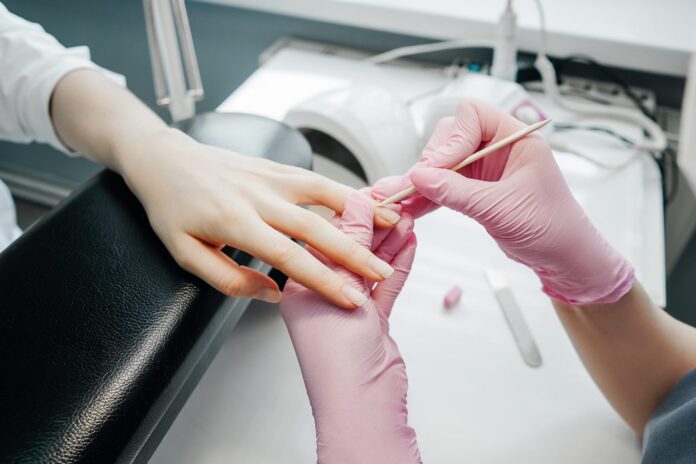
Employees at nail salons may be at health risk due to chemical air pollution in the workplace, according to a study published in the journal Risk Analysis.
Researchers tested air quality in five nail salons in New York. They measured indicators on a minute-by-minute basis over the course of a week and found that volatile organic compound (VOCs) levels varied across a wide range. The study, led by Dr. A. Michael Jerارت (PhD, CIH) from the CUNY Graduate School of Public Health and Health Policy (CUNY SPH), involved continuous monitoring with a photoionization detector and sampling specific chemical substances using desorption tubes.
According to the study, the chemical reading averaged around 15 ppm during the day, but concentrations reached much higher levels for short periods. Specifically, the 15-minute peak average was 31 ppm, reaching 113 ppm in one salon. The main sources of chemical concentrations were polish, acetone, and ethyl acetate. A low concentration of benzene—a chemical known for its carcinogenic properties—was also recorded.
According to the lead researcher, the periodic spikes in chemical concentrations can be comparable to levels found in chemical plants. Furthermore, surgical or cloth masks worn by nail care specialists are ineffective against chemical vapors. According to the researchers, ways to genuinely solve the problem are simple yet frequently neglected: good ventilation, open doors and windows, and keeping products—including liquid-soaked cotton balls—closed. The use of covered trash cans for wipes was also discussed.
The study notes that occupational exposure limits for chemicals in salons are established for healthy, adult males over an eight-hour work shift. However, researchers explain that these established limits may be insufficient for more vulnerable groups, including women of reproductive age, who make up a large portion of those employed in the nail care industry. In addition, full-shift averages do not fully reflect short-term peaks that may contribute to acute symptoms. It should be noted that the study did not evaluate specific symptoms, nor did it determine the sources of individual peaks.
“This study shows that traditional air sampling and risk assessment methods do not fully reflect the real picture in nail salons,” said Dr. Jerrett, an occupational and environmental health safety researcher at CUNY SPH. “Nail care specialists and other salon staff may experience high, periodic peak exposures to airborne chemicals during the workday, but the health impacts of these exposures have not been adequately assessed until now. Better understanding the limitations of existing approaches and methods is an important first step toward better understanding health risks and protecting salon workers.”
Notably, this was a small study of five salons, each tested for about a week, and cancer rates represent modeled estimates for workers exposed to such environments over many years rather than directly observed cases. In addition, the researchers did not measure what customers breathe during a single visit.
About the Journal Risk Analysis: Risk Analysis is a peer-reviewed journal publishing research on the assessment and management of risks affecting human health, safety, and the environment. Founded in 1980, the journal publishes qualitative and quantitative research results in disciplines such as public health, engineering, environmental and social sciences, and policy.
What Standards Do Chain Nail Salons Operating in Georgia Follow, and Are They Aware of the Risks?
Major chain salons in Tbilisi told Medscriptum that they protect both employees and customers through internal standards as well as internationally recognized approaches. At the same time, certain challenges exist in the market.
Elene Ghotvadze, founder of the salon “Nail Sunny,” explains that the administration is aware of the risks and complies with standards such as product quality, ventilation, surgical autoclave sterilization, and the timely removal of used products from the space:
“First of all, it is very important to choose products correctly, because simply placing waste in covered containers or having ventilation will not matter much if low-category materials are used. Harmful chemicals are formaldehyde and toluene; if a product contains these above the threshold, they are so easily volatile during application and drying that they will have a negative impact in any case. When choosing products, you should be guided by the MSDS document rather than personal opinions. This is an international document that every product has.
The second issue is ventilating all branches in any season. In addition, we have an exhaust system everywhere, and this is also very important. Every branch should have a cleaning person daily to tidy up both working surfaces and the floor several times a day. Also, in terms of protection, we must definitely talk about sterilization, which might not be highlighted in the study, but is a very important factor. If sterilization is not done properly, the specialist is also at risk, and in our country, outdated devices are still actively used, whereas today we have the luxury of having access to an autoclave—a surgical instrument sterilization apparatus—which we use in all branches,” explained Elene Ghotvadze, founder of “Nail Sunny.”
As explained by another salon chain, “Nail Beauty,” the company takes inhalation risks related to the work process into account, and for safety, both central ventilation is operational and an exhaust fan is installed on each desk to ensure clean air:
“Specialists work with protective masks and gloves, instrument sterilization is carried out in full compliance with regulations, and only disposable files and buffers are used for each customer.”
At the same time, the company notes that on the one hand, leading salons are actively introducing high standards, but on the other hand, challenges generally remain in the market:
“Positive dynamics are certainly noticeable in the Georgian market, and leading salons are maximally introducing modern safety norms. However, maintaining unified standards in the sector—in terms of proper ventilation, complete sterilization, and the use of disposable consumables—remains a challenge for a portion of the market. We are confident that the growing demand from customers and specialists themselves will gradually elevate the market to an even higher standard.”
According to Mariam Pipia, a representative of the “Nail Bar” chain, all branches have implemented preventive standards for the hazards mentioned in the study to protect both employees and customers, though risks may still exist in the market:
“We have quite powerful exhaust systems that ventilate the building, and such a system is also used during polish removal from nails to vacuum up particles. Of course, specialists wear masks and change them twice while working with a single customer, they work with gloves; removable solutions are, of course, sealed after every use and do not remain open, waste bins are also covered, and the cleaning person replaces them after every customer.
We follow general rules defined for salons, and to ensure customers are protected, all instruments are sterilized in an autoclave, we have passed state verification, and we always stay above standards. In my opinion, salons that have been on the market for a long time and have no violations follow these standards, but specialists who work at home or new and small-scale salons that do not know all the details probably do not follow such rules as well,” explained Mariam Pipia, representative of the “Nail Bar” chain.
Notably, the monitoring and control of aesthetic centers and beauty salons in Georgia are carried out by several main state bodies whose powers are divided according to registration, sanitary-hygienic norms, and labor safety.
Local monitoring of compliance with sanitary and hygienic norms is carried out by municipal bodies. They check whether an institution fulfills the requirements of technical regulations, rules for instrument disinfection and sterilization, and conditions related to hygiene. In case of detecting a violation, municipal representatives have the authority to draw up an administrative offense protocol and issue fines. Meanwhile, labor safety norms, working conditions, and infection prevention and control mechanisms are monitored by the Ministry of Internally Displaced Persons from the Occupied Territories, Labour, Health and Social Affairs.
It is interesting whether new studies will push state agencies to introduce additional regulations and tighten controls.
Sources:
