


A breakthrough has occurred in the field of neurotechnology. Keith Thomas, a New Yorker who injured his neck six years ago while swimming and was completely paralyzed below the shoulders, can now eat, drink water, and feel objects independently, thanks to microchips implanted in his brain and a brain-computer interface (BCI). The results of this revolutionary study were published in the prestigious scientific journal Nature Medicine.
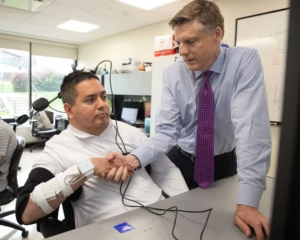
Scientists at the Feinstein Institutes for Medical Research, led by Professor Chad Bouton, created a so-called “double neural bypass” for the patient. This system decodes brain signals conveying the intent to move while simultaneously routing sensations from hand sensors back to the brain. Through this very technology, he was able to feel the touch of his sister’s hand for the first time since his injury.
However, the most surprising aspect of this achievement turned out to be neuroplasticity. Through simultaneous stimulation of the brain and spinal cord, Thomas retains sensitivity and motor function in his limbs even when the device is completely powered off.
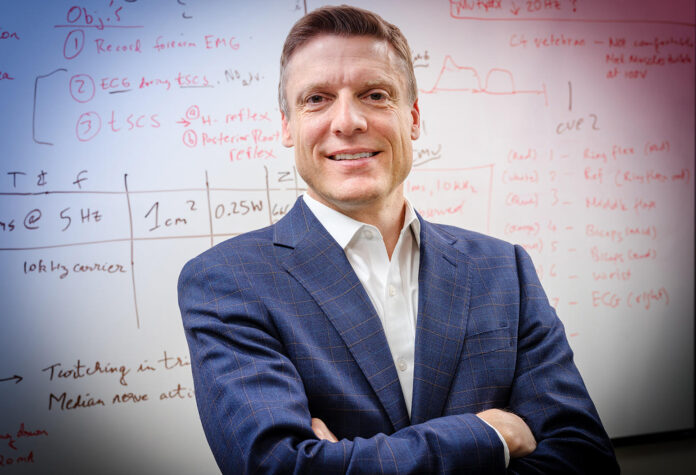
How realistic is the self-repair of the nervous system, and when will this technology become available to millions of patients worldwide? We spoke with Professor Chad Bouton, the lead researcher behind this innovation. Chad Bouton is a bioengineer, neuroscientist, and professor at the Feinstein Institutes for Medical Research, currently serving as Vice President at Northwell Health and Director of the Karches Neural Bypass and Brain-Computer Interface Laboratory.
Interview with Professor Chad Bouton
For decades, spinal cord injuries have been considered largely irreversible. Do you believe this achievement marks the beginning of a new era, or are we still at the very first step?
We and other groups around the world have now shown that electrical stimulation of the spinal cord can lead to lasting improvements in incomplete (partial paralysis below the injury level) type injuries. This study showed, for the first time, that it is possible for a brain-computer interface (BCI)—as part of a “double neural bypass”—to restore movement and sensation when combined with precision brain stimulation in a complete (full paralysis below the injury level) type spinal cord injury.
One of the most fascinating parts of this study is that some improvements remained even after the device was switched off. How do you explain this effect, and did it surprise your team?
We believe electrical neurostimulation can increase excitability, and therefore trainability and the propensity for plastic changes in a neural network’s “wiring,” ultimately strengthening connections even in damaged networks. When paired with physical/occupational therapy, these methods can lead to lasting improvements even years after a spinal cord injury.
We were not surprised by the movement and strength improvements, as we had shown this in a previous study, but the recovery of sensation below the level of injury (his wrist area) was a surprise. Even spinal cord stimulation for months did not improve his sensation in this area. Only when we used precision brain stimulation using a new method called “cortical mirroring” did we see the 10-fold improvement.
Your patient was able to feel his sister’s hand and even the fur of his dog again. As a scientist, what did that moment mean to you beyond the clinical results?
Not just as a scientist, but as a person, I was incredibly moved when Keith felt his sister’s hand again for the first time, years after his injury. And when he told us about feeling his dog’s fur, the whole lab was moved—the sense of touch is a visceral experience so central to our lives.
If this technology continues to succeed in larger clinical trials, how do you imagine the lives of people with paralysis could change five or ten years from now?
We hope that in 5–10 years, people will be able to use this technology not only in clinical environments, but also in their homes and achieve activities of daily life without having to ask for help. In fact, we have not only expanded our studies, but we have also formed a company, Neuvotion, to reach as many people living with paralysis as we can around the world. We have developed a non-invasive version—a wearable device called NeuStim—which uses AI to infer the user’s grasping intentions and delivers precision neuromuscular stimulation to activate the fingers of someone living with paralysis after a spinal cord injury or stroke.
Many breakthroughs make headlines but never become widely available. What gives you confidence that this technology has a real chance of reaching patients around the world?
I have been fortunate to invent and commercialize other technologies over the past 20 years in the fields of cancer diagnostics, bleeding/fluid sensing, radiology, and diabetes solutions. There is nothing more rewarding than to see something you and your team developed help someone else. We won’t stop until we’ve made a real difference in the lives of people living with paralysis and sensory loss.
