



The evolution of robotics has long been defined by cold precision and repetitive tasks. However, a new era is emerging—one where machines are designed not just to perform, but to perceive, interact, and empathize. At the heart of this transformation is a vision that treats technology not as a collection of isolated circuits, but as an integrated system mirroring the complexity of the human body and spirit.
In this exclusive interview, we sit down with Sahan Yapa, the founder of Spera and the visionary force behind South Asia’s first humanoid robot platform. From a childhood spent deconstructing the world’s most complex systems to launching a commercial software product at just twelve years old, Yapa’s journey is a testament to the power of self-taught mastery and relentless curiosity. Today, that journey has culminated in a mission to prove that world-class, foundational technology can thrive outside traditional global tech hubs, rooted in the rich talent pool of Sri Lanka.
Spera’s work, under Yapa’s leadership, goes beyond mechanical engineering; it delves into the nuances of human emotion, utilizing Neuro-Linguistic Programming (NLP) and behavioral AI to create supportive, context-aware interactions. Whether it is through humanoid research platforms or AI-powered wearables designed for animal well-being, the goal remains the same: to build an “intelligent presence” that respects privacy, maintains ethical boundaries, and enhances the human experience.
From the technical challenges of building a humanoid frame to the philosophical weight of creating emotionally intelligent machines, we explore the past, present, and future of an innovator who is teaching robots to understand humans—rather than just follow them.
Interview with Sahan Yapa
What inspired you to pursue robotics and AI from a young age?
From a very young age, I was fascinated by building things and constantly challenged myself to understand and create increasingly complex systems. As a child, I began asking what the most complex system in existence was, and I arrived at the human body and the human mind. That curiosity led me to realize that a robot resembles the human body, while software and intelligence resemble the human spirit or soul.
Once I discovered the concept of robotics, it became clear to me that this was the path I wanted to follow. I began teaching myself programming, electronics, and mechanics using whatever resources were available to me at the time. By the age of 10, I had built my first electronic security system. At 11, I developed a pneumatic actuator system combined with mechanical components, and by 12, I had created my first commercial software product.
These early experiences shaped the way I think about technology today, not as isolated components, but as integrated systems that combine structure, intelligence, and purpose. That mindset ultimately led me toward robotics and artificial intelligence as lifelong pursuits.
What motivated you to found Spera and build South Asia’s first humanoid robot platform?
Spera was founded with the belief that advanced, world-class technology does not need to be limited to a few global hubs. Sri Lanka has a deep pool of intelligent, disciplined, and highly adaptable technical talent that is often underutilized or restricted to outsourced work. I wanted to build a company that channels this talent into creating original, globally relevant technology.
The humanoid robot platform emerged as both a technical challenge and a statement of intent. Humanoid robotics represents one of the most complex intersections of mechanics, electronics, and artificial intelligence. Choosing this path was a way to prove that teams from South Asia can build foundational technologies, not just supporting systems.
Through Spera, the goal is to move beyond service-based innovation and develop original platforms that are designed, engineered, and owned from Sri Lanka, while meeting global standards.
Can you describe your humanoid robot and its capabilities?
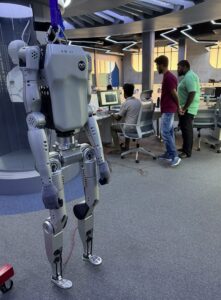
Our humanoid robot platform is designed as a research and development system focused on perception, interaction, and adaptability. It integrates vision, speech, motion, and AI-driven decision layers to operate in dynamic human environments.
Rather than focusing on a single task, the platform is modular and extensible. This allows us to explore different behaviors, interaction models, and application directions as the technology evolves. The emphasis is on building a flexible foundation for intelligent, human-centric robotics.
How do your robots understand and respond to human emotions?
Our approach is based on recognizing patterns rather than making assumptions. The system analyzes signals such as language structure, tone, pacing, and contextual behavior to estimate emotional states.
Responses are designed to be neutral, supportive, and adaptive. The goal is not to label or diagnose emotions, but to enable more appropriate and context-aware interactions that feel natural and respectful to the individual.
How does Spera use NLP and behavioral AI to support people emotionally or motivationally?
At Spera, we aim to help people move out of mentally low or disengaged states through emotionally aware interaction. We draw inspiration from Neuro-Linguistic Programming, particularly the concept that language and framing have a significant influence on emotional state and motivation.
By combining these principles with behavioral AI and robotics, our systems adapt their communication based on tone, language structure, and interaction patterns. This allows robots to engage in supportive, encouraging dialogue that helps individuals regain clarity, motivation, and engagement.
This approach is not intended as therapy, but as a supportive technological layer that uses language, presence, and interaction to guide people toward healthier mental and motivational states.
What kind of data do your AI-powered wearables track, and how can they improve well-being?
At present, our wearable technologies are focused on animals, particularly in the area of health and behavioral monitoring. These wearables collect a range of physiological and behavioral signals such as activity levels, movement patterns, rest cycles, environmental exposure, and other health-related indicators.
Using AI-driven analysis, this data is used to identify patterns and changes over time that may indicate stress, discomfort, reduced activity, or abnormal behavior. The goal is to provide early awareness and insights that can help owners, caregivers, or veterinary professionals respond more quickly and appropriately.
While these wearables are designed for animals, the underlying data analysis and behavioral modeling frameworks are built with broader well-being applications in mind. Our focus is on pattern recognition and trend analysis rather than diagnosis, supporting better awareness, preventive care, and overall quality of life.
How do you ensure your emotion-aware AI respects privacy and avoids misuse?
We approach this from both a technical and philosophical standpoint. AI systems are still maturing, and as they evolve, intelligence alone is not enough. Once AI reaches a certain level of capability, physical presence becomes important for experiencing and understanding the real world. However, a physically embodied machine without emotional intelligence or ethical grounding can become disruptive rather than helpful.
Because of this, emotional awareness and ethical boundaries must evolve alongside intelligence. At Spera, privacy, consent, transparency, and human oversight are built into the design process from the beginning. We focus on data minimization, avoid definitive judgments about individuals, and design systems to support rather than influence or control behavior.
When developed responsibly, emotionally aware AI can enhance safety, understanding, and well-being. When developed without these considerations, it carries a significant risk.
How could your humanoid robots and AI systems complement human care in healthcare settings?
Humanoid robots and AI systems can play a meaningful complementary role in healthcare by supporting consistency, engagement, and continuity, areas where human teams are often constrained by time and scale.
Our systems are designed to assist with interaction, communication, and structured engagement rather than clinical decision-making. This can include maintaining regular interaction, supporting motivation and engagement, assisting with guided routines, and acting as an intelligent interface between patients, caregivers, and digital systems.
By combining physical presence with conversational intelligence, these systems can reduce isolation, improve adherence to non-clinical routines, and provide continuous patient-facing interaction. This allows healthcare professionals to focus on diagnosis, treatment, and complex care while technology supports the surrounding human experience.
What has been the biggest challenge in developing emotionally intelligent machines?
The biggest challenge is respecting the complexity of human emotion. Emotions are contextual, cultural, and constantly changing. Building systems that respond appropriately without oversimplifying or crossing boundaries requires restraint, thoughtful design, and continuous ethical evaluation.
What is your long-term vision for Spera and the future of AI and robotics in human interaction?
My long-term vision is to build technologies that understand humans better, not control them. I believe the future of AI and robotics lies in emotionally aware, ethically designed systems that support human growth, care, and connection.
At Spera, we aim to contribute to that future by building intelligent machines that are responsible, respectful, and genuinely human-centric.
