


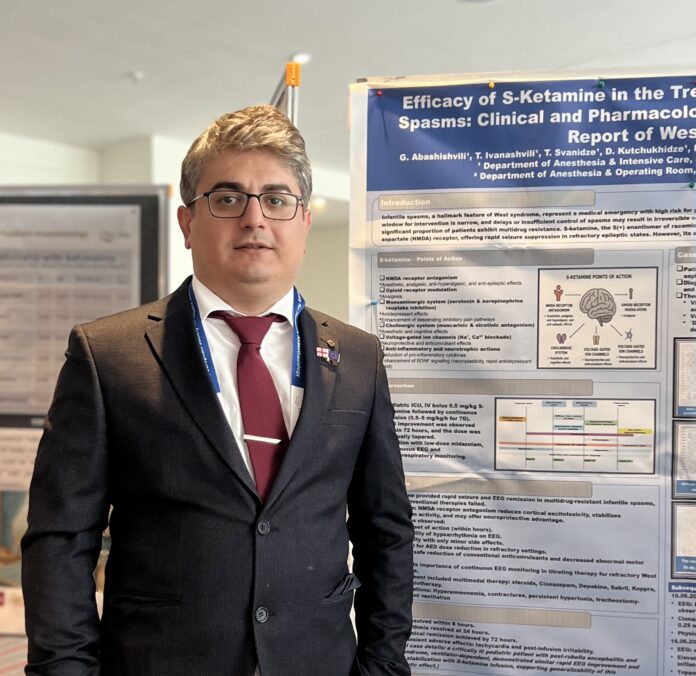
From October 2–4, 2025, Berlin hosted the 15th Anniversary Congress of the European Society for Paediatric Anaesthesiology (ESPA), where specialists from around the world presented the latest research and clinical experiences in pediatric anesthesiology and intensive care. The congress served as an important platform for sharing knowledge and innovative approaches, especially on topics such as neuroanesthesia, intensive therapy, and the management of early-age neurodevelopmental disorders.
A Georgian delegation, led by Dr. Giorgi Abashishvili, participated in the congress and presented a scientific abstract titled:
“The Efficacy of S-Ketamine in the Management of Multidrug-Resistant Epileptic Spasms in Pediatrics; A Case Report of Refractory West Syndrome with Recurrent Infantile Spasms.”
The case presented focused on the effectiveness of S-ketamine in pediatric patients with multidrug-resistant West syndrome, representing one of the region’s first experiences highlighting the importance of early aggressive therapy in the management of refractory epilepsy.
This kind of international activity marks a significant milestone in the development of pediatric anesthesiology and intensive care in Georgia. Dr. Abashishvili’s presentation demonstrated that local medical teams possess both the professional potential and academic readiness to participate in the international scientific arena.
The case is particularly important as it shows the potential for successfully implementing innovative therapeutic approaches, specifically the use of S-ketamine, in Georgian clinical practice. This contributes to the development of modern neurocritical medicine and brings Georgian medical standards closer to European norms.
Such precedents provide a strong motivation for young physicians and researchers, strengthen scientific engagement, establish international collaboration platforms, and promote the integration of Georgian medicine into the global scientific community.
Epileptic spasms and West syndrome represent some of the most challenging and prognostically unfavorable forms of early-age neuroencephalopathy, which often lead to chronic epilepsy and severe neurodevelopmental impairments despite treatment. In Georgia, as in many developing countries, pediatric neurologists and anesthesiologist-intensivists often work under conditions of limited resources and restricted therapeutic efficacy. Within this context, the presented case marks one of the first successful attempts at using S-ketamine for the treatment of multiresistant epileptic spasms.
S-ketamine, the S(+) enantiomer of racemic ketamine, possesses unique neuroprotective and anticonvulsant properties through NMDA receptor antagonism, enhancing glutamatergic modulation and reinforcing GABAergic inhibition. Acting as both an anticonvulsant and neuroprotective agent, S-ketamine influences synaptic plasticity and, due to its anti-inflammatory effects, plays a crucial role in reducing microglial activation and lowering the impact of cytokines TNF and IL-6 on the brain.
In this clinical case, intravenous infusion of S-ketamine led to a rapid clinical and electroclinical remission in a patient resistant to standard therapies for hypsarrhythmia—such as ACTH, prednisolone, vigabatrin, and other anticonvulsants. This underscores the drug’s potential as a tool for early intensive intervention.
On a national level, this case represents a major advancement in Georgia’s pediatric anesthesiology and intensive care practices. It shows that local teams are capable of successfully integrating modern neuropharmacological approaches, implementing continuous EEG monitoring, and applying internationally standardized sedation protocols. It also emphasizes the importance of multidisciplinary collaboration.
At the international level, this experience contributes to the growing scientific discussion around new therapies based on NMDA receptor modulation in the management of refractory epilepsy. The Georgian clinical example enriches global databases with real-world evidence, supporting arguments for including S-ketamine in early intervention strategies. Moreover, it demonstrates that the adoption of innovative approaches is possible not only in high-income but also in middle-resource countries, promoting a more equitable and global development of medical science.
Ultimately, the successful participation of Georgia at the ESPA International Congress in Berlin serves as a clear example that local medical initiatives can become active contributors to the international scientific dialogue. This achievement not only reflects the country’s potential but also strengthens Georgia’s position as a regional leader in pediatric anesthesiology and neurocritical medicine.
Such precedents serve as powerful incentives for the advancement of the national healthcare system, fostering the adoption of scientific innovation and integration with international standards. Through this progress, Georgian scientific and clinical practice continues to gain the importance necessary to protect and improve the health and quality of life of future generations, forming the foundation of modern, progressive, and patient-centered medicine.
