


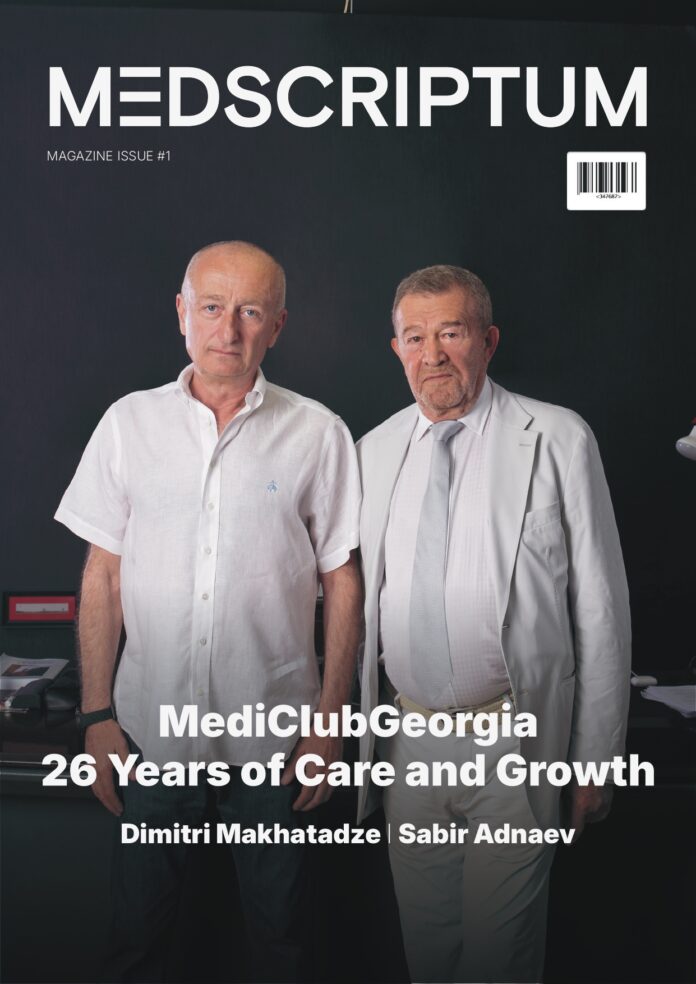
The 1990s were an extraordinarily difficult period not only for Georgia and the Caucasus but for every country that had been held within the Soviet system. Survival, development, finding and establishing the right geopolitical bearings: this is only a partial list of the challenges facing the nations, countries and people who had been forcibly united under the banner of building a “great Soviet Union.”
Anyone who remembers the particular character of the newly forming relationship between Georgia and Azerbaijan at the close of the last century’s final decade can easily imagine how unusual a meeting between two physicians would have been.
An encounter shaped by a strange convergence of circumstances in the right place, at the right time: “Pray that you are in the right place, at the right time, to meet the right person, that together you may help one another.” This phrase, and the reality it describes, is one way of understanding the first meeting between Sabir Adnaev and Dimitri Makhatadze in Baku in 1998.
(Photo: Ana Boko)
Just over a quarter of a century has passed since that first encounter with all its small practical difficulties and large-scale challenges, its successes and failed projects, its victories and its defeats, its particular blend of Hippocratic conviction and business pragmatism. The result is MediClub and MediClubGeorgia: brands that stand for the unconditional primacy of the patient; that are committed to the highest standards of professional practice; and that treat innovation, vision and expertise as the essential instruments of quality medical care.
In both countries, these brands are recognised as hallmarks of medical quality, and precisely for this reason, patients trust each member of the medical team.
Over the decades, MediClub Azerbaijan and MediClubGeorgia have grown into a unified organisation grounded in shared management principles and high-quality care. It is this shared foundation that has led both clinics to be known collectively as MediClub.
In this exclusive interview, MEDSCRIPTUM sits down with Sabir Adnaev – Honoured Doctor of the Republic of Azerbaijan, founder of MediClub and co-founder of MediClubGeorgia – and with his MediClubGeorgia co-founder, Dimitri Makhatadze. They look back on the journey, share what they have learned along the way, and set out their vision for the years ahead.
Tell us how you met and how the idea for a joint project first came about.
Sabir Adnaev: Our first meeting came about through a convergence of professional interests. At the time, Baku was hosting its first international conference on the reform and development of emergency medical services, and Dito was there with several colleagues. I listened carefully to his presentation, found it compelling, and we got talking briefly during the break. That same evening, we agreed to meet at MediClub, which had only been open for four months. I showed him around the clinic, we talked about what we were doing and where we hoped to take it, swapped a few stories from earlier in our careers, and parted late that night as friends. Two days later, as the conference came to a close, we said goodbye and agreed to keep in touch about the possibility of starting something together in Georgia.
Dimitri Makhatadze: Building a business relationship between our two countries back in 1998 was genuinely hard. The options for communication were few: in-person meetings, phone calls, and… the fax machine. Email wasn’t really viable in those early months, for various reasons. Of what remained, the fax turned out to be the most accessible, the most practical, and above all the cheapest. In January 1999, the first message came through: two sheets of paper, packed with small-font text. Economising, clearly. It set out a concise recap of our meeting and, more importantly, the concrete steps to set up a MediClub-style operation in Georgia – one with the ambition, capacity, and readiness to compete in an international tender for comprehensive medical services for the Baku-Supsa pipeline project. We spent a month deliberating, another planning, and by the third, we had everything in place. The tender was announced in May. What followed was five people working 22/7 until the 5th of June. We submitted a vast stack of printed documentation and then waited for a decision until the 1st of July. We won. The verdict: in Georgia, we were to take over from the British company entirely, fully operational by the 1st of August. It is easy to look back on it now, even fondly. But what we were about to take on was a life of almost unimaginable demands. And it has stayed that way ever since.
Who was providing medical services to the project before you?
Dimitri Makhatadze: Even in the early 1990s, we knew that an intergovernmental agreement was in place to build an Azerbaijani oil pipeline – one that would carry crude through the Supsa terminal and onward by sea to international markets. The scale of the project was almost inconceivable from where we stood in Georgia at the time, and so were its medical requirements: the standards, the systems, the specifications that any healthcare service during construction would have to meet. At the preparatory stage, the building consortium awarded the entire medical contract, through an international tender, to a Scottish company, OMS, which then oversaw and managed all medical operations until construction was complete.
Despite all of this, we set ourselves that ambitious goal and, as the years have since shown, we delivered on it.
The principles we worked by then – vision, innovation, professionalism – went on to become the founding motto of our company.
The tender deadline was the next day. Late at night, we realised we were a few sheets of paper short of completing the documentation, which had to be submitted in five printed copies, by post. A handful of missing pages could have undone everything we had worked for; the tender committee would simply have refused the submission. And remember, all of this was happening in 1999, when what looks today like the most trivial problem could, in those conditions, prove fatal. I remember searching for a single ream of printer paper in Tbilisi at midnight. Not one stationery shop was open. On a whim, I pulled over at an all-night grocery store and there, entirely by chance, tucked between the sweets and the toys, I spotted the thing that saved us: one ream of printer paper. I will never forget those few minutes.
That is how we won the tender. And immediately, we ran into the next problem – a financial one.
I remember our first working day clearly: 26 years ago, the 1st of August 1999. Eight staff – two drivers, five physicians, and a financial manager – sit in a 150-square-metre office in the old Lechkombinati building, waiting for the first patient. No patient came that day. But on that same day, the 1st of August 1999, we took on responsibility for the health of 4,000 BP employees and contractor staff. We have done so, successfully, ever since.
How quickly were you able to integrate into Georgia’s healthcare sector?
Dimitri Makhatadze: Today, in MediClub’s Tbilisi branch alone, 140 physicians work under contract. That speaks for itself regarding our integration into the healthcare system. Although Georgia’s and Azerbaijan’s healthcare systems differ significantly from one another, and both countries have undergone many reforms over these 26 years, MediClub has remained faithful to its principles and has maintained its high standard of patient care throughout.
One measure of this: MediClub was the first clinic in Georgia to receive JCI (Joint Commission International) accreditation.
What gives you the basis to say that?
Dimitri Makhatadze: Patients who have received care at MediClub in both Georgia and Azerbaijan consistently say the same thing: that the standards of quality are identical in both countries, and that in both, the focus is on patient safety and progress.
Sabir Adnaev: I agree with Dito entirely. The point is that we started from different positions. There are fields in which Azerbaijan leads, and equally, there are clinical areas where Georgian physicians’ qualifications surpass those of their Azerbaijan counterparts. These differences are still perceptible today, but not within MediClub, where we have succeeded in creating a unified high standard of patient care. The reason is that our focus was never on integration as such. It was always on the patient, who has always been our first priority.
We help advance not only clinicians but leaders. One of my former colleagues is now the Deputy Minister of Health of Azerbaijan. One of my current colleagues once said something interesting to me: “There is no neutral attitude towards MediClub – people either love it or hate it and fight it.” Why does that happen? Because a great many clinics appeared that tried to copy our standards and approaches, hoping to build something better and thereby diminish MediClub. My answer to them was always: “Don’t try to sink us – develop your own style, and let us be strong competitors.” However you look at it, the standards at MediClub hold firm. They are rooted in a single principle – patient safety – and that principle will not allow the bar to fall.
Working at MediClub has always carried a certain prestige among physicians. How did you build that?
Sabir Adnaev: We don’t engage in questionable dealings. We find it completely unacceptable when a physician sets aside their principles, picks up a calculator, and starts working out the percentage they stand to make on every unnecessary test or prescription. We refuse to enter into unethical arrangements with the pharmaceutical industry, and we prescribe only high-quality medication. This has sometimes cost us dearly, but we hold to these principles without exception. I remember Dito saying to me in our very first months of working together: “What kind of practice is it when a physician becomes a drug salesman? I will never agree to that.”
I smiled to myself at the time: two physicians with exactly the same values had met and decided to go into business together. The conventional wisdom at the time was that such a principled, uncompromising approach would never pay. Time has proved otherwise: we deliver quality care, and in return, we earn the trust of our patients.
In your view, what role has MediClub played in shaping private healthcare?
Sabir Adnaev: When we were building MediClub, we had corporate ethics, culture, and the quality of relationships in mind from the very start. Sadly, this is precisely the area where competition is still lacking today. A debate is going on around the world right now about the role of private medicine, about whether the state should take full responsibility for healthcare, and whether private providers are needed at all. I believe a strong private sector is essential. A healthcare system run entirely under strict state control will quickly lose its quality, and it is private provision that helps hold that quality in place.
Couldn’t the market regulate this on its own?
Sabir Adnaev: Sadly, no. When we set MediClub up, we aimed our services at a particular social segment, trusting that segment would grow over time. It hasn’t – and for a sizeable share of the population, these services remain financially out of reach, even on the modest margins MediClub operates on.
Dimitri Makhatadze: From 1999 to 2009, every resource we had went into servicing large corporate contracts. In 2009, we began planning a move to new premises that would allow us to expand, and from that point on, we became fully fledged players in the hospital sector. Unlike Azerbaijan, Georgia at the time already had several dozen private clinics up and running – but not one of them held internationally recognised accreditation. We set ourselves an extremely high bar and in 2017, we became the first clinic in Georgia, and the first in the wider region, to receive JCI (Joint Commission International) accreditation. At that point, only around 600 hospitals worldwide held this recognition.
What would you advise the next generation?
Sabir Adnaev: Medicine demands self-sacrifice, and it comes with enormous stress. Both Dito and I have lived through extraordinarily hard years – wars, crises – as practising clinicians: Dito as a surgeon, I as an anaesthesiologist and intensivist. Young people entering this profession need to understand clearly that medicine is both an art and a confrontation with life at its hardest. Above all, they need to love their patients.
Dimitri Makhatadze: We have spent our whole lives swimming against the current. We fought disease in places that lacked both the capacity and the resources to do it properly. We fought for every life. We don’t want our younger colleagues to go through what we went through.
When I look back at these 26 years, I understand more and more that no clinic, no medical company, and no physician can build something meaningful alone. Yes, modern medicine requires technology, infrastructure, and financial stability. But in reality, healthcare is always built by people – by their professionalism, humanity, loyalty, and willingness to stand beside each other even during the most difficult periods. Neither MediClub nor MediClubGeorgia could have become what they are today without the remarkable people who spent years of their lives working with us to build these institutions day by day. Many of them were not simply employees or colleagues – they became part of a shared journey, shared responsibility, and sometimes even shared sacrifice.
Sabir and I are physicians ourselves, and we dedicated a very large part of our lives to this work. But honestly, it would have been impossible for the two of us alone to help and support all the patients who trusted us over the years. Every achievement was the result of collective effort, teamwork, trust, and the quiet daily work of many people whose contributions often remain behind the scenes. Golda Meir once said something that has stayed with me ever since: “If you want to build a good country, provide the soldier, the teacher and the doctor with dignified conditions.”
Throughout the interview, both men’s phones rang without pause. They answered everyone and, throughout our conversation, continued discussing treatment plans and approaches for their patients.
And I had the sense that, despite the occasional notes of pessimism in what they said, neither of them could imagine living any other way.
That, perhaps, is precisely why MediClub remains a symbol of unwavering commitment to the patient.
By Mariam Sparsiashvili
