
Melanoma accounts for a relatively small proportion of malignant skin tumors, yet its aggressive behavior and potential for metastatic spread make it a disease of particular clinical importance. For this reason, improving our understanding of melanoma and developing more effective treatment strategies have become major areas of focus in oncology. Over the past two decades, melanoma has emerged as one of the malignancies in which diagnostic and therapeutic approaches have changed most dramatically.
While a diagnosis of metastatic melanoma was once associated with a very poor prognosis, advances in modern systemic treatment have significantly altered the natural course of the disease. The development of molecular diagnostics, targeted therapies, and immunotherapy has made increasingly individualized treatment possible, offering a growing number of patients improved outcomes and prolonged disease control.
Despite all the advances of modern medicine, however, the most powerful tool in the fight against melanoma remains its early detection.
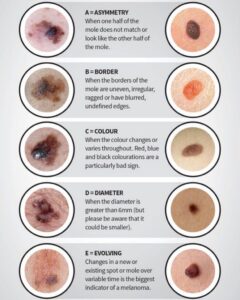
How Can We Recognize Melanoma?
One of the key factors for successful melanoma treatment is early detection. When diagnosed at an early stage, surgical treatment can, in many cases, be curative. It is therefore important to know which features may raise suspicion for melanoma and when medical evaluation is warranted.
Melanoma may develop either from a pre-existing mole or on previously normal skin. One of the most widely used approaches for the initial assessment of suspicious pigmented lesions is the “ABCDE rule”, which helps both healthcare professionals and the general public recognize features that may require further evaluation.
In addition to the ABCDE rule, another simple principle widely used in clinical practice is the “ugly duckling” sign. This refers to a mole or other pigmented lesion that looks noticeably different from the other moles on a person’s skin and therefore deserves particular attention. Such an “outlier” lesion may represent melanoma even when it does not fully meet all of the ABCDE criteria.
“Ugly duckling” sign
It is important to emphasize that neither the ABCDE rule nor the “ugly duckling” sign can establish a diagnosis of melanoma. Rather, they serve as practical tools to help identify suspicious skin changes at an early stage.
If a skin lesion appears suspicious, the next step is evaluation by a physician. Confirmation of melanoma requires a biopsy of the suspicious lesion, with the obtained tissue submitted for histopathological and immunohistochemical examination. These studies ultimately confirm or exclude the diagnosis.
Once melanoma is diagnosed, it is also essential to determine the extent of the disease – whether it remains localized to the skin or has spread to other parts of the body, including the lymph nodes or distant organs. Depending on the clinical situation and stage of disease, imaging studies such as **CT, MRI, and/or PET/CT** may be required for staging.

How Is Melanoma Treatment Selected?
In early-stage melanoma, the first step in treatment is surgery. Complete surgical removal of the tumor can, in many cases, be curative. Although systemic therapy plays the central role in the treatment of metastatic melanoma, surgery may still be considered in selected cases at this stage of the disease.
When systemic treatment is required, modern oncology offers two main therapeutic approaches – targeted therapy and immunotherapy. The choice between them depends on the biological characteristics of the tumor, the clinical course of the disease, and the individual characteristics of the patient.
Targeted Therapy – When Treatment Is Tailored to the Molecular Features of the Tumor
Not all melanomas are biologically the same. Two patients with the same diagnosis may have tumors with very different molecular characteristics. For this reason, treatment planning in melanoma today involves not only determining the stage of the disease but also evaluating its molecular profile.
Approximately 40–50% of melanomas harbor a BRAF V600 mutation in the tumor cells. This alteration results in continuous activation of signaling pathways that promote cell growth and division, contributing to uncontrolled tumor proliferation. The identification of this molecular alteration paved the way for the development of targeted therapy. Testing for a BRAF mutation is therefore an essential part of contemporary clinical practice when systemic treatment is being considered.
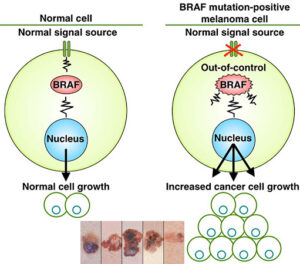
Targeted therapies are designed to specifically inhibit the altered BRAF protein and the associated MAPK signaling pathway, thereby interfering with the signals that drive tumor growth.
One of the main advantages of targeted therapy is the rapid onset of response- tumor shrinkage can often be observed within the first weeks of treatment. This makes targeted therapy particularly important for patients with rapidly progressive disease, a high tumor burden, or significant clinical symptoms.
The efficacy of this approach was first established in patients with metastatic BRAF V600-mutated melanoma. The phase III COMBI-d and COMBI-v trials demonstrated that the combination of dabrafenib and trametinib significantly improved both progression-free and overall survival. Subsequently, the phase III COLUMBUS trial also confirmed the high efficacy of the combination of encorafenib and binimetinib.
The success of targeted therapy in metastatic disease led to its evaluation at earlier stages of melanoma. The phase III COMBI-AD trial showed that, in patients with resected stage III BRAF V600-mutated melanoma, one year of postoperative (adjuvant) treatment with dabrafenib and trametinib significantly reduced the risk of disease recurrence and death. As a result, targeted therapy is now used not only in metastatic melanoma but also as adjuvant treatment for patients with high-risk resected disease.
Despite its high efficacy, tumor cells may develop resistance to targeted therapies over time. For this reason, treatment strategy is always individualized and may need to be modified depending on the course of the disease and response to therapy.
Immunotherapy – When the Immune System Takes a Central Role in Treatment
Unlike targeted therapy, immunotherapy does not act directly on the tumor cells. Instead, its aim is to activate the body’s own immune defenses, enabling the immune system to recognize and destroy cancer cells.
Under normal conditions, the immune system continuously monitors the body and eliminates foreign or damaged cells. Over time, however, cancer cells can develop mechanisms that allow them to evade this immune surveillance. One way they achieve this is by exploiting natural regulatory mechanisms known as “immune checkpoints”. Under normal circumstances, these checkpoints are essential for preventing the immune system from attacking the body’s own healthy tissues. Cancer cells, however, can take advantage of these mechanisms to suppress the immune response and protect themselves from immune destruction.
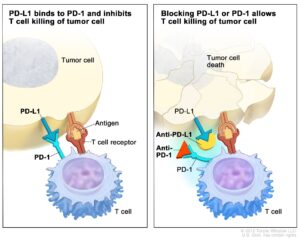
Today, the most widely used immunotherapies for melanoma are immune checkpoint inhibitors targeting PD-1 and CTLA-4. These drugs block mechanisms that normally suppress the immune response, allowing T lymphocytes – key cells of the immune system – to regain their ability to recognize and attack cancer cells.
An important feature of immunotherapy is that its effects do not always develop rapidly. However, in patients whose disease responds well to treatment, the benefit can often be remarkably durable.
The efficacy of immunotherapy was first established in the treatment of metastatic melanoma. The phase III CheckMate 067 trial demonstrated that the combination of nivolumab and ipilimumab, as well as nivolumab alone, significantly improved overall survival compared with ipilimumab. Ten-year follow-up data have shown that disease control can be maintained for many years in a proportion of patients, representing one of the major advances in modern melanoma treatment.
Similarly, the phase III KEYNOTE-054 trial demonstrated that pembrolizumab significantly reduced the risk of disease recurrence in patients with resected stage III melanoma. As a result, immunotherapy is now an established component of adjuvant treatment for patients with high-risk resected melanoma.
The development of systemic therapy for melanoma has continued beyond the metastatic and adjuvant settings. In recent years, particular attention has focused on the neoadjuvant approach – administering immunotherapy before surgery. The phase III NADINA trial showed that, in patients with resectable stage III melanoma, preoperative treatment with nivolumab and ipilimumab resulted in improved disease control compared with the standard adjuvant approach. Importantly, the pathological response observed after surgery also provided an opportunity to further individualize subsequent treatment.
Another emerging and promising area in melanoma treatment is the development of therapeutic mRNA vaccines. Of particular interest are personalized vaccines designed according to mutations and neoantigens specific to an individual patient’s tumor. The aim of this approach is to stimulate the immune system to recognize cancer cells more precisely and generate an effective antitumor immune response. mRNA vaccines are being actively investigated, particularly in combination with immunotherapy; however, they remain investigational and are not yet part of routine standard treatment for melanoma.
Melanoma Care in Georgia: Where Do We Stand Today?
In Georgia, melanoma diagnosis and treatment are carried out in accordance with international recommendations, and there are already many years of experience with the use of modern systemic therapies.
At present, under the state healthcare program, patients with BRAF V600-mutated melanoma have access to targeted therapy with the combination of dabrafenib and trametinib, which is recognized by international guidelines as one of the standard treatment options.
Immunotherapy is also available in Georgia; however, it is currently not covered by the state program, meaning that the cost of treatment must be borne by the patient. Participation in international clinical trials represents another important opportunity to gain access to modern anticancer therapies.
For patients, participation in a clinical trial means more than simply gaining access to a modern treatment. It involves receiving care according to a predefined study protocol, in line with international standards and under the close supervision of a multidisciplinary team. Many of the treatment standards used in modern oncology today are based on evidence generated through clinical trials, making clinical research an integral part of progress in cancer care.
Melanoma is one of the clearest examples in modern oncology of how advances in science and clinical research can fundamentally change the course of a disease. Over the past two decades, progress in molecular diagnostics, targeted therapy, and immunotherapy has significantly improved outcomes for patients with melanoma and has made personalized treatment an integral part of everyday clinical practice. Despite these advances, early detection remains one of the most important prerequisites for successful treatment. For this reason, any suspicious change in the skin should be evaluated by a specialist without delay.
Author: Salome Kordzaia, MD, Clinical Oncologist at Consilium Medulla Clinic; PhD Candidate at Ivane Javakhishvili Tbilisi State University