


Time, in many specialties, is a resource to be used carefully. In emergency medicine and toxicology, time is not a resource. It is the disease. A patient in septic shock loses measurable tissue with each hour that antibiotics are delayed; a pufferfish toxin does not pause while a physician reaches for a reference text. The two specialties that gathered in Tbilisi on July 17-18, 2026 are, underneath everything else they teach, built around a harsher premise than most: the information you want will often arrive after the decision that needed it. Everything else in these fields – the protocols, the registries, the toxidromes, the years of institutional argument about what “good care” even means – exists to narrow that gap between acting and knowing. It never quite closes it.
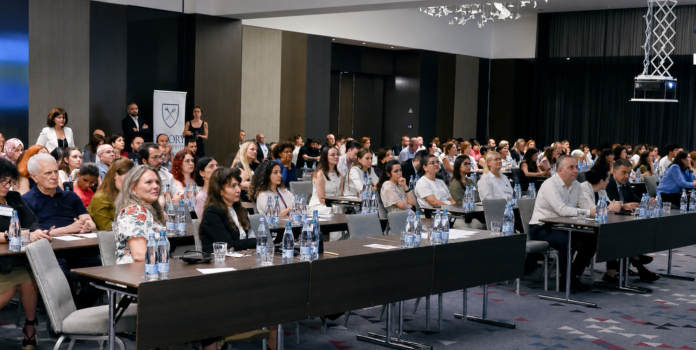
That premise, more than any single lecture, is what the Frontiers in Advanced Emergency Care and The Mediterranean Academy of Emergency Medicine Joint Congress was actually about. Organized by Emory University’s Center for Advanced Emergency Care and MENATOX, with KWIU and GEMPA, and a toxicology track co-sponsored by the OPCW, the congress gathered sixty international speakers and over two hundred delegates in Tbilisi.
Professor Archil Undilashvili, representing Ken Walker International University, views this event as a new milestone in showcasing Georgia on the international stage:
“It is noteworthy that Georgia is hosting such large delegations arriving from various countries around the world, including all leading medical and university centers. As you know, the Department of Emergency Medicine at Emory University is an organizer of the event, while Ken Walker International University is the host in Georgia. It is especially important for us that, through the collaboration of these two universities, we were able to hold an event of this caliber in Georgia.”

For Georgian emergency medicine and toxicology, that scale was not a given; it was a return. As GEMPA president Dr. Giorgi Gotsadze pointed out, “The very first international congress was held in 2016, and now, following the COVID periods, this is the first international congress of this scale, with delegates represented from many different countries.” Six years is a long time for momentum to sit dormant. That it did not stay dormant – that it returned larger, not smaller – is itself the first story worth telling about this congress.
He tied that renewed scale directly to purpose. “The idea behind this congress is to develop emergency medicine and toxicology in Georgia. This congress aims for education, development, knowledge sharing, and mutual support, which is very important today for our country, our society, and for the field of emergency medicine.”
A Discipline That Had to Invent Itself Twice
Emergency medicine did not arrive in world medicine as an obvious idea. For most of the twentieth century, the sickest and most urgent patients were simply distributed among existing specialties – a heart attack went to cardiology, a fracture to orthopedics, an overdose to whoever happened to be on call.
What changed, gradually and then all at once, was the recognition that the first hour of a crisis is not a smaller version of the specialty that eventually treats it. It is its own discipline, with its own logic: rapid triage under incomplete information, coordination across teams that don’t normally work together, and a tolerance for acting before certainty that most of medicine is trained to avoid. Toxicology grew alongside it for the same reason – poisoning rarely announces itself as poisoning, and recognizing it in time required physicians willing to treat “I don’t yet know what this is” as a starting point rather than a failure.
Georgia’s own version of that realization arrived unusually late and unusually fast, and no one at the congress described it more directly than Dr. Nikoloz Kvachadze.
“The first emergency rooms started operating in Georgia in 2003, and it was pediatric emergency rooms. As for adult emergency rooms, they started in 2006. Back in 2009, we had a job interview with Ken Walker. Following that, the first and second groups of emergency medicine physicians were trained by professors from Emory University. After years of long, hard work, newly trained doctors, and the creation of a formal curriculum, a brand-new medical specialty was approved in Georgia back in 2014, and we had our first residents then.”
 What Dr. Kvachadze described was not an institution adopting a specialty that already existed elsewhere. It was a country building the discipline’s entire foundation – curriculum, training pipeline, formal recognition – largely from a single conversation that, on the day it happened, looked like nothing more than a hiring decision.
Walker did not live to see this congress. His influence did not need him to. Dr. Otar Dikhaminjia made that continuity explicit in his own remarks, describing decades of partnership between Emory and Georgian medicine and crediting Kazzi directly with carrying the work forward:
“The partnership between Emory University and the Georgian healthcare sector spans decades,” he said. “Along the historic path, we must honor the memory and immense contribution of the late Professor Ken Walker, whose legacy will forever remain in our hearts. I am delighted that Professor Walker’s invaluable work is being honorably carried forward by a true friend of Georgia – I can safely say friend of Georgia – Dr. Professor Ziad Kazzi. It’s difficult to list and separately address all of his successful initiatives, ranging from the Lead Project and annual international conferences on trauma and poisonings, to his academic activities in the University of Georgia.”
Two Tracks, One Argument
On paper, the two tracks looked like they belonged to entirely different worlds – one was focused on system management and clinical optimization, while the other dealt with toxicological hazards and lethal risks. But followed closely, both tracks turned out to be making the same underlying argument, just from opposite directions: better outcomes rarely come from having more resources. They come from noticing more.
The emergency care track opened by dismantling a familiar excuse – that a chaotic, overcrowded department is simply a symptom of not having enough staff or beds. Using queuing theory and a well-known conceptual framework for department flow, the argument reframed overcrowding as a mismatch between how sick patients actually are on a given day and how rigidly a hospital has chosen to schedule itself. “The field has not failed,” as Dr. Brooks Moore reminded the audience, “it has been solving the wrong problem in the right system.”
That same idea carried through the rest of the day, from department design down to the bedside – including a session on elderly patients that reframed prescribing as an act of restraint as much as treatment, built around a statistic worth sitting with: delirium in patients over seventy-five goes unrecognized an estimated 44 percent of the time, often simply because no one thought to ask the family member in the room. Discussing polypharmacy and the habit of prescribing by protocol rather than by person, Dr. Ethan Meisel offered the line that reframed the whole session: “You aren’t prescribing to disease, you are prescribing to patient.”
At the level of a single diagnosis, the question becomes recognition rather than judgment – and this is where the congress’s toxicology track made its case most vividly, through Dr. Badria Alhatali. Explaining why a collaboration reaching into Georgia mattered to her field specifically, she laid out a network of relationships built one physician at a time:
“This is not the first time that we approach different countries. Georgia – there are many reasons to be that. First of all, this is a joint meeting with Emory University, and Emory University has a very good relationship with Georgia, it’s extended like many, many years beyond. The other thing is that one of our colleagues, Dr. Otar, who basically also attended the training course in Emory as well, and I’m part of the faculty. Actually, Otar visited and attended the MENATOX conference last year. Toxicology by itself is a newly developed kind of subspecialty, and we need this kind of collaboration to enforce and strengthen our abilities in different countries.”
Dr. Alhatali deeply believes that collaboration and finding like-minded peers form the foundation of any systemic change. This vision was shaped by her own practice when she had to build a poisoning center in Oman from scratch. She evaluates the attendant difficulties of institutional building as follows:
“Starting something from scratch was not easy. You need to convince the stakeholders and the ministry how important this is and why they should invest in it. It was not an easy path, and I would say we are still struggling. One thing that helped a lot is this kind of collaboration – learning from different people how they started their service, and better understanding of the mentalities of the stakeholders and what things will attract them.”
Dr. Michael Kosnett described the same recognition problem from the opposite direction, making clear that the exchange was never one-directional.
“I think it’s an extraordinary opportunity for us to learn from each other,” he said, “because in the United States, we have been developing a lot of advances in medicine and we rely a lot on high-tech approaches, but we don’t necessarily see all the exposures that sometimes occur in developing countries and in other areas where patients come forward with more advanced cases. And to learn about how people in other parts of the world have diagnosed and managed unusual poisonings or uncommon poisonings has been a real advantage to us. So we have learned from our colleagues in other countries as much as we have helped to teach them. It’s very effective that way.”
The importance of this international dialogue is further confirmed by the involvement of Romanian colleagues. Dr. Viorela Nitescu, who participated alongside visiting physicians from Romania, noted that such platforms are the best means for strengthening professional ties across borders.
His point, stated plainly rather than as diplomacy, was structural: recognition accumulates wherever the cases have actually occurred, not wherever the resources are greatest – which is precisely why a congress built around mutual exchange, rather than one-directional instruction, was the correct format for this problem in the first place.
At the level of a system, the same question becomes institutional memory – a hospital, or a country, choosing to build the infrastructure that lets one physician’s hard-won recognition become every physician’s inheritance. It was announced during the congress’s graduation ceremony that Georgia has secured access to REDCap, a data platform that will anchor the country’s first national database of acute poisoning cases and, eventually, a national poison registry and center. Dikhaminjia called it “a crucial foundation for the future creation of a national poison registry and a national poison center.”
The same ceremony also paused to recognize Dr. Nino Bukhrikidze, honored for what organizers described as a monumental contribution to building emergency medicine as a specialty in Georgia – a reminder that the infrastructure being celebrated on stage, REDCap included, was never inevitable. It was built by specific people who chose to do the unglamorous work of building it. Read against everything the toxicology track had just spent the day demonstrating — a country with real toxicological threats and no centralized system yet for tracking them — that single administrative fact is not a footnote. It is the same intellectual move that data-driven registries have made elsewhere in emergency medicine, playing out at the scale of an entire healthcare system for the first time.
What this congress actually argued, across two days, is that the gap between a good outcome and a tragic one is rarely intelligence, and rarely even resources. It is whether someone, at some point, cared enough to build the thing that lets the next physician know what the last one learned. Georgia is still building that thing. So, in different ways, is everyone else in this profession, everywhere. The congress ended. The building did not.
