


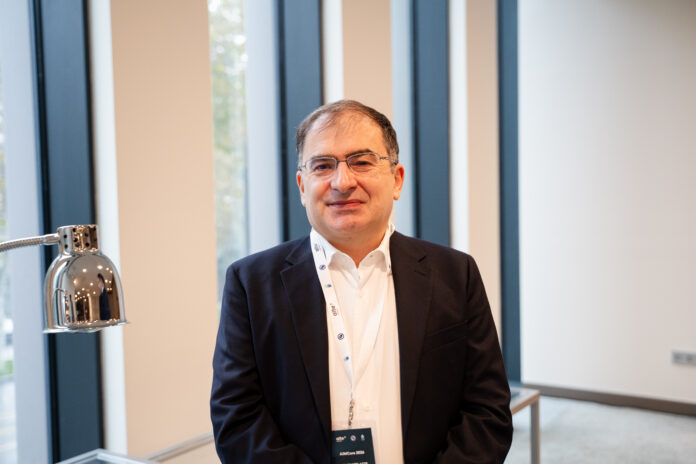
On October 29–30, Tbilisi hosted the conference “Artificial Intelligence in Healthcare and Medicine” (AIMCare 2026), organized through the cooperation of Alte University and Tbilisi State Medical University, and supported by the Shota Rustaveli National Science Foundation of Georgia.
The international event brought together local and international industry experts, covering key topics such as the application of AI in clinical diagnostics and therapeutic interventions, medical education and professional training, as well as administration and management.
At the conference, the first Georgian medical speech recognition and text conversion system (Speech-to-Text) — Enagram — was presented by Professor Rati Skhirtladze, founder of the Data Analysis Laboratory and head of the Computer Science and Artificial Intelligence program at Caucasus University, who spoke with us about the capabilities of the new technology and its significance in the medical sector.
Mr. Rati, what is the product you developed, and what prompted the need to introduce a Speech-to-Text system in the healthcare sector?
Our product is called the “Enagram Medical Speech-to-Text System.” In English, it is referred to as Speech-to-Text, although a corresponding term is not yet established in Georgian. We are trying to establish the term “speech writer”. This system is primarily adapted to English [Note: likely a slip of the tongue in the original interview referring to the adaptation model workflow, or meaning tech standards generally] and saves doctors significant time, allowing them to spend less time on medical bureaucracy and form-filling.
In 2023, a study conducted in America found that doctors spend an average of about 15 hours and 30 minutes a week on this work — medical forms and other bureaucratic tasks. Within the scope of the same study, it was found that doctors speak 4–5 times faster than they write. Therefore, it is natural that this direction has enormous potential, and in the West — in the United States and Western Europe — these products are quite developed.
What technical or linguistic challenges were involved in developing the Georgian-language model, and what stage is the project at today?
We have been modeling the Georgian language for 23 years now. Things are more complex here because Georgian is an agglutinative language, meaning a word consists of morphemes — parts. For example, if an English verb has 5 forms, a Georgian verb has considerably more forms, and the system must recognize all of them.
Despite the challenges, we tackled this task: we recorded over 200 doctors and medical students, had them read more than 100 medical texts, textbooks, Form 100 documents, and drug instructions, and trained the Georgian system at the cost of a great deal of energy. It is much more accurate than any other Speech-to-Text specifically for medical terminology and texts — making about 5 times fewer errors than the best, say, Amazon Georgian Speech-to-Text.
Specifically, which model did you base its creation on?
Wav2Vec 2.0 (Wave to Vectors 2.0) is the Speech-to-Text system that we retrained on our data. We achieved very high accuracy, but this still requires processing. As I mentioned, we have been modeling the Georgian language for 23 years, and this second part (linguistic processing/correction) was done using our traditional methods.
Medical data security and confidentiality are top priorities for clinics. In this regard, how secure is patient data when using your system?
Medical data security is, quite rightly, a top priority for clinics to ensure that this information is reliably protected and does not end up in the hands of third parties. This system of ours was created in Georgia and can be fully installed directly on the clinic’s server. This data is guaranteed never to leave the territory of that clinic. Whereas when using international Speech-to-Text systems (Microsoft, Amazon, or any other), it inevitably leaves the country’s borders. In terms of data protection, this system is completely unique.
How should we protect ourselves against inaccuracies?
Ultimately, the doctor remains responsible. We cannot blame artificial intelligence for anything; it only significantly simplifies our work — it might save 80% of our time, but the final responsibility still lies with the human. Naturally, the doctor must cross-check every term.
Now we have done all of this in a laboratory setting, in our lab, and our goal is to offer clinics the opportunity to start introducing it in test mode. During the implementation process, as new audio material is added, we will further increase this accuracy, and this will be an ongoing process.
