


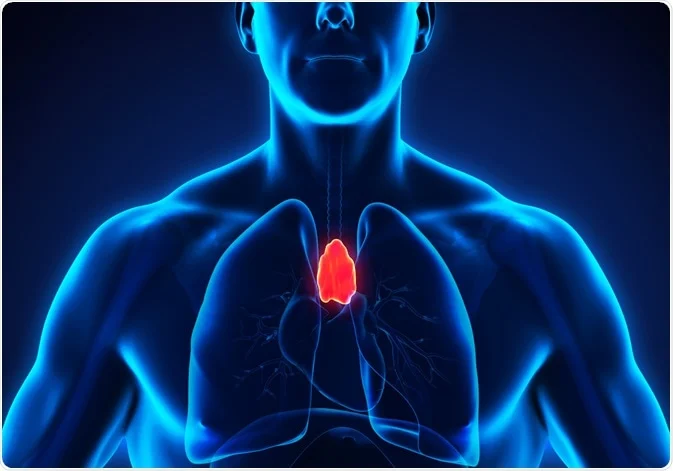
For a long time, the notion that the thymus gland exhausts its primary function during childhood was considered an unshakable axiom. This view was based on the belief that “trained” T-cells at an early stage create a kind of immune reserve that lasts a person throughout their entire adult life. However, the results of a recent study published in the journal Nature reject this long-standing medical dogma. It turns out that in adulthood, the thymus is not a non-functional organ at all; moreover, it appears as an independent indicator of such critical risks as oncological or cardiovascular pathologies and premature death.
The Traditional View of Thymic Involution
At an early age, the thymus plays a decisive role in the formation of the body’s immune system. Its main purpose is the selection and so-called “training” of T-cells, which helps these cells recognize various antigens and prevent autoimmune reactions. The congenital absence or dysfunction of this organ causes Severe Combined Immunodeficiency (SCID) in infants, which confirms its vital importance once again.
In contrast, the involution of the thymus in adulthood – which implies the gradual replacement of functional tissue with a fatty structure – was previously considered a completely benign and biologically regular process. Experts assumed that the resource of T-cells accumulated during childhood was sufficient for a person until the end of their life through peripheral proliferation.
However, the study by Kooshesh et al. confirmed that a thymectomy performed in adulthood leads to a long-term decline in patient health. While this surgical intervention is rarely encountered in clinical practice, it was established that it determines the development of oncological pathologies and an increase in the mortality rate.
Along with this, it was discovered that the pace of natural involution is individual, which directly reflects on each person’s immune status. It is also noteworthy that hypotheses regarding a link between the thymus and cardiovascular diseases existed before, although this view had lacked large-scale clinical validation until now.
Study Details
Researchers developed a Deep Learning model that was “trained” on 5,674 independent chest CT scans. The system determines the state of the thymus on a continuous scale, where 0 units denote the full degradation of the organ and 100 denotes optimal functional activity. Based on the data obtained, the algorithm divides patients into low, medium, or high categories according to cohort percentiles. The model demonstrated a high degree of validity in the large-scale FHS and NLST studies, which involved the prospective study of the cardiovascular and oncological outcomes of more than 27,000 individuals.
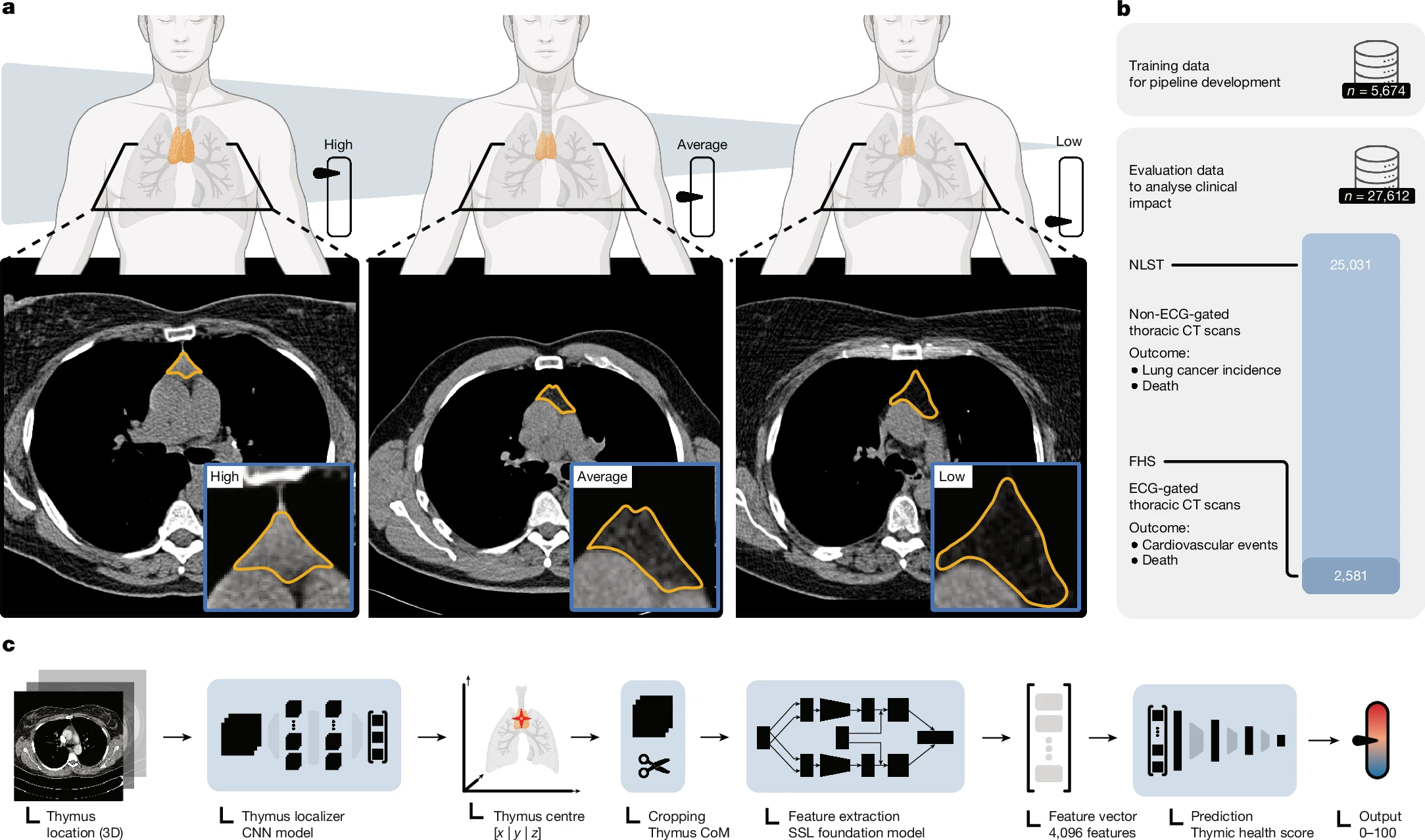
As a result of the data analysis, higher indicators of thymic health were recorded in women than in men, while a clear trend of declining scores was revealed with increasing age and body mass index (BMI). The stability of the model successfully withstood repeated testing and significantly outperformed manual methods during the validation process. While by traditional approaches a vast majority of adult thymuses were considered “fully fatty,” artificial intelligence was able to identify functional tissue within them with much higher accuracy.
Predictor of Mortality
The analysis conducted over a 12-year observation period revealed that the state of the thymus represents a significant independent indicator of survival. Within the framework of the NLST study, mortality among persons with low functional indicators of the gland amounted to 25.5%, while in the group with high scores, this figure was almost twice as low—13.4% (HR 0.49). Notably, this correlation remained unchanged even after adjusting for sex, age, tobacco consumption intensity, and concomitant pathologies, which reinforces the statistical reliability of the data.
An analogous pattern was confirmed by the FHS study, where the mortality rate in groups with high and low scores turned out to be 3.9% and 14.5%, respectively (HR 0.24). Continuous analysis of the data revealed a so-called “dose-response” principle: every increase in the thymic health score determined a progressive improvement in survival. Most importantly, the functional state of the thymus was found to have prognostic value independent of standard clinical variables, which increases the accuracy of existing medical models.
Reduction of Cancer Cases and Mortality
Focusing on the risks of developing lung cancer within the framework of the study revealed clinically noteworthy patterns. According to the data, a low functional indicator of the thymus significantly increased the 6-year prognostic risk of developing the disease. Specifically, the incidence in the high-score group was 3.4%, while in persons with a low indicator, this figure rose to 5.3%. A similar trend was revealed in specific mortality rates, where a healthy thymus nearly halved the probability of a fatal outcome (1.1% vs 2.0%). Notably, this close correlation remained unchanged even in active tobacco users and maintained statistical significance after adjusting for all concomitant factors.
Parallel to the improvement of the functional state of the thymus, a declining trend in total oncological mortality rates was recorded. The strongest correlation was revealed in active smokers, which once again emphasizes the immunobiological importance of this organ. This fact points to the critical role of the thymus in identifying specific neoantigens induced by tobacco consumption and generating an effective immune response against them.
Disease Incidence
The study results confirm that a high functional score of the thymus significantly reduces the risk of lethality caused by cardiovascular pathologies. Analysis of the NLST cohort showed that lethality in the high-score group was 2.9%, which points to a sharp reduction in risk compared to persons with low scores (7.5%). The results obtained within the FHS study reveal an even more radical difference, where the mortality rate under conditions of high functional activity did not exceed 0.3%. The mentioned trend was also reflected in the overall rates of disease incidence, which confirms once again the close link existing between thymic health and cardiovascular outcomes (5% vs 16.7%).
The study revealed that the protective effect of thymic functional health is not limited only to specific diagnoses. Analyzing various causes of mortality, it was established that high indicators of the organ reduce fatal outcomes caused by respiratory pathologies by 61%. An analogous trend was revealed in the case of metabolic disturbances (for example, diabetes mellitus), where the risk of lethality drops by 68%. The state of the thymus is also closely linked to the outcomes of digestive system diseases, specifically hepatobiliary and pancreatic diseases, as a 54% decline in mortality was recorded in this category.
Lifestyle, Metabolic, and Inflammatory Factors
Metabolic data obtained within the framework of the FHS study highlighted those modifiable factors that act on the functional state of the thymus. Specifically, an optimal level of high-density lipoproteins (HDL) was in a positive correlation with the functional reserve of the organ. In contrast, dyslipidemia, hyperglycemia, and systolic hypertension significantly accelerated the structural degradation of the thymus. At the same time, it was confirmed that a decline in the thymic functional score is reflected in direct proportion to the “frailty index,” which was manifested clinically by mobility restrictions and the exhaustion of the organism’s total physiological reserve.
Furthermore, proteomic analysis () confirmed a close correlation between thymic health and the inflammatory processes ongoing in the body. Out of 68 inflammatory markers studied, 24 were directly linked to low thymic functional indicators; among them, such critical cytokines and chemokines as IL-6, IL-18, VEGFA, and CXCL were highlighted. A persistent increase in C-reactive protein (CRP) (>3 mg/L) was named an independent predictor of thymic structural degradation. These data point to a solid mutual link existing between systemic inflammation and the functional involution of the thymus.
Advantages and Limitations of the Study
One of the central achievements of the study represents the radical improvement of diagnostic sensitivity. Traditional manual evaluation methods recorded the presence of functional tissue in adults in only 25–40% of cases. In contrast, artificial intelligence revealed thymic functional activity in 75% of the adult population. These data confirm that the AI algorithm was able to identify that “invisible” biological resource whose differentiation was previously impossible under conditions of standard visual inspection.
Despite the results obtained, certain methodological limitations still accompany the study. The considered cohorts were primarily dominated by Caucasian, elderly, and nicotine-dependent individuals, which requires additional validation of the obtained data in different ethnic and age populations. Along with this, the observational design of the study cannot fully establish cause-and-effect links, because of which an in-depth prospective study is necessary in the future.
From a technical standpoint, the heterogeneity of the scanners used and research protocols requires bringing diagnostic standards into a unified framework. To fully study the genetic determinants of the thymus’s functional state, it is necessary to integrate the results of GWAS (genome-wide association studies) into the databases. These steps will facilitate the transformation of the thymus, as a biomarker, into a practical component of personalized medicine.
Clinical and Research Significance
As a result of the study conducted, the state of the thymus has turned from a subject of theoretical interest into a clinically significant biomarker. Integrating the mentioned parameter into routine computed tomography (CT) will make the screening process much more valid and effective. This is especially relevant for smokers and those persons who exhibit a high genetic or exogenous risk of developing oncogenesis at an early age. Along with this, modern immunotherapeutic strategies might select patients precisely by taking into account T-cell clonal diversity and thymic functional reserve.
Interventional mechanisms available to patients include such modifications of lifestyle as the prevention of tobacco consumption, correction of body mass, and regular physical activity. At the pharmacological level, the use of anti-obesity and systemic anti-inflammatory drugs represents therapeutic potential. It is noteworthy that the large-scale initiatives of ARPA-H, which aim at thymic regeneration and functional restoration, directly point toward the significant clinical progress expected in this field.
Source: nature
