


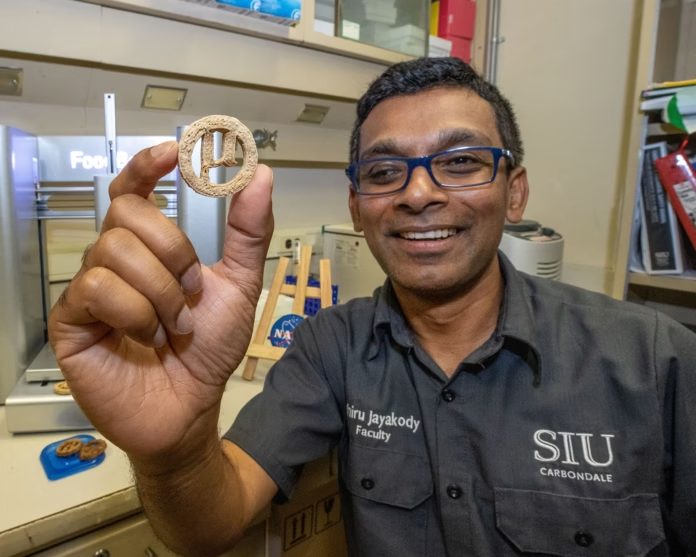
Cookies made from plastic might sound like the plot of a dystopian science fiction story, but American scientists have already managed to turn this into a reality. As part of a NASA-funded project, researchers have developed an innovative technology that produces edible, 3D-printed cookies from plastic and agricultural waste. The main goal of the project is to provide astronauts with food during future long-term space missions.
How does the technology work?
First, under high temperature and pressure, scientists break down poly-ethylene terephthalate (PET), one of the most common plastics used to manufacture single-use bottles. The resulting carbon-rich molecules are fed to specifically programmed, genetically modified yeast. The yeast feeds on these plastic residues and converts them into beneficial proteins, fats, and other nutrients. The resulting edible mass is placed into a 3D printer, which prints disc-shaped cookies. Notably, researchers used a different strain of yeast to give the cookies a vanilla flavor.
“Plastic is carbon, and food is carbon. Why shouldn’t we exploit this similarity?” explains Dr. Lahiru Jayakody, a microbiologist at Southern Illinois University and project lead. Although the cookies have a pleasant aroma, the team has not tasted them yet, as they are waiting for official approval for human testing. Currently, producing 1 kilogram of these cookies costs $60, but as the technology is refined and scaled up, costs will decrease significantly.
This innovation was created as part of NASA’s specialized program, the Deep Space Food Challenge. As the project lead explains, a round trip to Mars takes a total of 3 years. Since supplies on a spacecraft are strictly limited, surviving in such extreme conditions will require astronauts to maximize every available resource, including plastic waste.
However, beyond space exploration, scientists believe this technology will play a critical role on Earth as well—in submarines, disaster zones, and in the fight against global hunger and plastic pollution. According to projections, food demand will increase by 35–56% by 2050, leaving 30% of the population at risk of hunger—a crisis scientists believe can be mitigated through microbes and synthetic food.
Nevertheless, the primary challenge remains the public’s psychological barrier. People will need to come to terms with the idea of consuming food derived from plastic.
