


Bile acids were once viewed mainly as digestive detergents that help absorb dietary fats. They are now recognized as signaling molecules that connect the liver, gut microbiome, immune system, and tumor microenvironment.
A recent review in Immunity examines how this bile acid–microbiome–immune axis may influence cancer development, tumor progression, and response to immune checkpoint inhibitors. Its central message is nuanced: bile acids are not uniformly harmful or protective. Their effects depend on their chemical structure, concentration, receptor interactions, cellular targets, and anatomical location.pubmed.ncbi.nlm.nih+1
From digestion to immune signaling
Primary bile acids are synthesized from cholesterol in the liver and conjugated mainly with glycine or taurine. After entering the intestine, most are reabsorbed and returned to the liver.
The fraction that reaches the colon is transformed by gut microbes into secondary and modified bile acids, including deoxycholic acid, lithocholic acid, ursodeoxycholic acid, and microbial conjugated bile acids.
The relationship is bidirectional. Microbes reshape the bile acid pool, while bile acids influence microbial growth, intestinal barrier function, and epithelial signaling.
Bile acids signal through receptors including the farnesoid X receptor, or FXR, and TGR5. They can also engage the vitamin D receptor, pregnane X receptor, RORγt-related pathways, and cellular stress mechanisms.
The biological effect depends on three factors:
The bile acid’s chemical identity.
The receptors and pathways expressed by the responding cell.
The tissue and concentration at which exposure occurs.
The liver and colorectal cancer
The hepatobiliary system is especially vulnerable because it produces, transports, and excretes bile acids. Cholestasis, biliary obstruction, cirrhosis, and hepatobiliary tumors can disrupt this system, causing bile acid accumulation and systemic spillover.
In experimental models, bile acid overload can activate oncogenic pathways such as YAP. In hepatocellular carcinoma, elevated primary conjugated bile acids have been associated with disease burden and mortality.
Tumor-cell bile acid conjugation may also contribute to immune escape. In mouse models, increased conjugated bile acids accumulated in tumor-infiltrating CD8-positive T cells, promoting oxidative stress and apoptosis. Bile acids can also influence tumor-associated macrophages, shifting them toward immunosuppressive states.
In cholangiocarcinoma, bile acid-rich environments may activate TGR5 in cancer-associated fibroblasts, promoting chemokines that recruit immature neutrophils and limit T-cell access to the tumor. FXR signaling in exhausted CD8-positive T cells may increase LAG3 expression and weaken effector function.
The colon represents another major site of bile acid–immune interaction. Microbial secondary bile acids can influence Wnt/β-catenin and NF-κB signaling in colorectal epithelial cells and may contribute to oxidative stress, abnormal proliferation, and DNA damage.
They can also weaken antitumor immunity by impairing CD8-positive T-cell function or promoting regulatory T cells and myeloid-derived suppressor cells. Diet, microbial enzyme activity, and the overall intestinal environment all shape these effects.
Effects beyond the gut–liver axis
Bile acid signaling can extend to other organs through reflux or systemic circulation.
In gastroesophageal reflux, bile acids can expose the esophagus to epithelial inflammation, oxidative stress, and DNA damage. Their direct effects on local antitumor immunity remain less clear.
In pancreatic ductal adenocarcinoma, primary conjugated bile acids may be elevated in the circulation and pancreatic juice. Bile acids can promote tumor-related pathways such as MUC4 expression, although the relative effects of local reflux and systemic spillover are not yet defined.
Distant tumors may also be affected. In breast cancer, some bile acids have been associated with slower tumor growth, while microbiota-derived deoxycholic acid has been linked in other studies to an immunosuppressive tumor microenvironment. In non-small-cell lung cancer, elevated circulating primary bile acids have been associated with macrophage programs that suppress CD8-positive T-cell activity.
These apparently conflicting findings emphasize that total bile acid levels are less informative than the specific species, tissue, and immune context involved.
How bile acids influence immunity
The review maps bile acid signaling onto several stages of the cancer-immunity cycle.
Some bile acids can reduce dendritic-cell activation and promote regulatory T-cell induction. Others influence the balance between Th17 and regulatory T cells.
In CD8-positive T cells, bile acids may impair calcium-dependent transcription, trigger oxidative or endoplasmic-reticulum stress, and promote exhaustion or apoptosis. However, selected bile acid derivatives have been reported to preserve stem-like CD8-positive T-cell states and improve responses to checkpoint blockade in experimental models.
Bile acids also influence the tumor’s myeloid and stromal compartments. FXR and TGR5 signaling can alter macrophage polarization, myeloid-derived suppressor-cell activity, neutrophil recruitment, and cancer-associated fibroblast function.
These effects may create tumors in which T cells are physically excluded, metabolically impaired, or suppressed by surrounding myeloid cells.
Therapeutic possibilities
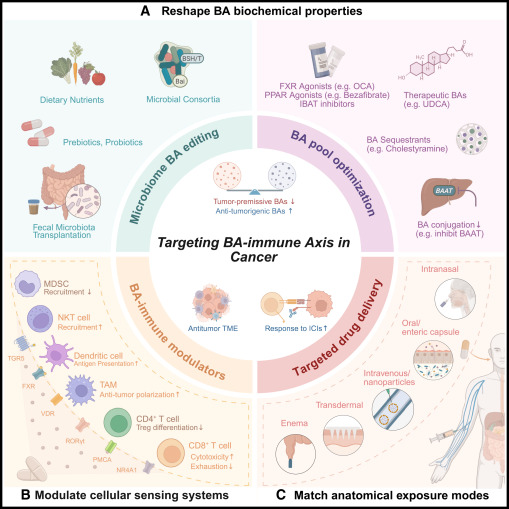
The review identifies several potential treatment strategies, all of which remain investigational in oncology.
Source: Immunity
Reshaping the bile acid pool
Possible approaches include tumor-selective BAAT inhibition, restoration of bile acid efflux from T cells, UDCA supplementation, bile acid sequestrants, and inhibition of the ileal bile acid transporter.
Broad depletion may not be safe or beneficial, however, because some bile acids may support immune surveillance or normal intestinal function.
Modifying the microbiome
Microbiome-directed strategies could alter bile acid output by targeting bacterial functions rather than simply eliminating individual species. Possible approaches include defined microbial consortia, fecal microbiota transplantation, engineered bacteria, and dietary interventions.
The challenge is that bile acid production depends on microbial community structure, diet, host physiology, and available substrates.
Targeting bile acid receptors
FXR and TGR5 are potential therapeutic nodes, but their effects differ across tumor cells, fibroblasts, myeloid cells, hepatocytes, and lymphocytes. A receptor intervention that helps one compartment could harm another.
Cell-selective or tissue-selective delivery may therefore be necessary to limit systemic metabolic adverse effects and other complications such as pruritus.
What remains unknown
Most mechanistic evidence comes from mouse models, cell cultures, organoids, and observational human studies. The field still needs to determine:
Which bile acid species directly cause immune suppression.
Which receptors or stress pathways mediate their effects.
Whether blood and stool signatures are causal or simply markers of disease.
How diet, medications, microbial enzymes, and circadian rhythms alter exposure.
Which patients and tumor immune phenotypes are most likely to benefit.
Whether bile acid modulation improves checkpoint-inhibitor outcomes in humans.
A major goal is to develop species-resolved and compartment-specific bile acid profiles that can guide treatment selection.
Source: Immunity
