


The severity of antibiotic resistance is confirmed by daily clinical practice, where therapies aimed at pathogen elimination often end in failure. However, the root of the problem is not solely the genetic resilience of bacteria. The primary obstacle is created by their collective defense mechanisms, known as biofilms. This structure represents a physical barrier for therapeutic agents and prevents them from penetrating to their target points.
To dismantle these complex structures, a new copper-based compound, BMDC (N-benzyl-N-methyldithiocarbamate), was created. It serves as an effective alternative against pathogens that exhibit resistance to vancomycin and other standard antibiotics.
Mechanism of Action of BMDC
The principle of BMDC’s action is based on the active transport of copper ions inside the bacterium. It acts as a conductor that sharply accelerates the penetration of the metal into the pathogen’s cytoplasm.
Research has shown that when using this compound, intracellular copper levels increase 70-fold within 30 minutes. The high concentration of metal within the bacterium induces powerful oxidative stress. The increase in peroxide levels destroys vital proteins and dismantles the cell structure.
This process leads to the complete collapse of the bacterium’s energy. Cellular energy levels drop by 84-90%, depriving the pathogen of its ability to reproduce and manage vital functions.
Study Details
Within the scope of the study, the effectiveness of BMDC was evaluated in combination with metals such as copper and zinc. The primary targets were methicillin-resistant Staphylococcus aureus (MRSA) and Staphylococcus epidermidis—pathogens responsible for the development of pneumonia, systemic blood infections, and implant-associated complications.
In laboratory conditions, metal-BMDC compounds showed high efficiency. The copper-BMDC complex instantly halted the growth of free-floating MRSA and maintained the population at a stably low mark for 24 hours. The zinc-BMDC compound also demonstrated powerful bactericidal action.
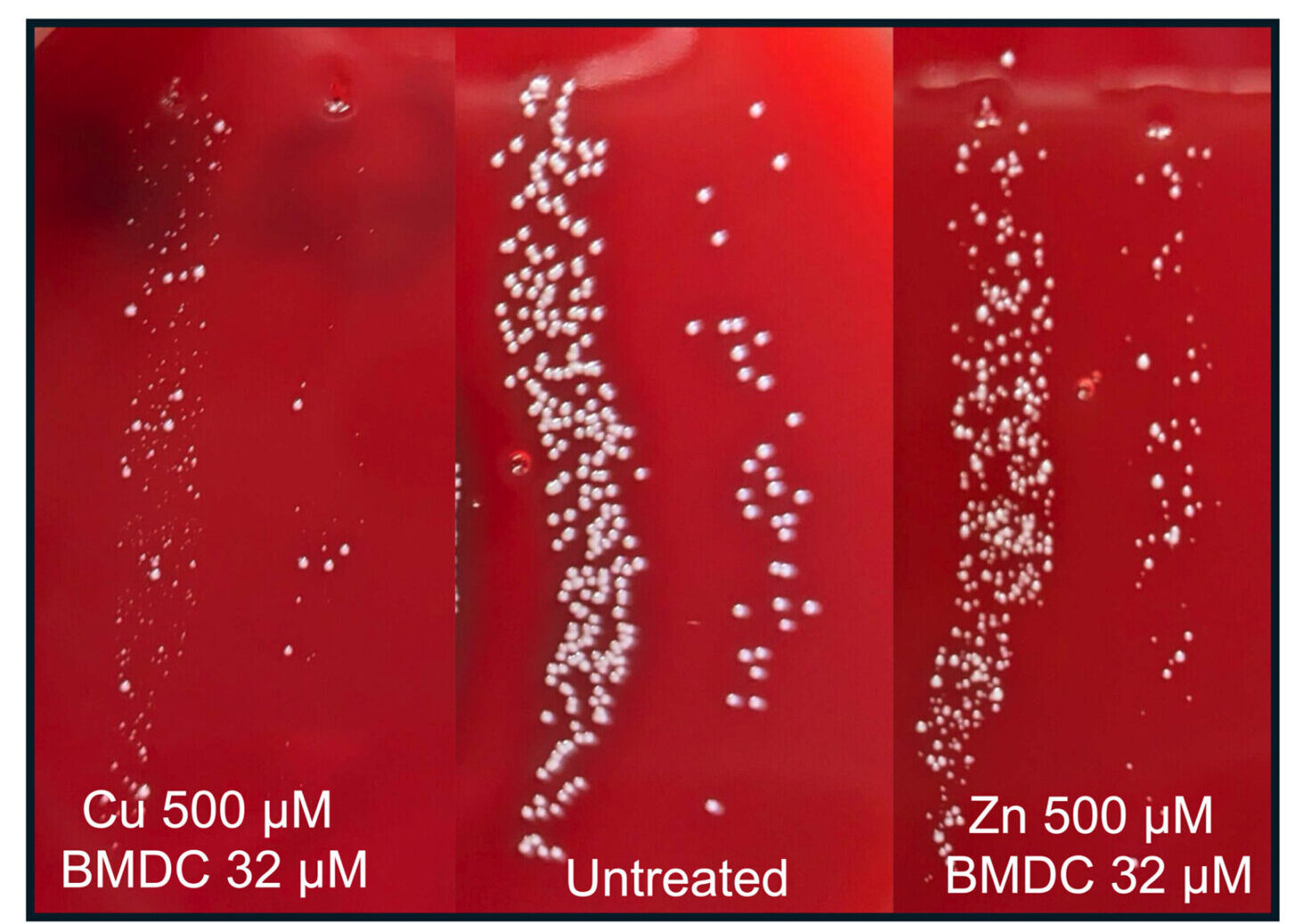
In mature biofilms, the bacterial mass was reduced by 64-87%, and the number of living cells dropped by 99.9%. The combination with vancomycin is also interesting: copper-BMDC and the standard antibiotic exhibited powerful therapeutic synergy. This combination achieves maximum effect with small doses, which excludes toxic damage to the kidneys.
The laboratory study showed that the copper-BMDC complex is capable of effectively dismantling bacterial biofilms. However, the next stage is clinical trials, which must confirm the safety and efficacy of the compound.
Source: American Society for Microbiology
