


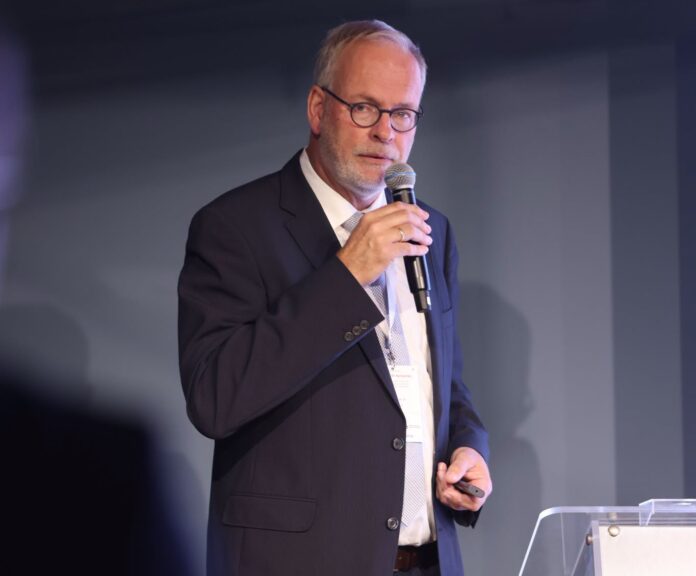
On November 5-6, 2026, the University of Georgia in Tbilisi hosted the international workshop “Strengthening One Health Networks: Advancing Strategic Cooperation Between Georgian and European One Health Sectors.” The symposium brought together clinicians, epidemiologists, veterinarians, environmental microbiologists, and policymakers from across the Caucasus and the European Union to bridge the systemic divide separating human healthcare, animal health, food safety, and environmental protection.
Among the keynote guests was Dr. Arjen van de Giessen, President of the European One Health Association (EOHA) and Head of the Centre for Zoonoses and Environmental Microbiology at the National Institute for Public Health and the Environment (RIVM) of the Netherlands. With a career spanning four decades at the forefront of bacterial zoonoses and infectious disease surveillance, Dr. van de Giessen has been instrumental in building operational frameworks that translate cross-disciplinary science into national preparedness and international policy.
In this conversation, Dr. van de Giessen reflects on what it truly takes to move One Health from an academic ideal into administrative reality. Drawing on hard-won European lessons – from missed outbreak signals to the politics of antimicrobial stewardship – he explores what happens when surveillance stops working in isolation and begins holding different sectors accountable to one another.
You work at the interface of zoonoses, environmental microbiology, and also cross-domain research. What drew you first to One Health, to this concept, and how has your understanding of this approach evolved over your career ?
Well, my career has already spanned almost forty years mainly in bacterial zoonoses. In fact, One Health collaboration between public health and veterinary institutes was part of my research from early on. For instance, we worked closely with the poultry sector to combat and investigate Salmonella and Campylobacter.
Of course, nowadays there are vast challenges. We know very well that the connection between public health, animal health, and the environment is real, but it is also fragile. It is critical to recognize that this balance can be disrupted by global changes: environmental shifts, climate change, biodiversity loss, pollution, transitions in food production systems, and widespread land-use changes. All of these pressures disturb the interconnections between humans, animals, and the environment.
Because of this, a multidisciplinary, cross-sectoral One Health response is essential. Where One Health used to mean bilateral collaboration between veterinary and public health disciplines, it has broadened into a comprehensive picture. Environmental expertise is now indispensable because environmental health underpins the entire framework. Social equity and fairness are equally important; solutions must be equitable across all sectors of society.
The concept has evolved significantly. Long recognized within the scientific community, it is now gaining genuine traction among policymakers, which is precisely what is needed. Moving into policy is a real institutional challenge because ministries traditionally operate in rigid silos – public health, agriculture, environment – and are unaccustomed to seamless cross-sectoral collaboration. Research communities have integrated much faster. Today, the imperative for ministries and political leaders is to embed this collaborative mindset into administrative practice.
We observed this momentum across Europe, notably at the Copenhagen conference under the Danish EU Presidency, where policymakers drafted concrete cross-sectoral recommendations for their peers. Earlier this year, President Emmanuel Macron hosted a global One Health Summit in Lyon, bringing together heads of state and major international bodies to commit to worldwide implementation. One Health is now seen as an indispensable strategy to overcome institutional fragmentation and manage current global environmental and health crises.
You have also contributed extensively to early warning systems for zoonoses in the Netherlands. What makes an early-warning signal credible enough for public health authorities to take concrete action?
There are defined criteria. When a signal emerges regarding an emerging zoonosis, it rarely stays confined; it touches both animal reservoirs and human populations. Pathogens are often circulating within animal populations under active veterinary monitoring. That intelligence must be communicated early to human health specialists.
This requires institutional collaboration. In the Netherlands, we built what is known as the National Zoonoses Structure. Every month, human public health experts and veterinary professionals convene to table, debate, and risk-assess early warning signals. Often, no emergency action is required because routine monitoring and control protocols – for example, regarding avian influenza – manage the situation adequately.
However, novel pathogens inevitably emerge that fall outside established statutory frameworks, demanding exceptional coordination. Policymakers must be tied directly into these technical assessment loops.
Our experience with the large Q-fever outbreak in the first decade of this century demonstrated this sharply. Coxiella burnetii was detected in livestock, while general practitioners were simultaneously reporting unexplained cases of pneumonia in patients. Initially, the clinical and veterinary links were not made in time. Connecting those separate signals took too long. Once the connection became clear, joint interventions followed, but our goal ever since has been to prevent such delays by establishing permanent institutional platforms where cross-domain signals are identified immediately.
I also want to explore genomic surveillance, given its expanding role. What does genomic surveillance mean in practical terms, and how can we translate sequencing data into actionable public health interventions?
Surveillance is increasingly driven by molecular genomics. In my early career, we relied on traditional phenotypic methods such as serotyping and phage typing. Today, pathogen characterization relies on whole-genome sequencing (WGS) or targeted genomic typing.
The primary advantage is that sequence data can be integrated into shared international and inter-agency databases. With computational tools, isolates from human clinical cases, veterinary samples, food products, and environmental matrices can be compared side-by-side in real time.
This enables investigators to detect hidden transmission links that standard epidemiological methods would miss. In influenza surveillance, for example, Dutch databases track strains identified in poultry, swine, and humans. Certain animals, particularly pigs, can act as a ‘mixing vessel’ for influenza viruses, creating a risk that reassortant viruses may emerge which could pose a risk to public health. Real-time genomic comparisons allow epidemiologists to identify potential zoonotic reassortants early and implement targeted containment measures. Shared, interoperable sequence repositories transform surveillance from passive historical logging into real-time risk mitigation.
Could you also comment on antimicrobial resistance (AMR) through the lens of One Health? We frequently view resistant infections solely through a hospital or human diagnostic lens, overlooking external reservoirs.
AMR is arguably the single clearest demonstration of why One Health is non-negotiable. Novel resistance genes can emerge in food-producing animals exposed to selective antimicrobial pressure and subsequently disseminate through the food chain, direct contact, or runoff into human environments.
In the Netherlands during the early 2000s, this reality triggered a nationwide strategic shift between veterinary and public health authorities. We instituted binding cross-sectoral policies to restrict and preserve critical classes of antimicrobials. The veterinary use of highest-priority critically important antimicrobials – drugs essential for treating severe human infections – was strictly prohibited or phased out.
If identical antimicrobial classes are used indiscriminately across veterinary and human medicine, resistance selection intensifies and therapeutic options for clinical medicine evaporate. A One Health approach establishes transparent inter-sectoral agreements delineating which compounds can be administered in agriculture and which must be protected strictly for human clinical care.
Food safety sits at the intersection of agriculture, trade, public health, consumer behaviour, and the environment. How would you evaluate the actual severity of the food safety situation today? How can food-safety policy become more preventive rather than reactive?
Global changes, such as increasingly complex food supply chains, agricultural intensification, rapidly changing food systems, consumer behaviours and dietary habits, aging populations and climate change, create new food safety challenges and call for a One health approach.
Lastly, Georgia is actively strengthening its partnerships with European One Health institutions, as highlighted by this workshop. What should be the core priorities for collaborative initiatives of this kind?
Georgia has shown strong initiative in engaging with wider European and global One Health consortia, which is a very positive foundation. As President of the European One Health Association, I have seen Georgian institutions – such as the One Health Institute of Georgia and the Agricultural University of Georgia – participate actively as committed members. Both OHI, SRCA, and GNHI are members of EOHA.
Personal and institutional connectivity is essential. Experts across the region must build professional networks, exchange methodologies, and establish joint programs. We saw this demonstrated effectively during the session by colleagues from Armenia as well.
Substantive collaboration rests on three pillars: mutual engagement, transparent sharing of scientific data, and the systematic harmonization of diagnostic protocols and surveillance frameworks. That is the practical purpose of these bilateral workshops.
