


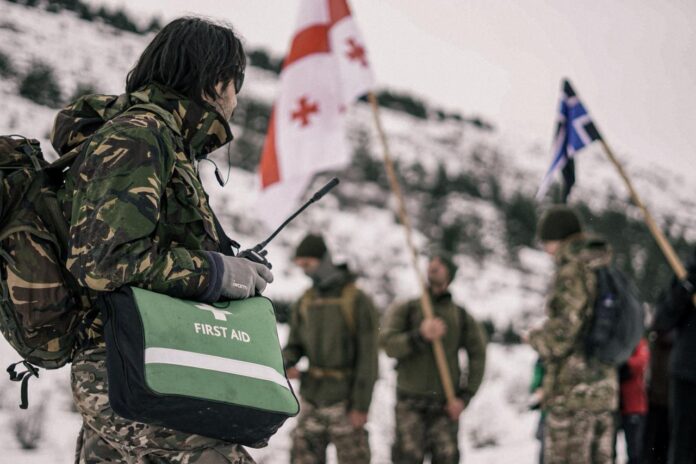
This has become an especially topical issue. Security challenges in the region, natural disasters, road accidents, and crisis situations remind us once again that survival often begins in the very first minutes, where professional medical assistance has not yet arrived. Meet the General Giorgi Mazniashvili Youth Legion, which for many years, through pure enthusiasm, has been engaged in spreading basic knowledge—including field medicine—among youth, fostering a patriotic spirit and the idea of an honest citizen.
The General Giorgi Mazniashvili Youth Legion is a volunteer organization founded in 2013, which has managed to train thousands of Georgian citizens. One of the main directions of the organization is field medicine and providing basic medical aid knowledge to cadets. To speak on this topic, Medscriptum contacted the head of the Legion’s medical section, physician Davit Nartyoshvili.
What purpose does the Legion serve and what path have you traveled?
“The Legion was ideologically conceived in 2007-2008 and officially founded in 2013. Its main goal is to ignite a patriotic spirit in youth and form responsible citizens. The idea is to bring ideologically strong, responsible, and law-abiding people together in one space so they can find themselves and each other. We put maximum time and energy into interesting more young people in these activities because, while they have the time and are still forming, they can acquire many more skills and learn to dedicate their free time to this and subsequently to the country—rather than to the streets, uneducational computer activities, or other harmful habits. We put maximum resources into helping them develop themselves and giving them a healthy foundation to form into real professionals and face life’s challenges with dignity.”
Initially, the organization was focused on youth aged 14-18. “We wanted to replicate the European experience. Where there is a high volunteer culture, everything starts at a young age; it is at this age that values and interests are formed, and a healthy environment defines the face of the future citizen. In subsequent years, the Legion expanded its age limit and today unites volunteers up to 50 years old. Representatives of practically every field are present with us, which makes me very happy because it is an opportunity for individuals with shared interests to share ideas, receive advice from experienced people, and even work together professionally.”
Basic Medical Training — International Experience
“The Legion’s basic course is conducted under a unified standard, both in Tbilisi and in the regions. Our goal is for the cadets to learn the skills that an ordinary military infantryman learns. The training includes: management of massive hemorrhage (with tourniquets and packing), airway control, trauma recognition, and evacuation of the injured to a safe zone—elementary skills that, in various critical situations, avoid bad outcomes. This standard fully complies with modern Western approaches, as years ago we specifically contacted the U.S. Department of Defense’s medical department and translated their guidelines into Georgian, adapting them to the local reality. Although a Legionnaire may not encounter a critical situation daily, they are given a solid foundation that they can always review and recall through our video instructions, which are publicly available on the YouTube platform.”
Development Beyond the Basics — Educational Programs
The medical section is not limited to basic first aid. After the basic course, if interested, volunteers can undergo programs such as:
-
BLS (Basic Life Support);
-
TECC/TCCC (Tactical Emergency/Combat Casualty Care), at the levels of individual fighter, combat lifesaver, and combat medic;
-
Bleeding Control Course, based on the official program of the American College of Surgeons;
-
ACLS (Advanced Cardiac Life Support).
A subsidiary of the Legion is the Center for Extreme Medicine, which issues official certificates for STB and TECC programs as an educational partner of these organizations. Regarding cadets who come as permanent members of the section, our main goal is to prepare personnel who will provide medical support to the Legion’s basic courses and camps. Here, training moves to a higher level: trauma management, general first aid, and protocol-based decision-making. It is especially noteworthy that recently the section has significantly expanded its range of practical skills, made possible by the appearance of new tools and resources, such as intubation, cricothyrotomy, wound treatment, and others.
Challenges — Time and Resources
“Like all volunteer organizations, the Legion faces challenges associated with a shortage of finances and resources. But when you are called a volunteer, you must be reconciled to the fact that you must provide for yourself; it is the same in other successful European examples. Such organizations exist in Poland, the Baltic countries, Finland, Sweden, and others. One of the secrets of their success is precisely that authenticity and unity around an idea is the axis that maintains the organization. Otherwise, I would probably single out the problem of time most of all. Since daily life requires its share of time and responsibility, it is difficult for me and other like-minded people to give ourselves fully. It is difficult to shame others and demand they put in their own time and energy; perhaps that is why those who came to the organization at a very young age and made this work a lifestyle are more active.”
What are your safety standards for cadets during training?
“The organization’s priority is indeed that nothing happens to the cadet during the basic training period.” Therefore, strict screening of health conditions takes place. Diabetes, heart defects, chronic asthma, and other serious chronic diseases become grounds for refusal because “there is always a risk that strong physical exertion could create a problem for life, so we hedge risks as much as possible. Attention is also paid to flat feet, allergies, and other chronic conditions, and decisions are made after their review. In any case where a minor incident has occurred during field training, we follow the cause and problem to the end so as not to miss anything.”
State and Volunteer Crisis Management
The Legion cooperates with the LEPL “Defense Volunteer,” which creates a legal and institutional basis for placing its activities within an official framework. This format ensures the integration of resources and the possibility of using the skills and capabilities of Legionnaires in an organized manner during crisis situations, whether these are forest fires, landslide processes, or other emergency cases (for example, events of the scale of the Shovi tragedy). As a result of this cooperation, the Legion will have the opportunity to act officially in coordination with the relevant state structures, which increases efficiency, accountability, and operational readiness. The final result serves the country’s interest and public safety, rather than the goals of specific individuals. This is precisely the basic principle and purpose of our organization.
What would you say to your colleagues who might be interested in such activities?
“Representatives of the medical field in every developed country constitute one of the most important parts of the nation, based on their role and education. A professionally and intellectually active medical sector is only beneficial for the country’s development. I would advise doctors to take an interest in the Legion not only as a military organization but as a platform. The Legion is a space where professionals can share their knowledge and develop many very useful practical skills. Just as learning is possible until old age, it is also possible to share and teach others what might prove decisive in saving a life somewhere.
To the youth, I would say that this is an opportunity to get into a healthy space where many paths open up for you to develop yourself, learn, teach, acquire like-minded people, and even potential future colleagues.”
Today, when knowledge of first aid can be the line between life and death, the Legion’s medical section creates a platform where volunteerism and professionalism merge. This is not just military-style training; it is a model of civic responsibility, medical readiness, and community empowerment that is gaining more and more importance in the reality of Georgia.
