


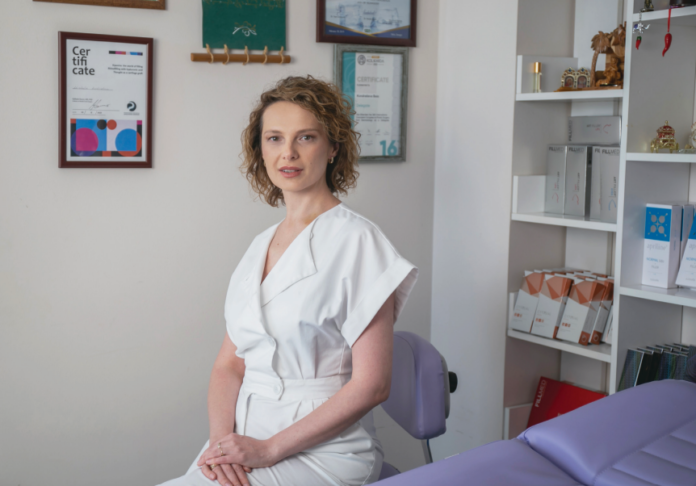
Once considered a luxury in Georgia, aesthetic medicine has evolved into an independent, fast-moving, and highly technological field, attracting more people every year. But this rapid growth has also brought challenges that require careful and critical attention. To better understand this transformation, we spoke with Dr. Baia Kondrateva, an aesthetic physician with fifteen years of practical experience in both the Georgian and international markets.
Over the past fifteen years, the field has changed dramatically in Georgia. Kondrateva remembers a time when high-risk procedures and a lack of professionalism were common features of everyday practice. There was little clinical research to rely on, and many practitioners worked without clear evidence-based guidance. Today, the picture is very different. As international experience has accumulated, physicians have moved away from procedures that were once performed with relative ease despite their risks, including nasal filler correction and filler injections in the glabellar area, both of which are now known to carry serious vascular complications. Photos: Ana Boko
At the center of Kondrateva’s approach is the belief that aesthetic medicine should be held to the same standards as clinical medicine. In her view, a procedure should never be treated simply as a way of fulfilling a patient’s request. It must be based on a careful analysis of anatomy, physiology, and potential risk. “The benefit must outweigh the risk” is the golden rule she follows in her own practice, and one whose absence she observes with concern across the wider market.
A Field Without Rules One of the most pressing problems in Georgia’s aesthetic medicine sector is the absence of rigorous regulation. Competencies are frequently ill-defined, leaving the field operating at what can only be described as a salon level rather than a medical one. It was precisely to address this gap that the Georgian Aesthetic International Association (GAIA) was established, of which Kondrateva serves as a board member. The association’s goal is to unite professionals and develop unified medical protocols.
With her active involvement, GAIA is working to define clearly which practitioners are permitted to perform which types of procedures. Her efforts are directed at bringing aesthetic medicine out of an unregulated space and into a proper medical framework, one in which patient safety and practitioners’ legal rights are both protected.
International Expertise, Brought Home Kondrateva also serves as a knowledge conduit between international institutions and Georgia. As an international trainer for global brand, the French company Fillmed, she systematically attends world-class conferences, aiming to receive the latest information from global experts at least five times a year and to share that knowledge with Georgian colleagues.
Among the innovations she follows most closely in skin care and anti-aging medicine, she singles out several that she considers significant advances in the field:
-
Polynucleotides (PDRN) and exosomes: She notes that these newer preparations work exceptionally well in anti-aging therapy. In her assessment, they are considerably safer and more promising than some of the older methods they are displacing.
-
Dermapen: She highlights this technology as a <> and, particularly recommends it for treating conditions such as post-acne marks and scarring.
She is currently introducing innovative, well-evidenced approaches, including polynucleotides and exosomes, which represent a new frontier in anti-aging medicine. Her approach to innovation is always critically grounded: something new must be not merely fashionable, but clinically justified and safe for patients.
Shaping the Law Central to this work is close collaboration with the Ministry of Health. Kondrateva is actively involved in drafting legislation that draws on international models, specifically British and American experience. She cites the English seven-level training model as one reference point, and the American standard under which certain procedures may only be performed by licensed medical personnel, as another. These frameworks provide a basis for Georgia to bring aesthetic medicine under a coherent legal framework.
The existence of legal regulation and clinical protocols serves the safety of both parties: practitioner and patient alike. When a specialist operates within a state-recognised protocol, they are afforded a degree of legal protection in the event of a complication, provided that there is no evidence of negligence on their part. At the same time, the patient feels better protected knowing that their health is in the hands of a licensed and competent professional. In today’s reality, where the sector operates largely without regulation, even a legal dispute is difficult for a patient to pursue because many practitioners work without any official license at all.
Awarded, but Grounded The logical continuation of Kondrateva’s professional achievements was the international award she received at a physician’s awards ceremony in 2025. Yet she responds to this recognition with characteristic modesty, noting that the greatest reward for her remains the trust of satisfied patients and colleagues.
For Kondrateva, aesthetics and ethics are inseparable. She frequently challenges prevalent myths and resists patients’ irrational requests. In her view, a specialist must be prepared to decline a procedure if it is anatomically unjustifiable, regardless of what the patient asks for.
Georgia’s aesthetic medicine sector is at a turning point. The existence of practitioners like Baia Kondrateva gives reason for optimism that this field will eventually mature into a medical discipline defined by a high level of professional responsibility. Her work, from individual patient care to legislative advocacy, serves a single goal: that Georgia should become a country in which beauty and health are understood as genuinely inseparable.
Author: Nini Jalabadze
Photo: Ana Boko Lordkipanidze
