


The rapid development of Artificial Intelligence poses a threat to many professions, and science is, of course, no exception. Nature magazine surveyed more than forty researchers from both academic and industrial sectors to determine how real the prospect of AI replacing scientists truly is.
Which positions are at risk?
Most researchers agree that the advancement of AI has already significantly reduced the demand for specialists involved in coding or basic data analysis—tasks that were typically performed by students and early-career scientists.
For instance, Xuanhe Zhao, an engineer at the Massachusetts Institute of Technology (MIT), notes that the disappearance of certain roles in computer modeling is already a reality, as technology performs these tasks far more efficiently.
This trend has also affected fields adjacent to science, particularly technical translation, where the number of employees is sharply declining. This is evidenced by the American Translators Association, whose Science and Technology Division has seen a 26% decrease in membership over the last two and a half years.
Which positions remain in the “safe zone”?
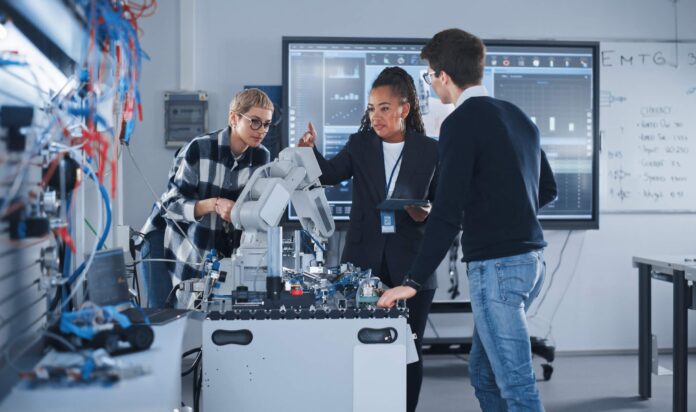
Some scientists believe that positions requiring laboratory work and hands-on experimentation are currently more protected. Robotic systems are still unable to perform complex physical tasks or interpret results with human-like precision.
The activities of senior scientists, which involve organizing and coordinating research projects, are also considered relatively safe. However, economist Anton Korinek warns the public that “purely cognitive tasks” will be the first to be hit and will be fully taken over by AI in the near future.
“Purely cognitive tasks” refer to intellectual processes that require only thinking, logical reasoning, and information processing, without the need for physical intervention.
Scientists warn that if entry-level specialists and technicians lose their places in laboratories due to the automation of basic work, it will break the chain of progression on the scientific career ladder. Claus Wilke, a biologist at the University of Texas, believes that while the volume of research may temporarily increase thanks to AI, the price will be a collapse of scientific resources and a long-term decline in the field.
Future Perspective
Although technology successfully handles text editing and code generation, its main limitation remains a lack of innovative ideas. Quantum physicist Jonathan Oppenheim notes that while AI is useful for the critical review of papers, it is not yet capable of independently generating entirely new, original scientific ideas.
According to expert assessments, the ultimate solution lies in adaptation. Scientists agree that AI does not diminish the role of the scientist but rather forces them to shift toward complex tasks where humans still hold a “comparative advantage.” As mathematician Terence Tao explains, adapting to inevitable changes is a prerequisite not only for survival but for achieving a new kind of success.
