


Dementia is one of the most daunting challenges of the modern era, threatening the independent lives of millions worldwide. Statistics show that every three seconds, someone on Earth develops dementia, and by 2050, the number of people living with this diagnosis is expected to reach 150 million.
In response to this escalating global crisis, the British startup CrossSense has developed a new technology designed to help those with dementia regain their lost independence. At the heart of this innovation is a virtual assistant named Wispy, which uses a camera and microphone integrated into smart glasses to analyze the user’s environment in real time.
Through voice and visual cues, the smart glasses assist users with daily tasks such as locating household items, boiling a kettle, or communicating with loved ones. For this breakthrough, the startup was awarded the prestigious British Longitude Prize on Dementia, receiving 1 million pounds sterling.

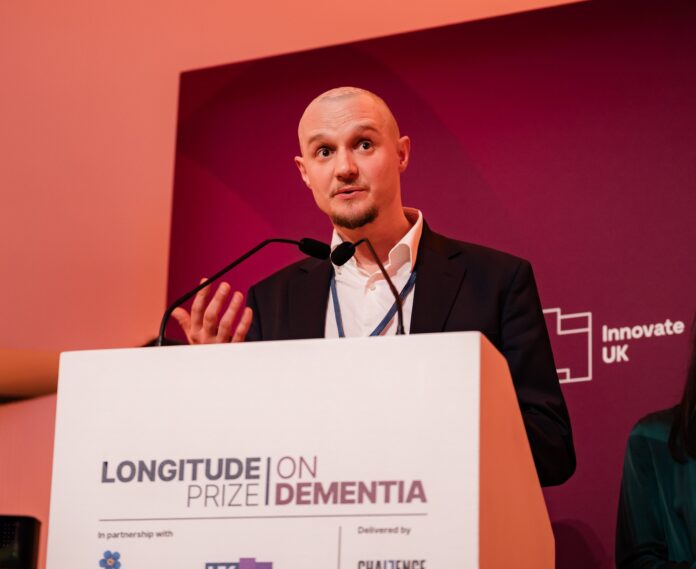
We spoke with Szczepan Orlins, the CEO of CrossSense, regarding the implications of this breakthrough technology. In our discussion, Orlins elucidates how artificial intelligence has transformed a visionary concept from a decade ago into a sophisticated technological reality. He further examines the specific strategic and regulatory hurdles the startup must navigate to secure a definitive foothold in the global market.
What originally inspired you to create CrossSense? Was there a particular moment, personal experience, or story that made you realize this problem needed solving?
Our inspiration for CrossSense stemmed from research around synaesthesia – an experience where one sense is activated by another simultaneously. We discovered that by connecting different senses (e.g., associating names with colours) the brain could build new pathways or strengthen existing ones, making it more resilient.
This realisation happened around a decade ago, a time where Alzheimer’s research and clinical breakthroughs seemed to have stalled. Coupled with some of our team members having personal experience with dementia, this inspired our vision. We knew smart glasses could be a perfect device to deliver CrossSense – however the technology wasn’t quite there yet.
Over the years, we’ve prototyped various clunky models all the way up to the present day. Alongside rapid developments in AI and machine learning, these wearables have become light and powerful enough to make smart glasses like CrossSense possible.
Your assistant, “Wispy,” doesn’t just give reminders; it actually engages in conversation and reacts emotionally. What made you decide to design it this way, instead of keeping it more functional and task-focused?
Designing Wispy as an interactive and conversational AI companion provides cognitive stimulation to get people living with dementia thinking, talking and imagining which helps to maintain neural connections, improve quality of life and slow cognitive decline.
The technology is designed to augment the user’s life, supporting their existing way of living harnessing multi-sensory processing – the brain’s ability to integrate and input from multiple senses, such as sight and sound which are essential for daily tasks.
Working with the University of Sussex, we found that as well as improvements in naming objects, users significantly improved in other cognitive abilities in short-term and working memory (digit recall) and visual-spatial understanding – which is why it has been designed this way.
From your early testing, what was the most unexpected way people with dementia interacted with CrossSense?
In addition to being able to name objects while wearing the glasses, we were delighted to see that the cognitive and functional effects often persisted after the glasses had been taken off. During testing, some people living with dementia explicitly credited the glasses for their ability to identify an object after removing them.
Unlike a lot of AI products that are currently on the market, during co-creation sessions we discovered that people with lived experience rejected the requirement of a ‘call word’ to activate an assistant. They found the trigger requirement quite unnatural which led us to develop CrossSense in a way that allows for spontaneous conversation with our AI companion, Wispy.
There’s often a gap between promising prototypes and real-world adoption. What do you see as the biggest barrier to people actually wearing and relying on smart glasses like yours every day?
The overwhelming focus of existing ‘dementia tech’ tends to be for the benefit of carers; it is not actually designed to be used by the person living with dementia. While monitoring and sensor technologies can provide carers and loved ones vital piece of mind, they do not help people living with dementia live independently and keep doing the things in life that bring them fulfillment. Often, this is where the barrier to lack of adoption lies.
CrossSense has been co-created with people living with dementia to ensure that it truly empowers the individual – the way they’ve used the prototypes and their feedback has shaped how we have iterated CrossSense in the last two years. While AI should never be used to replace human interaction or in-person care, when used correctly, technology can offer transformative effects.
The AI learns the unique routines of each user along the way, adapting to their needs, offering prompts that enable people to continue doing everyday activities independently and with confidence. Co-creation has and will remain at the heart of CrossSense, helping us overcome potential adoption barriers through offering tested, real-world support for people living with dementia.
Your study showed that some cognitive benefits remained even after users took off the glasses. Do you think this technology could eventually train the brain, rather than just assist it?
While CrossSense has been developed for someone living with dementia, there is the future possibility that the glasses could be used to help people who aren’t diagnosed with dementia but at risk – supporting improved cognition or ‘brain training’.
Working with the University of Sussex, the CrossSense team found that as well as improvements in naming objects, users significantly improved in other cognitive abilities in short-term and working memory (digit recall) and visual-spatial understanding.
A key concern raised by experts is privacy and consent, especially since the system continuously processes real-world data. How are you approaching this challenge in a way that builds trust with both users and their families?
CrossSense ensures that data collected is anonymised and strictly protected, using encryption and a secure data centre located in the UK. It does not share or sell any data collected by the glasses and will not in the future.
Our participation in the ICO Regulatory Sandbox – a controlled environment where organisations can test innovative products like CrossSense using data under the supervision of the UK data protection authority – reinforces these standards, making sure data protection is built into solutions like ours from the outset.
This “data protection by design” spots privacy risks for both users and people around them, making sure this information is still accessible for people living with the early stages of dementia.
Some experts point out that assistive technologies often fail not because they don’t work, but because people don’t use them consistently. How are you designing CrossSense to fit naturally into everyday life?
We wanted CrossSense to be as easy to use as possible. Something as simple as popping on a pair of glasses, for example, is an action most people are familiar with and could slot into their everyday routine quite naturally.
However, as everyone experiences dementia differently, we understood the importance of creating a solution that could grow and evolve with someone as their dementia progresses. Thanks to the rapid advances in AI and machine learning, we’re now able to do this – creating technology that works for the person living with dementia and not the other way around.
Wispy, the adaptive AI companion, delivers this type of real-time cognitive support. By asking gentle questions, Wispy understands a person’s unique way of doing things such as making a cup of tea – making it a friendly and helpful companion in someone’s life.
