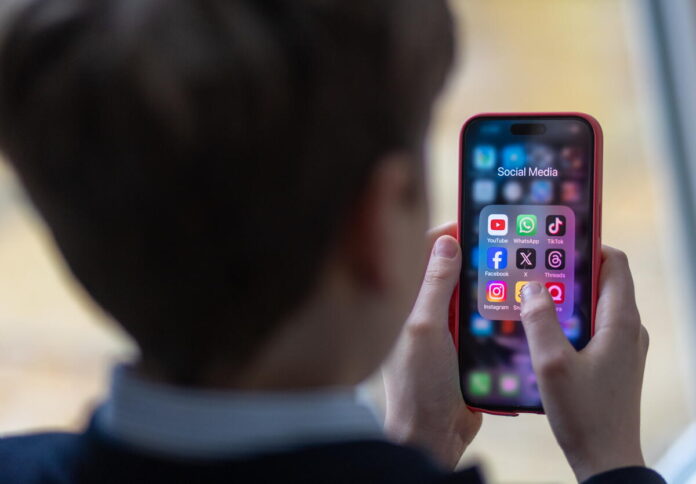
Countries around the world are considering banning social media for children, though its practical effectiveness remains a subject of intense debate. To help resolve this dispute, the charitable foundation Wellcome Trust has launched large-scale research to examine children’s mental health, sleep, and physical activity before and after a ban on social media for under-16s takes effect in the United Kingdom.
The regulation in the UK is scheduled to be introduced in the spring of 2027, with a total research budget of £9.3 million.
“We all know there is a heated debate surrounding the social media ban, both in the UK and globally, yet scientific evidence on how social media and its restriction actually affect young people’s mental health is very scarce,” explains Dr. Camilla Iannone, research lead at the Wellcome Trust.
According to her, these restrictions offer a unique opportunity to evaluate the impact of social media on youth mental health at scale.
“We certainly do not view this as a simple question of whether social media is good or bad, or whether restrictions work or not,” she noted. “On the contrary, the teams will investigate whether altering young people’s digital environment leads to noticeable changes in their mental health and wellbeing.”
Notably, Australia restricted social media use for adolescents under 16 last year, while Canada, Greece, Denmark, and several other countries are working on similar measures.
In the UK, the social media ban for under-16s entails restricting access to platforms such as Instagram, YouTube, TikTok, Snapchat, Facebook, and X. The restrictions will also extend to live-streaming and communication with strangers on gaming platforms.
Opinions regarding the regulations are divided. Some experts and officials fear that the move will harm young people for whom social media is a primary means of socializing with friends, while others believe that children will inevitably find ways to bypass the ban.
One of the projects funded by the Wellcome Trust is Smart Schools Plus, co-led by Professor Victoria Goodyear of the University of Birmingham. Covering 16 schools and 800 pupils across England, the study will examine not only mental health and wellbeing, but also physical activity, sleep, social circles, behavioral issues, academic performance, and school attendance. Researchers will utilize questionnaires, apps, interviews, digital diaries, and other tools.
The team will also investigate whether harmful content—such as material related to self-harm, suicide, and eating disorders—migrates to other online platforms following the ban.
Another project, co-led by Dr. Gemma Knowles of King’s College London, will explore whether the impact of the ban differs among young people across different genders, social classes, and sexual orientations.
Meanwhile, Dr. Alex Kwong of the University of Edinburgh noted that his team will work with families across England, Wales, and Scotland, and will also examine whether teenagers seek out workarounds to bypass the restrictions.
In total, up to ten studies are planned to be conducted with funding from the Wellcome Trust.