


In the first half of the last century, the introduction of effective means to fight bacteria created the illusion in society of a complete victory over infectious diseases. At that time, it was unlikely to predict that this achievement would facilitate the formation of antibiotic-resistant “superbugs” and, inadvertently, “help” them refine their survival mechanisms.
The appearance of penicillin laid the foundation for the antibiotic era, which turned previously fatal pathogens into manageable problems. However, this scientific triumph led to an underestimation of evolutionary processes. The bacterial world, with its long history, maintains a unique ability for genetic adaptation and data exchange.
The mass use of antibiotics created strict selective conditions for these microorganisms, facilitating the survival and spread of resistant forms. As a result, we have received an “accelerated course of evolution,” where bacteria have “learned” to neutralize the action of antibiotics and break down their molecular structures.
The World Health Organization (WHO) 2025 report describes the critical phase of this global crisis. The document emphasizes that antibiotic resistance is no longer limited to clinical challenges; simultaneously, it poses a threat to global biosafety and economic stability.
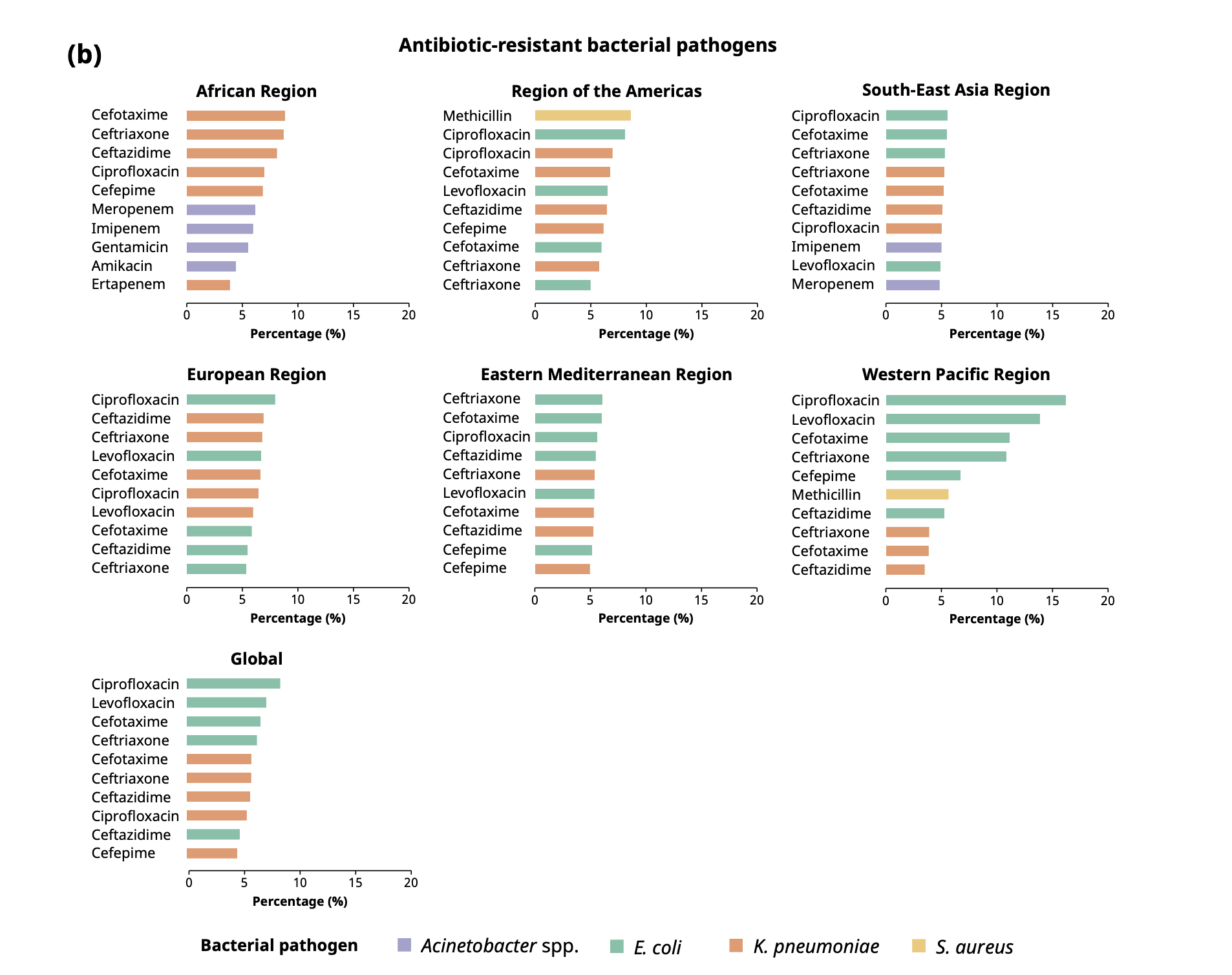
According to the report, the spread of multi-resistant strains returns modern medicine to an era where even a simple bacterial infection could become a fatal and insurmountable barrier. Against this background, the solution lies not in the search for new, more aggressive cytotoxic agents, but in the radical reconstruction of the bacterial genome. In this process, the CRISPR system performs a decisive function. It can strip bacteria of the genetic information that determines the formation of multi-resistant strains.
Why Fight Resistance at the DNA Level?
Bacterial resistance is formed through both chromosomal mutations and horizontal gene transfer (via the exchange of plasmids). Traditional strategies focus primarily on the synthesis of new pharmacological agents or the fragmentation of target genes via CRISPR-nucleases. However, the standard methodology, based on the “catch and destroy” principle, exhibits low efficacy in conditions where plasmids exist in a high number of copies.
In response to the existing challenge, UC San Diego‘s research group developed the “Prokaryotic Active Genetics” (Pro-AG) strategy. In this system, CRISPR components are not limited to just cutting out the target gene. Instead, they build a specific genetic instruction, a “guide-cassette,” into the damaged site.
This replacement generates a continuous, self-propagating process. As soon as one plasmid receives this new instruction, it finds other, undamaged plasmids within the cell by itself. As a result, the system spreads automatically: every corrected copy begins editing the others and destroying the resistance code within them.
pPro-MobV: The Genetic “Navigator”
Scientists combined all the necessary components of the system into a single “launch” plasmid. During the research, they discovered a pattern: the system works most effectively when the “launch” plasmid is present in the cell in small quantities, while the number of “target” plasmids is high.
This seemingly paradoxical phenomenon is explained by the fact that when only one or a few “launch” plasmids enter the cell, the system directs its entire molecular resource toward editing the many surrounding “target” copies. During this time, the system does not “scatter” itself on copying its own structure and devotes all its energy to the rapid spread of the self-propagating cassette. Accordingly, the larger the quantitative difference between the few “launchers” and many “targets,” the faster and more perfectly the system manages to erase the resistance code from all plasmids.
Based on this discovery, pPro-MobV was created—a specific carrier (vector) capable of spreading across a wide spectrum of bacteria. Its structure includes three main components:
Molecular “Scissors”: The Cas9 protein and a recombination system responsible for genome editing.
Target “Navigator”: A specific cassette (sgRNA) that directs the system toward a specific resistance gene.
Transmission Mechanism: Functions that help the plasmid move from one bacterium to another.
This system effectively works like a “beneficial infection”: it spreads through the bacterial population and strips them of their ability to resist antibiotics at the genetic level.
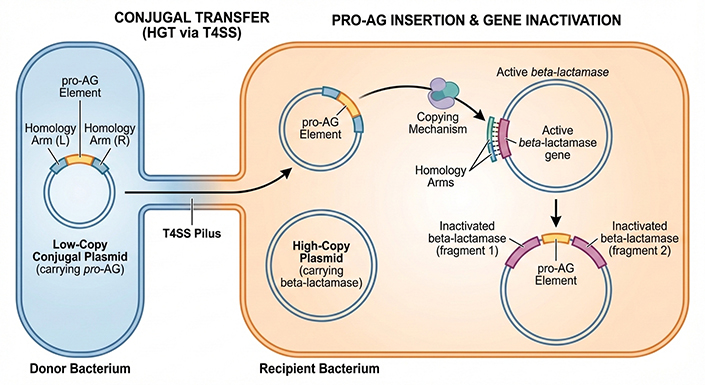
To test the system’s effectiveness, scientists used donor bacteria that transferred the pPro-MobV vector to recipient cells that previously maintained resistance to ampicillin. As a result, the number of ampicillin-resistant bacteria decreased 1,000-fold.
The study showed that this genetic “disarmament” of bacteria is carried out in two different ways:
Insertion: The system does not delete the resistance gene but builds a new genetic “instruction” in its center. This insert causes the gene to lose its function and makes the bacterium sensitive to the drug.
Deletion (HBD – Homology-Based Deletion): After the Cas9 “scissors” cut the resistance gene, the bacterium’s own repair system considers this code redundant. As a result, the microorganism itself deletes the entire section of resistance, finally losing its defense mechanism.
The most innovative aspect of this technology is the reversibility of the process. Thanks to the HBD mechanism, it is possible not only to delete the resistance gene but also to later cut out the engineered code (the cassette) that was artificially built into the bacterium. This means that the restoration of the gene to its original, natural state is fully achieved.
This function makes the process safer. If the spread of genetic changes in the environment causes unforeseen results, scientists can stop the process and return the bacterial DNA to its starting point at any time.
Source: nature
