


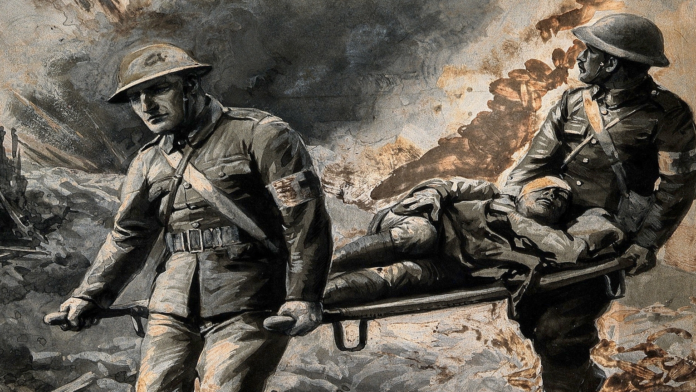
Military medicine is a unique field where scientific progress and human resilience collide amidst the chaos of war. Over the centuries, this discipline has undergone a significant transformation. While the wounded were once left to their fate on the battlefield, today high-tech mechanisms are in place with the primary mission of preserving soldiers’ health and ensuring their full reintegration into society. Interestingly, methods invented during wartime often become an integral part of medicine in times of peace.
At the Roots of Military Medicine
Until the end of the 18th century, wounded soldiers were often left on the battlefield, receiving assistance only after hostilities had ceased. The turning point was brought about by Napoleon’s chief surgeon, Dominique Larrey. He created the so-called “flying ambulance”—special horse-drawn wagons designed to evacuate the wounded directly from the battlefield.
Larrey also established the triage (sorting) system, which remains the foundation of any modern emergency department today. According to this system, the wounded were divided into three categories based on priority: light (those who could soon return to the front), treatable (those requiring urgent surgery), and critical (those whose chances of survival were minimal). This system reached its peak during World War I, when the immense number of casualties turned military medicine into an efficient administrative machine.
The Evolution of Weaponry and Surgical Challenges
As weaponry evolved, so did the nature of wounds. Before the advent of gunpowder, surgeons primarily treated injuries inflicted by swords and spears. However, artillery and firearms created traumas of an entirely new scale, such as mangled limbs and deep wounds contaminated by microbes.
Before the era of antibiotics, infection killed more people in war than weapons did. For example, during the Crimean War (1853-1856), far more soldiers died from diseases (such as cholera and typhus) than in direct combat.
The sanitary reforms implemented by Florence Nightingale during the Crimean War at the Scutari Military Hospital (modern-day Istanbul) brought about a revolutionary change. In an institution overwhelmed by poor sanitation and epidemics, she introduced strict hygienic standards, improved nutrition, and ventilation, reducing the mortality rate from an alarming 41% to just 2%.
Later, during World War II, the mass production of penicillin caused another major shift in medicine. Effective infection control allowed surgeons to perform complex operations on the head and chest—tasks previously deemed impossible and fatal in earlier eras.
Invisible Wounds and Rehabilitation
War does not only leave physical scars. The understanding of mental health in military medicine evolved through a painful journey. In World War I, the term “Shell Shock” was often perceived as malingering or cowardice. It was only later, during World War II, that the term “combat exhaustion” emerged, reducing stigma and acknowledging that “every man has a breaking point.” Today, this condition is known as Post-Traumatic Stress Disorder (PTSD), and its treatment is a priority for military medicine.
War has also brought great progress in physical rehabilitation. The high rate of limb loss led to the development of prosthetics. Of particular note is Dr. Ludwig Guttmann, who founded a spinal injury center after World War II and laid the groundwork for the Paralympic Games, proving that sport is a powerful tool for rehabilitation.
How Military Medicine Changed Modern Healthcare
The legacy of military medicine has had a fundamental impact on modern healthcare, providing numerous achievements that are now an inseparable part of civilian daily life: the triage system used in emergency medicine; plastic surgery, developed by Harold Gillies during World War I to treat severe facial traumas; and mass vaccination and screening methods, originally used for the selection and rehabilitation of soldiers.
Ultimately, the history of military medicine is a vivid reminder that even in humanity’s most critical and darkest periods, the drive to save lives remains the primary engine of scientific innovation.
