


The development of HIV vaccines created a significant diagnostic dilemma: Vaccine-Induced Seropositivity (VISP). VISP means that vaccinated individuals produce antibodies that are virtually indistinguishable from antibodies caused by a real HIV infection using standard testing methods. This can lead to widespread false positive results, causing stress and confusion for patients.
A new study presents a technological breakthrough to solve this problem: a portable Point-of-Care (POC) diagnostic test that simultaneously detects four main HIV markers in 5 minutes. By integrating electrochemical sensor technology and machine learning algorithms, the test can accurately differentiate between active HIV infection and a vaccination reaction.
The VISP Challenge and Standard Tests
Prophylactic HIV vaccines work by prompting the immune system to produce antibodies against key HIV protein components (gp120, gp41, p24)—the same targets that standard diagnostic tests look for. As a result, vaccinated but uninfected individuals often receive a false-positive result on antibody-based tests. The frequency of VISP can range from to depending on the vaccine and test used.
Limitations of Standard Tests: Conventional antibody-based tests (ELISA, Western blot, rapid tests) cannot differentiate between vaccination-induced and real infection-induced antibodies. This diagnostic conflict causes severe clinical and social consequences: acute psychological distress, social stigma, prohibition from blood donation, and incorrect clinical management. While RNA-based viral load tests can confirm genuine infection, they are expensive and lab-intensive, limiting their widespread use.
Multiplex Electrochemical Analysis: The Breakthrough
Researchers created a nanotechnology-based, multiplex electrochemical assay capable of simultaneously detecting four target markers:
How the Sensor Works:
Platform: The test uses a high-tech electrochemical sensor platform based on Gold Screen-Printed Electrodes (Au-SPEs).
Sensing: The electrode surface is chemically modified with two types of biomolecular probes: specific antibodies (for protein targets) and antisense oligonucleotides (to capture viral RNA).
Signal Generation: These probes are tagged with Methylene Blue (MB), an electroactive molecule that generates an electrical signal (redox signal).
Detection: When a target molecule (e.g., p24 antigen or viral RNA) binds to the probe on the electrode, it changes the redox activity of Methylene Blue. This is measured by Cyclic Voltammetry as a sharp change in the redox signals, allowing researchers to accurately determine the presence/concentration of the HIV marker in the sample. The electrodes function as highly sensitive sensors, converting a biological event (molecular binding) into an electrical signal.
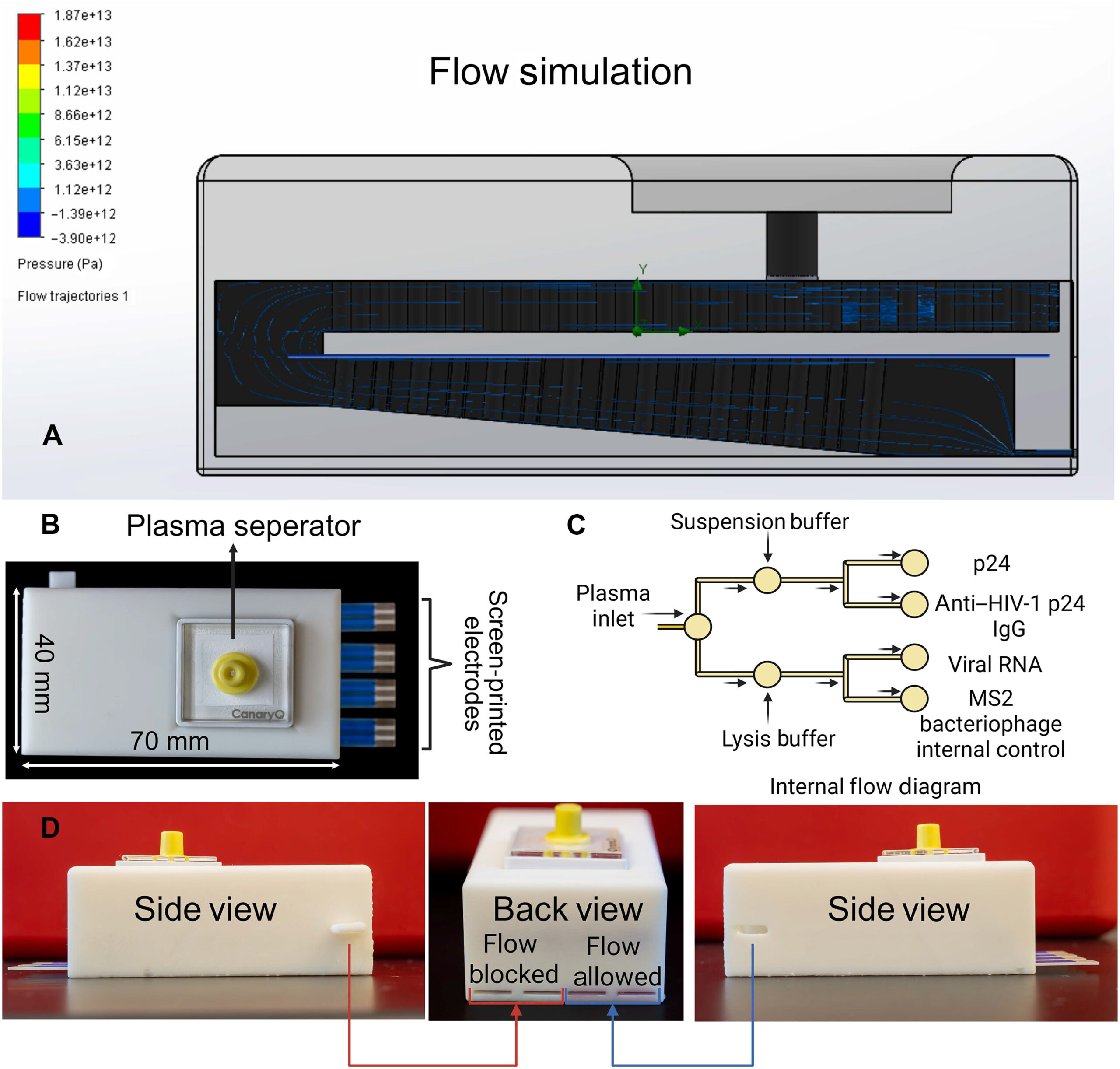
The advantage of this high-sensitivity assay is its simplicity: a smartphone-sized, 3D-printed portable device processes samples after only a 4-minute viral lysis step. This eliminates the need for complex laboratory extraction, making the test an ideal tool for rapid diagnostics in field or resource-limited settings. This innovation fully satisfies the WHO’s ASSURED diagnostic criteria: Affordable, Sensitive, Specific, User-friendly, Rapid and robust, Equipment-free (or minimal), and Deliverable.
Marker Selection and Clinical Validation
Marker Strategy: Viral RNA appears earliest (days after infection), followed by the p24 antigen, with antibodies appearing last. RNA detection allows for the earliest detection in the “eclipse phase,” which antibody tests miss. Plasma RNA testing indicates active viral replication and infectivity.
Sensitivity & Specificity: The analytical detection limit for the p24 antigen () and antibodies () is competitive with or exceeds existing ELISA tests. Crucially, the RNA detection limit reaches with high specificity and no cross-reactivity with related viruses like Zika or Dengue.
Clinical Evidence: Rigorous clinical testing on 104 plasma samples (including HIV-positive, negative, vaccinated, and unvaccinated individuals) confirmed the test’s high efficacy, showing sensitivity and specificity in distinguishing HIV infection from vaccination-induced reactions.
Source: Science Advances
