


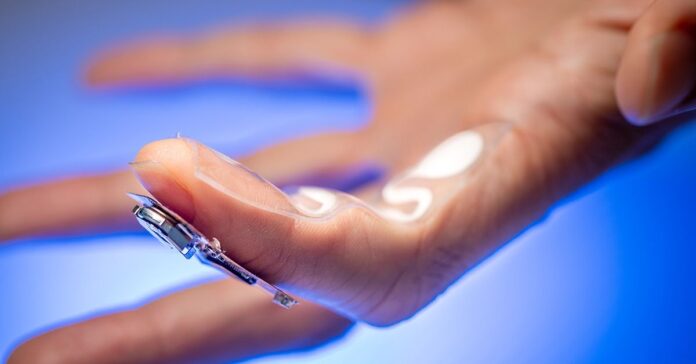
Engineers and neuroscientists at the University of California, San Diego (UC San Diego) have created an innovative, flexible patch worn on the fingertip that measures the concentration of Levodopa—the primary medication for treating Parkinson’s disease—in the body in real time using sweat.
According to the study published in the scientific journal PNAS, the device does not require a battery. It derives energy directly from chemical reactions present in the patient’s sweat. Clinical tests showed that the data provided by the patch is just as accurate as laboratory blood tests, the results of which typically take several days.
Selecting the precise dose of Levodopa is one of the main challenges for Parkinson’s patients: a shortage of the drug causes limited mobility, while an overdose leads to involuntary, abrupt body movements. As the disease progresses, the window of the medication’s effectiveness narrows from several hours down to two hours, and doctors previously had to adjust dosages based on patients’ subjective reports.
A special hydrogel placed on the fingertip absorbs sweat. When the Levodopa in the sweat interacts with enzymes embedded in the patch, it generates a small electrical voltage, which feeds the device on one hand and indicates the exact level of the drug in the body on the other.
The study also revealed that the bodies of Parkinson’s patients eliminate Levodopa significantly faster than those of healthy individuals. According to the scientists, this technology will lay the foundation for an automated system where the patch connects to a specialized pump and automatically delivers the exact required dose of medication to the patient as needed.
