


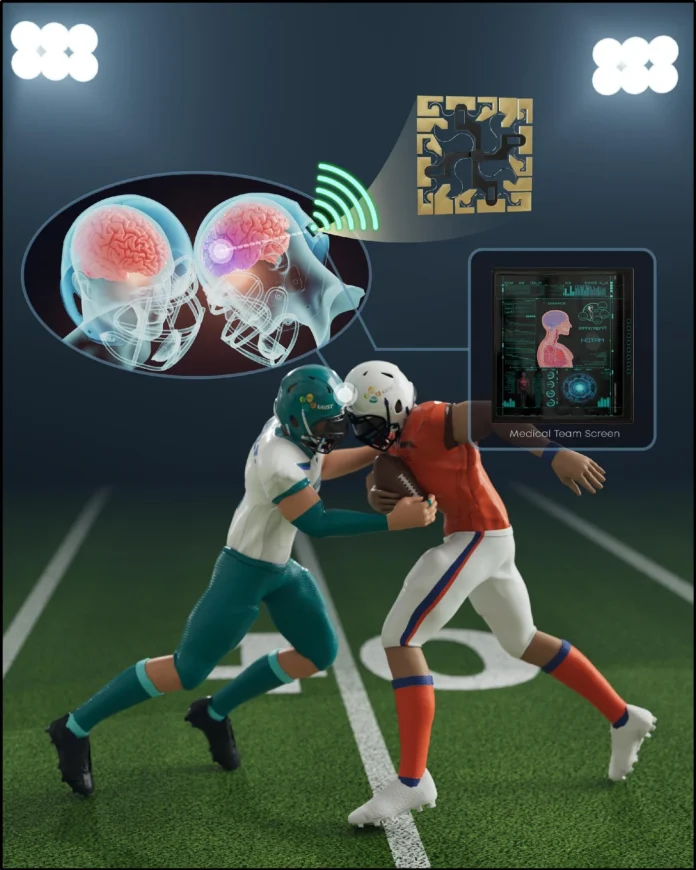
Scientists have developed an innovative, thumbnail-sized sensor capable of instantaneously identifying dangerous impacts to the head. The study, published in the journal Scientific Reports, aims to fundamentally transform safety monitoring standards in sports, the automotive industry, and other high-risk sectors.
How Does the Technology Work?
Developed by scientists at KAUST (King Abdullah University of Science and Technology), the device operates on the principle of a smart detector. Unlike existing analogs that require constant power and quickly drain batteries, this sensor remains in a passive mode, consuming no energy at all until an impact occurs.
During a forceful impact, a mass inside the chip comes into contact with electrodes, closing the circuit and activating the device.
One of the primary advantages of the device is its comprehensive, 360-degree accuracy. The sensor is designed to detect impacts from any angle or direction. This means that regardless of whether the impulse comes from the side, top, or front, the system records it instantaneously.
Furthermore, the sensor is equipped with a multi-level control mechanism. Built-in specialized electrodes allow the device to clearly distinguish between a minor, harmless bump and a serious, life-threatening injury. This feature eliminates false alarms and focuses attention only on real threats.
Another standout feature of the technology is its compactness. The thumbnail-sized housing allows the sensor to be easily attached to any accessory: be it a sports helmet, ski goggles, a construction hard hat, or others.
Future Plans for the Project
For the project’s author, electromechanical engineer Yousef Algosaibi, this technology is more than just a scientific achievement. In 2018, Yousef lost his brother in a car accident. According to Algosaibi, doctors were too late in diagnosing the head injury and internal bleeding. This tragic event pushed the inventor toward this new idea.
The sensor is a sort of “seatbelt for the brain” that protects a person at the most critical moment. Laboratory studies have already confirmed that the sensor responds flawlessly to impacts of the magnitude that cause concussions. To further perfect the technology, the next stage will involve testing the device on crash test dummies to determine how it performs under real, complex conditions.
The final version of the product will be able to send an instant notification to a mobile app upon impact, emit an audible signal, or automatically provide information to coaches, parents, and emergency responders. A patent for the technology has already been granted, and the research team is currently seeking ways to commercialize it with partners.
