


David Kvaratskhelia, Oncology Resident, Todua Clinic
There are moments when medical reality changes so rapidly that you feel the boundaries of your profession have expanded infinitely. For me, attending ESMO AI & Digital Oncology 2025 in Berlin was exactly that kind of experience. It wasn’t just a scientific conference; it was a touchpoint with the future, a future that is practically already here.
Why does this congress hold special significance?
ESMO, the European Society for Medical Oncology, has long demonstrated that modern oncology must be built on clear standards, evidence-based practice, and teamwork. However, the AI & Digital Oncology congress is on another scale entirely. It is a place where an oncologist meets a data scientist, a morphologist meets an engineer, and a clinical mind meets an algorithm.
Arthur Clarke has a well-known quote: “Any sufficiently advanced technology is indistinguishable from magic.” At ESMO AI & Digital Oncology 2025 in Berlin, I felt precisely this, that the “magic” has already become very real. What a few years ago appeared only on the final “future directions” slides of presentations has now become everyday clinical tools.
The congress showcased the full wave of technologies currently entering oncology:
-
Digital morphology – whole-slide scanning of histology specimens, digitization, and algorithmic analysis. This includes quantitative analytics, detailed evaluation of the tumor microenvironment, and immune infiltration.
-
Virtual 3D simulations in morphology – three-dimensional tumor modeling, predicting invasiveness and spread, and visualizing different treatment scenarios. This is no longer just a visual effect, it is data used for decision-making.
-
“Black box” technologies and Explainable AI – how to combine high accuracy with interpretability; how to explain to doctors and patients why an algorithm decided a certain way; what ethical and legal questions arise when AI partly participates in treatment planning.
-
Multi-omics integration – combining genomic, transcriptomic, immunologic, and clinical data into unified predictive models.
-
A strategic vision for digital oncology – what skills tomorrow’s oncologist will need; how “technically literate” a doctor should be; how the education system must evolve.
All of this created the feeling that modern oncology is rapidly transitioning into a new era, where a physician can no longer be just a good clinician. They need technical thinking, at least basic data-handling skills, and a culture of collaborating with AI.
My contribution within this context
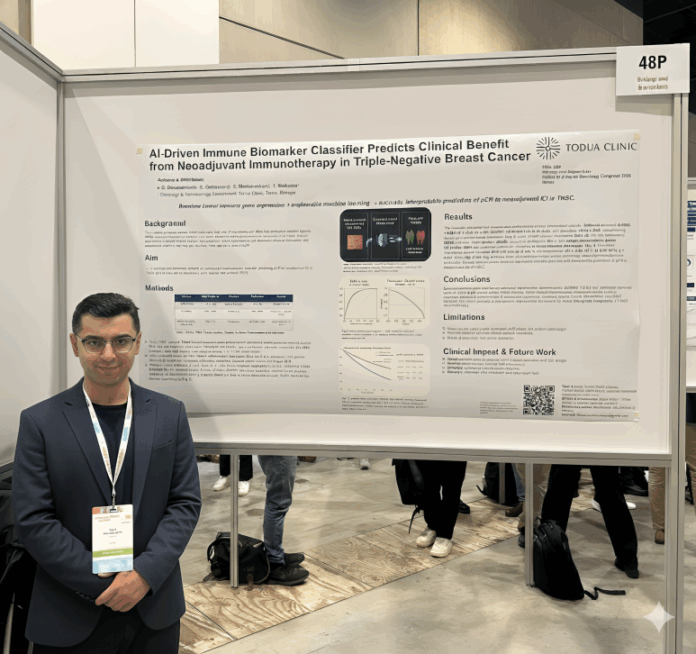
At ESMO AI & Digital Oncology 2025, I presented a poster titled:
“AI-Driven Immune Biomarker Classifier Predicts Clinical Benefit from Neoadjuvant Immunotherapy in Triple-Negative Breast Cancer.”
The aim of this project is to predict, in advance, which patients with triple-negative breast cancer will truly benefit from neoadjuvant immunotherapy.
The model is based on:
-
multi-cohort datasets built from several international cohorts,
-
surrogate labels when long-term outcomes are not directly available, using surrogate data (e.g., 5-year disease-free survival, immune activity profiles),
-
a nested cross-validation framework to avoid overfitting and unnecessary optimization,
-
SHAP-based interpretation to observe which genes and immune features drive the model’s decisions.
The entire analytical pipeline was built using the Python ecosystem: preprocessing, modeling, interpretation, and visualization.
This research was developed at Todua Clinic, a medical institution that plays a leading role in integrating innovative approaches into daily clinical practice in Georgia. For me, this project is not merely a personal academic interest; it demonstrates that meaningful research can be created in Georgia that fits naturally onto international stages such as ESMO AI & Digital Oncology.
Insights gained from the poster discussions
The discussions surrounding the poster became a long-term roadmap. Conversations with experts from different countries clarified:
-
where the primary strengths of the model lie,
-
how it can be expanded, additional clinical variables, more omics layers,
-
what kind of validation is needed for models like this to ultimately become part of real clinical decision-support platforms.
This wasn’t just a “demonstration.” It was a dialogue, collaboration, and collective reflection on how to turn AI into a knowledgeable, trustworthy partner for the patient.
A personal experience
Attending this congress in Berlin became not only a professional but a deeply personal experience. Being physically present in the sessions, observing firsthand how oncologists, morphologists, data scientists, and engineers speak the same language, this cannot be replaced by a theoretical article. Only there, on site, does it become clear that clinicians increasingly need to speak at least some level of the technical language.
Even before returning to Georgia, I was already organizing my thoughts:
What level of digital pathology development is realistic here?
Which AI projects can we practically work on?
What should be added to medical education so that the next generation has not only classical clinical thinking but also technically equipped vision?
To be honest, I was already quite motivated technically: programming, data analysis, bioinformatics, model explainability, all of this was part of my personal goals. ESMO AI & Digital Oncology 2025 added several more levels to this motivation. Now I see with much greater clarity that:
-
a technically advanced doctor is no longer an “eccentric exception”; they must gradually become the norm;
-
the future oncologist’s profile will require not only clinical intuition but also the ability to speak, to some degree, the language of algorithms;
-
active participation from Georgia in this global process is absolutely realistic, if we work systematically and purposefully.
A thought to reflect on
Along with all of this, Isaac Asimov’s words often come to mind:
“The saddest aspect of life right now is that science gathers knowledge faster than society gathers wisdom.”
This is exactly what we are seeing today in AI, digital oncology, and biomedicine: knowledge, algorithms, and models evolve at an unimaginable speed, while society, healthcare systems, and sometimes even physicians don’t have enough time to turn this knowledge into wisdom, responsibility, and a culture of correct use. In these circumstances, forums like ESMO AI & Digital Oncology become especially important — they are spaces where both science and wisdom become visible simultaneously.
I returned from Berlin with a clear understanding that:
the future of oncology and AI are inseparable;
the technically skilled physician must become a standard;
and Georgia is not behind in this global race, as long as we work structurally and purposefully.
To echo Clarke once more: our task is to give the “magic” the right form — to make it reliable, ethical, patient-centered, and understandable to everyone.
And personally, as a future oncologist and researcher, I now know far more clearly that I don’t want to be just an observer of this process. I want to be an active participant — in Georgia and in the global scientific community.
