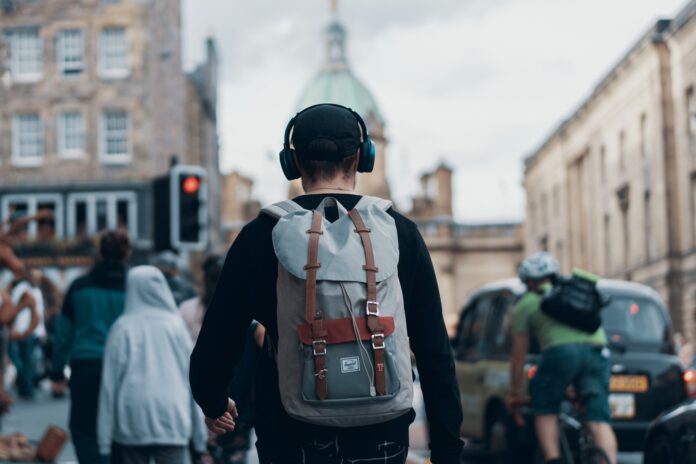
According to Edison Research data, individuals aged 13 to 34 spend an average of 4.5 hours a day listening to music or podcasts. Furthermore, Generation Z accounts for 56% of Spotify’s global audience. While wearing headphones has become an everyday, seemingly harmless habit, psychologists point to a key concern: by constantly immersing themselves in an audio bubble, young people lose their ability to live in the present and stay connected to their immediate environment.
Headphones as a Social Shield
Dr. Richard Davidson, psychiatrist and director of the Center for Healthy Minds at the University of Wisconsin–Madison, observes that the majority of people in public spaces now navigate their surroundings wearing headphones. This pattern directly undermines spontaneous social engagement—such as casual encounters with strangers, chatting in line for coffee, or exchanging smiles with passersby. As the psychiatrist explains, such micro-interactions are critically important for mental well-being, while widespread headphone use progressively isolates individuals from one another.
Escaping Thoughts and the Fear of Silence
Professor Gloria Mark of the University of California approaches the issue from a different perspective. Modern individuals have virtually lost the capacity to sit in silence, remain alone with their thoughts, or even experience boredom. Any cognitive downtime is immediately saturated with some form of audio content.
Experts emphasize that maintaining a constant background of music and podcasts serves as an avoidance mechanism against unwanted thoughts and emotions (so-called rumination), yet its protective effect is purely temporary.
“It is a false promise. When the music stops, distraction, anxiety, and neurotic thoughts return with redoubled force,” notes Davidson.
What Happens Without Headphones?
Research indicates that adults spend nearly 47% of their waking hours mind-wandering rather than focusing on the present moment. Constant audio stimulation exacerbates this attentional deficit. Behavioral experiments demonstrate that when walking routine routes without headphones, individuals notice far more details in their environment—new buildings, infrastructure changes, and passersby that previously escaped physical perception altogether.
For this reason, psychologists advise young adults to intentionally carve out time for an “audio detox” throughout the day to re-establish a direct connection with the world around them and with themselves.