


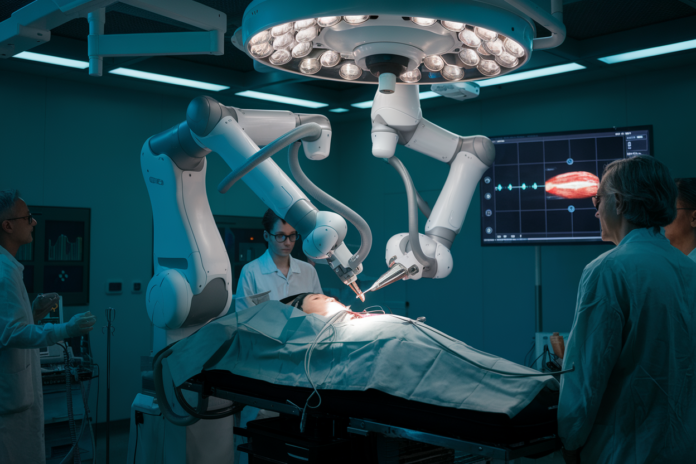
Scientists at Johns Hopkins University have developed an autonomous robotic system capable of performing surgical maneuvers within the smallest blood vessels of the eye with greater precision than a human.
Retinal Vein Occlusion (RVO) is a severe condition that leads to vision loss. One of its most promising treatment methods is cannulation: the insertion of a microscopic needle into the blocked vein. However, retinal veins are thinner than a human hair, requiring a margin of error of less than 100 microns. This level of precision lies beyond the limits of human physiological capabilities.
How Does the Robotic System Work?
The new system, detailed in the scientific journal Science Robotics, consists of several interconnected, high-tech components. Each plays a crucial role in ensuring the safety of the procedure.
The foundation of the system is the Steady-Hand Eye Robot. These specialized robots manage microscopic needles and other surgical instruments. Their primary purpose is to eliminate the natural tremors characteristic of the human hand and stabilize movement, allowing surgeons to perform manipulations with micron-level accuracy.
Machine learning algorithms play a vital role in managing the process. Artificial Intelligence analyzes visual data from the surgical microscope and Optical Coherence Tomography (OCT) scans in real-time. Through OCT, the system “sees” the layers of eye tissue and the depth of blood vessels, based on which the algorithm precisely determines the needle’s trajectory.
One of the system’s most impressive features is its autonomy. The robot can independently, without human intervention, detect the exact moment the needle touches and enters the vein. This ensures that the instrument stops at the required depth and does not damage other sensitive parts of the retina.
Research Results
The new technology has already been successfully tested in a series of experiments on porcine (pig) eyes, where the robot showed impressive results. Researchers tested the robot in two different scenarios:
-
In the first case, when the eye was completely stationary, the robot performed 9 out of 10 operations (90%) perfectly.
-
In the second case, the situation was complicated by moving the eye to simulate a patient’s breathing. Even under these difficult conditions, the robot demonstrated 83% accuracy, meaning it can adapt to micro-movements caused by respiration in a real-world environment.
This technology represents a massive leap forward for medicine. The system will enable even less experienced surgeons to perform complex operations with the same high quality as top professionals. This will significantly reduce the workload on doctors, eliminate human error, and make this type of treatment far more accessible.
