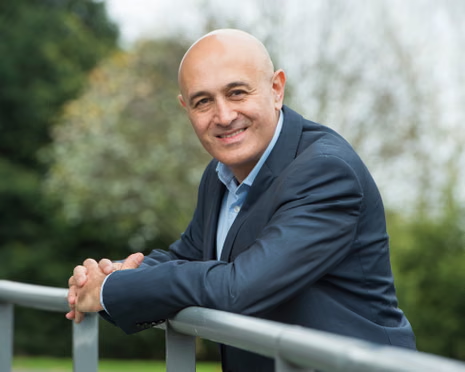
According to renowned theoretical physicist Professor Jim Al-Khalili, tech billionaires who are trying to extend human life indefinitely are wasting their time. The scientist believes that people should spend their energy not on the utopian pursuit of immortality, but on making the most of the present.
While ordinary people are turning to peptide injections and ice baths in an effort to slow aging, the ultra-wealthy are pursuing far more radical methods. For example, tech entrepreneur Bryan Johnson even received a plasma transfusion from his 17-year-old son in an attempt to preserve his youth, although he later admitted that it had produced no results.
Professor Al-Khalili, who will deliver this year’s traditional Christmas Lectures at the Royal Institution on the phenomenon of time, approaches the subject from the perspective of physics. Drawing on Albert Einstein’s theory of relativity, he explains that time does not flow at the same rate for everyone — it is affected by an object’s speed of motion and by gravity. According to Einstein, the past, present and future coexist simultaneously, much like different points in space, although humans perceive only the present.
According to the physicist, travelling backwards in time is mathematically possible. This is linked to so-called “closed timelike curves”, in which spacetime becomes so strongly curved by gravity that an object moving seemingly forward can eventually return to its starting point. However, most scientists consider this impossible in practice, as such jumps into the past would create unexplained paradoxes. Travelling into the future, by contrast, is theoretically much simpler and would require either travelling at speeds approaching that of light or orbiting a supermassive black hole.
The scientist will also address one of the most difficult puzzles in physics during his Christmas Lectures: why does time flow in only one direction when the fundamental equations do not specify a preferred direction of time? Al-Khalili claims that he has solved the so-called “arrow of time” problem and will share the details with the public during the lecture series.