


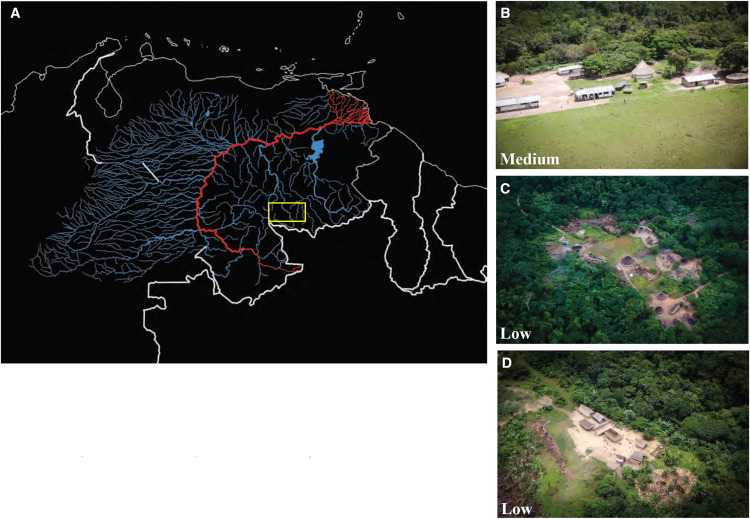
In the far south of Venezuela, across roughly 45,000 square kilometers of dense jungle, the indigenous Ye’kwana and Yanomami-Sanema communities live in scattered settlements. Their daily lives follow a rhythm passed down through generations—fishing, hunting, and cultivating yucca, while constructing homes from materials found in the surrounding forest. Most of these villages are accessible only by air or river.
For all of recorded history, these communities had almost no contact with modern medicine. This changed in 2015, when a public health program reached even the most remote villages via helicopter, bringing something truly invaluable: medication to treat onchocerciasis, also known as “river blindness.”
The program was a success. Meanwhile, a team of researchers who had been observing these communities for years did not miss this unique opportunity. They were able to measure the locals’ microbiome before any external medical contact and then again during every subsequent visit. Scientists could track in real-time what happens to the microscopic ecosystems within the human body at the very first touch of modern medicine.
The Role of the Microbiome
The human body is home to trillions of microorganisms—bacteria, fungi, viruses, and other microscopic life forms. They are everywhere: in the gut, on the skin, and in the mouth and nose. This biological community forms the human microbiome, whose members actively manage the body’s vital functions.
Indigenous populations living traditional lifestyles, who consume diets rich in plant fiber and maintain a close connection to nature, possess incredibly diverse gut microbiomes—a species richness that populations in industrialized countries have effectively already lost.
Researchers have long known that this diversity decreases with urbanization. However, the key question has always been exactly when this decline begins and what serves as its primary trigger. Is it a change in diet? Antibiotics? Or being confined within four walls? Typically, these factors accompany civilization simultaneously, making it nearly impossible to isolate a specific cause. This study provided a unique chance to separate these variables.
Study Details
As part of the study, experts collected biomaterial—swabs from the intestinal tract, mouth, nose, and skin—from 335 volunteers living in seven isolated settlements before the start of the humanitarian mission and after the completion of the first two stages. To ensure data reliability, the scientists included a control settlement whose members had longer experience interacting with civilization. This approach allowed for an analysis of the effects of long-term pharmacological exposure.
Notably, the visits from medical teams introduced no other adjustments to the indigenous way of life. The locals continued to eat products obtained from traditional farming, hunting, or fishing; no outside food was introduced. The specialists’ visits were limited to brief, targeted medical screenings and therapy. Consequently, their routine remained unchanged—the only modified variable was the medical intervention itself.
The Gut
The most dramatic shifts occurred in the gut microbiome: groups such as Prevotella, Treponema, Ruminococcaceae, and Lachnospiraceae decreased sharply. These microbes are responsible for breaking down plant fiber and synthesizing short-chain fatty acids, which are fundamental for immune regulation and controlling inflammation. In industrialized societies, these bacteria have almost entirely disappeared.
This transformation occurred without the participation of any dietary or social factors, pointing directly to the influence of medical intervention on the microbial ecosystem. Furthermore, as the frequency of visits increased, the concentration of antibiotic-resistance genes in the population also rose, likely a result of antibiotic therapy.
Mouth, Nose, and Skin: Unique Dynamics Across Anatomical Zones
The study showed that different parts of the body react individually to medical intervention:
Oral Cavity: Microbial diversity decreased immediately after the first visit. Although some disappearing microbes are associated with pathologies, the overall trend of decline mirrors the industrial world model.
Nasal Cavity: Diversity unexpectedly increased after the second visit, indicating that interventions do not affect anatomical zones uniformly.
Skin: An immediate decrease in diversity and the total disappearance of several bacterial groups were recorded.
It is also noteworthy that these changes were most evident in children, which stands to reason—their microbial ecosystems are in the formative stage and are more sensitive to disruptions.
Methodological Limitations
This study is observational in nature, meaning it describes correlations rather than direct cause-and-effect relationships. The medical missions involved the arrival of outside personnel, which raises the possibility that some of the microbial shifts were caused by physical contact with new people rather than the specific medications. The factor of seasonal dietary changes cannot be entirely ruled out either, though biomaterial collection took place strictly during the dry season under conditions of a stable diet.
The study also cannot answer whether this microbiome transformation is reversible—that is, whether the communities’ original ecosystems would be restored if medical visits ceased. Most importantly, the scientific group cannot verify how these microbial shifts impacted the overall health of the population.
The primary achievement of this work is demonstrating that the timing and dynamics of the changes coincide precisely with the schedule of medical interventions. This is further underscored by the fact that the pattern was identical across different anatomical zones, in several isolated villages, and among both children and adults.
Balancing Benefits and Losses
When analyzing these findings, it is essential to maintain scientific impartiality. No one denies that onchocerciasis is a severe disease, and the mass treatment campaign with ivermectin has brought immense global success—the disease has been completely eradicated in four American countries, and its prevalence in Venezuela has been minimized. It is a fact that this medication saved thousands of local residents from irreversible health problems.
However, the data also point to another reality: even the most progressive medical interventions are accompanied by unpredictable biological losses. This refers to the disruption of internal ecosystems that evolved alongside the human species over millennia.
Researchers estimate that this is a price we pay in exchange for access to healthcare: we successfully reduce the spread of dangerous infections but, at the same time, we lose unique microbial diversity for which Western medicine does not yet have a formula for restoration. The goal here is not to criticize medicine, but to serve as a reminder that microbial balance should not be overlooked during pharmacological interventions. This factor must become an integral part of developing global health policy and analyzing its outcomes.
Source: Cell
