


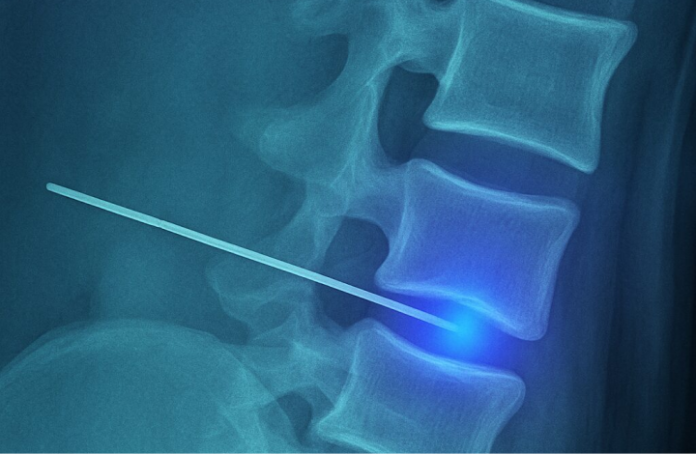
Lumbar disc herniation is one of the most common causes of acute back pain and sciatica (pain radiating down the leg). A large portion of patients often face a dilemma when traditional conservative treatment (medications, physical therapy) is ineffective, yet open surgical intervention carries significant risks and prolonged rehabilitation. This so-called “therapeutic gap” between these two extremes is being increasingly and effectively addressed by minimally invasive medicine, specifically oxygen-ozone therapy.
What is Oxygen-Ozone Therapy and How Does It Work?
Oxygen-ozone therapy is a medical procedure in which a precise, controlled gas mixture of oxygen and ozone is administered directly into the affected intervertebral disc (intradiscal) and around it (periganglionic).
The biochemical action of this method is based on several key mechanisms:
Reduction of Disc Volume: Ozone breaks down water-binding molecules (proteoglycans) within the core of the disc. Consequently, the herniation shrinks (“dries out”), significantly reducing pressure on the nerve root and alleviating mechanical pain.
Anti-inflammatory Effect: Ozone neutralizes inflammatory agents (cytokines) that are actively released during disc herniation and irritate the nerve.
Improvement of Microcirculation: The procedure enhances blood circulation and oxygen supply to the damaged area, accelerating the natural tissue healing process.
What Does the Clinical Data Show? (Data from London Spine Unit)
Scientific data published by the UK’s London Spine Unit clearly demonstrates the high efficacy of this method. A clinical study involving 600 patients presenting with clinical signs of lumbar disc nerve root compression showed compelling outcomes:
-
Group A (300 patients): Received a single session of intradiscal and periganglionic injection of the oxygen-ozone mixture. The success rate reached 70.3%.
-
Group B (300 patients): Received the same oxygen-ozone mixture, supplemented with a periganglionic injection of a corticosteroid and an anesthetic during the same session. In this case, the success rate increased to 78.3%.
The study concluded that the combined administration of medical ozone and steroids produces a cumulative effect, significantly enhancing the overall treatment outcome and helping patients avoid open surgery.
Safety Standards and SIOOT Protocols
Scientific papers published in the medical journal MDPI emphasize the safety of the procedure, which directly depends on adherence to international standards. Specifically, the strict clinical protocols developed by the Scientific Society of Oxygen-Ozone Therapy (SIOOT) regulate the precise gas concentration, dosage, and delivery techniques. The procedure is performed under image guidance (CT and/or fluoroscopy control), which eliminates incorrect needle trajectory and ensures maximum precision.
US FDA Recognition and the Triojection® Technological Breakthrough
While this approach has been successfully utilized for years across Europe and Canada, its official establishment in the United States market is entering an advanced phase. SpinaFX Medical Inc. developed the innovative Triojection® system—a minimally invasive, image-guided device designed for the treatment of intravertebral disc disorders.
The timeline of Triojection® development features several major milestones:
-
August 2025: The U.S. Food and Drug Administration (FDA) granted Triojection® the Breakthrough Device Designation, highlighting the technology’s immense potential to transform current care standards.
-
June 2026: The FDA granted an Investigational Device Exemption (IDE), permitting the initiation of a pivotal U.S. clinical trial to evaluate intradiscal ozone/oxygen injection plus nerve root block compared with nerve root block alone.
The planned prospective, randomized, multicenter trial will be unprecedented, enrolling 300 patients across up to 30 specialized spine treatment sites in the USA. The study will evaluate pain relief, functional outcomes, and health economics.
As noted by Prof. Kieran Murphy, Interventional Neuroradiologist at Toronto Western Hospital and Co-Founder/Chief Medical Officer of SpinaFX Medical, this trial is intended to evaluate the safety and effectiveness in a rigorous clinical setting, ultimately providing clinicians and patients with a validated, minimally invasive option to bridge the gap between conservative care and surgery.
The treatment of herniated discs expands beyond the binary choice of “medications or surgery.” Minimally invasive oxygen-ozone therapy, backed by its biochemical properties, high safety profile, and clinically proven 70–78% success rate, has established itself as a leading modality in modern spine care. The advent of specialized technologies like Triojection® ensures further standardization and broader integration of this therapy into global medical practice.
