


We already know that spending time in green spaces tends to make people feel better. That’s not news. What’s less settled—and far more interesting—is why it works, and whether the benefits humans get from nature are the whole story, or just one half of a much bigger picture. A new umbrella review takes a hard look at both questions, and its findings are as notable for what’s missing from the evidence as for what’s actually there.
Beyond “Not Sick”: What Does It Mean to Flourish?
Health, in the classic sense, is often framed as the absence of disease. But researchers working in this field argue that this sets the bar too low. Flourishing is a broader idea—it is about living well across several dimensions of life at once: psychological, including mental health and positive emotion; social, including relationships and connection; physical, including energy and vitality; values-related, including meaning and purpose; and environmental, including safety, security, and access to resources.
Rather than simply not being unwell, flourishing describes how well a person’s life is going across these domains over time. It is a multidimensional concept that includes health but extends beyond it.hfh.fas.harvard+1
The researchers extend this idea one step further with a concept called ecological-collective flourishing, or “e-co-flourishing”: the pursuit of human flourishing alongside the flourishing of natural ecosystems and their collective and individual constituents. It is deliberately two-way—not just “How does nature help us?” but also “How can our flourishing and nature’s flourishing rise together, rather than one coming at the other’s expense?”
Why This Matters Right Now
The backdrop for this research is sobering. Before COVID-19, some global indicators of health, income, and well-being had improved over time, although progress was uneven across countries and social groups. The pandemic disrupted several of those gains: between 2019 and 2021, global life expectancy fell by 1.8 years, reversing nearly a decade of progress. Subsequent recovery has been uneven, and economic insecurity and cost-of-living pressures continue to affect health and well-being.who+2
Meanwhile, many environmental systems are under increasing pressure. Biodiversity loss, land degradation, water insecurity, and changes in ocean chemistry are linked substantially to human activity. The consequences often fall disproportionately on communities that depend directly on natural resources for food, income, safety, and well-being.oecd+1
Existing frameworks such as One Health, EcoHealth, and planetary health already recognize that human, animal, and ecological systems are deeply intertwined. Their emphases differ: One Health has traditionally focused strongly on connections among human, animal, and environmental health, while planetary health places greater emphasis on the health of human civilization and the natural systems on which it depends.academic.oup+1
The researchers argue that the emerging e-co-flourishing framework adds a related but distinct emphasis: not only preventing environmental conditions from harming human health, but also actively pursuing mutually beneficial progress for people and the natural world. That is the gap this review helps illuminate.
What the review found
This was an umbrella review, meaning that the researchers synthesized existing systematic reviews rather than collecting new participant-level data. The review searched seven academic databases and four grey-literature sources and identified nine eligible systematic reviews. Those reviews included 45 underlying studies.
The review team focused on research that examined mechanisms connecting humans with natural entities—including plants, animals, fungi, and ecosystems—rather than reviews that addressed only outcomes without considering possible pathways.
The included evidence pointed to several recurring mechanism domains:
Psychological pathways: attention restoration, reduced stress and rumination, improved mood, and greater self-efficacy.
Social pathways: social contact, cohesion, belonging, and interpersonal functioning.
Physical pathways: physical activity, sleep, and indicators such as obesity or blood pressure.
Environmental pathways: reduced exposure to noise or air pollution and greater access to green or blue spaces.
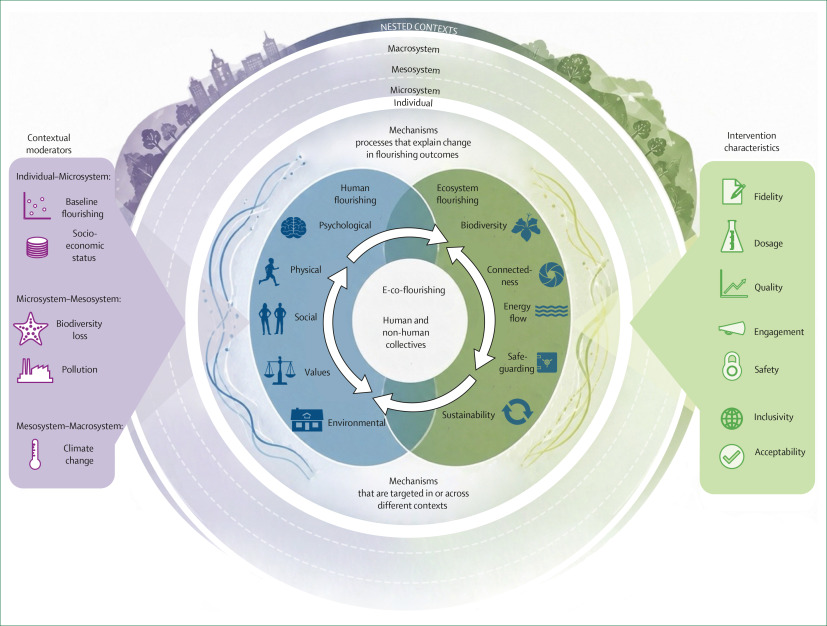
Psychological mechanisms had the most consistent support. Findings for social, physical, and environmental pathways were more variable and depended on the specific exposure and outcome being studied.
When researchers looked at broader well-being or quality-of-life outcomes rather than isolated psychological, social, or physical measures, positive associations were reported across several domains, including values-related outcomes where these were assessed. However, the review did not establish that all proposed mechanisms are equally well supported, nor that any single pathway reliably causes flourishing.
The evidence gap
The most important limitation is the weakness of the causal evidence. Much of the underlying research was cross-sectional or qualitative, meaning that it captured experiences at one point in time or explored them through interviews and other nonexperimental methods. Only a small proportion came from stronger designs, such as randomized controlled trials.
That matters because an association between nature exposure and flourishing can arise through several pathways. People with better mental health may be more likely to visit parks, maintain gardens, or seek outdoor activities. Wealth, neighborhood safety, mobility, social support, and access to healthcare may influence both exposure to nature and well-being. Without stronger designs, it is difficult to determine how much of the association is attributable to nature itself.
The missing half

Every eligible review examined how natural environments or other natural entities affected humans. None examined, in a mechanistic and systematic way, how human flourishing might affect ecosystems and other species, or how both might change together.
This is a notable omission for a framework built around mutual flourishing. Human well-being may encourage stewardship, conservation, civic participation, or sustainable resource use. Conversely, ecological degradation may undermine health, security, livelihood, and social cohesion. Researchers have described these possibilities as reciprocal contributions and feedback loops, but they have not yet been adequately tested within the systematic-review literature captured by this umbrella review.
nature appears to support several dimensions of human well-being, particularly psychological well-being, but the causal evidence remains limited. Meanwhile, the reciprocal relationship—how human flourishing may support or damage the natural world—has barely been studied in a mechanistic way.
E-co-flourishing is therefore best treated as a promising framework for guiding future research and policy, not as a conclusion that science has already established.
Source: The Lancet Planetary Health
