


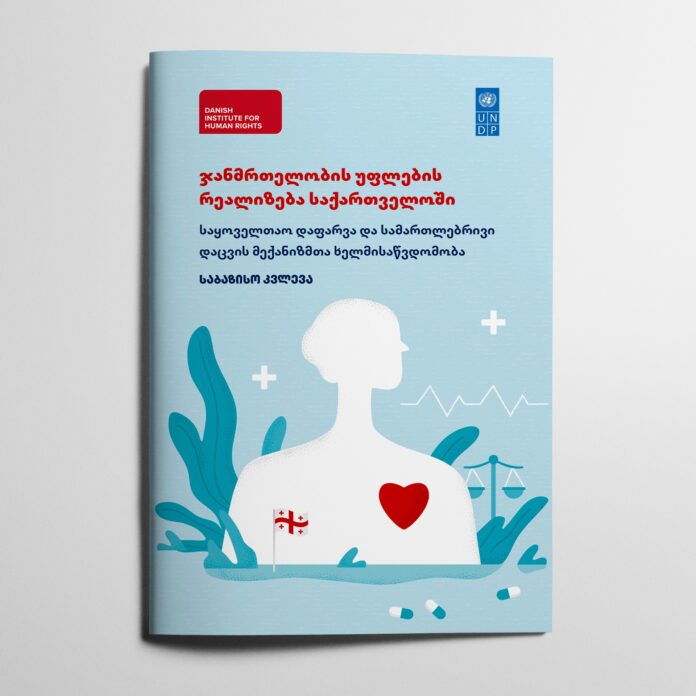
The United Nations Development Programme (UNDP), in collaboration with the Danish Institute for Human Rights (DIHR), has published a research report titled “Realizing the Right to Health in Georgia: Universal Coverage and Access to Legal Protection Mechanisms.” The report analyzes Georgia’s Universal Healthcare Program (UHCP), with a specific focus on persons with disabilities (PWDs), patient rights, and institutional mechanisms.
The state-funded UHCP, introduced in 2013, ensured 90% population coverage, increased life expectancy, and significantly reduced out-of-pocket (OOP) payments for patients (from 73% to 40%). Despite declared progress, the system failed to achieve structural optimization of primary healthcare (PHC), leading to a service imbalance and an artificial increase in hospitalization rates (the hospitalization rate in Georgia is 3 to 4 times higher than the European average).
The fiscal consolidation process starting in 2017—involving the segmentation of high-income beneficiaries and the introduction of co-payment mechanisms—shifted part of the financial burden back to patients. The system’s financial instability is evidenced by a chronic deficit between planned and actual budgetary expenditures, while the spending limits introduced in 2023 represent only a fragmented attempt to mitigate the negative economic impacts caused by the low cost-effectiveness of the primary sector.
Key Research Findings and Recommendations:
-
Inadequate Legal Regulation and Opaque Decision-Making: The absence of a clear and comprehensive legal framework facilitates discretionary executive control over the distribution of health services. Benefit packages are often defined by complex government decrees developed without proper engagement or evidence-based democratic participation. This is evidenced by the exclusion of preventive or mitigating disability services and a lack of regulation for private insurers, which can lead to discriminatory treatment based on disability status.
-
Coverage Expansion and Financial Barriers: Although OOP expenses dropped from 73% in 2012 to 40% by 2022, financial barriers remain a major challenge. The 2017 co-payment mechanisms and the exclusion of individuals earning over 40,000 GEL significantly weakened the reform’s social impact. Consequently, despite increased state investment, health-induced poverty decreased by only 0.6% by 2023.
-
Rights of Persons with Disabilities: Although the Law “On the Rights of Persons with Disabilities” mandates prevention, early diagnosis, and rehabilitation, these obligations are not properly met. For instance, cochlear implants and BAHA bone-conduction implants are excluded from the package despite their potential to reduce disability. The situation is further exacerbated by the lack of price regulation for expensive medications and the prevalence of polypharmacy.
-
Excluded Services: The UHCP excludes various services without reasonable justification, including regular therapeutic treatments, specialist consultations, and advanced diagnostics (e.g., PET/CT scans) outside limited PHC or emergency scopes. Furthermore, family planning and specialized healthcare for the transgender community (hormone therapy, gender-reassignment surgery) are not covered. Following autocratic shifts in Georgia, the 2024 “Anti-LGBT Law” now prohibits even self-funded medical gender reassignment interventions.
-
Primary Healthcare and Urban-Rural Imbalance: PHC faces chronic underfunding and a lack of institutional monitoring, leading to staff shortages and inefficiency. Patients often bypass PHC for expensive specialized services, increasing the risk of avoidable diseases. In rural areas, PHC is largely limited to monitoring the elderly and administering vaccines. Vertical programs (Diabetes, HIV, Reproductive Health) are concentrated in urban centers, creating logistical and financial barriers for rural residents.
-
Institutional Oversight: The Referral Committee operates with broad discretion and low accountability. Oversight of medical quality remains fragmented, focusing on basic safety (infection control) rather than clinical effectiveness. The Regulatory Agency for Medical and Pharmaceutical Activities is hindered by a lack of resources, covering only 26% of hospitals and 4% of outpatient clinics annually. As of September 2024, only 33% of the 682 complaints submitted in 2022–2023 had been reviewed. Similarly, the Professional Development Council lacks independence, with members appointed solely by the Minister, raising concerns regarding political neutrality.
Recommendations: It is essential to define clear priorities and evidence-based rationing criteria for the UHCP. The government should ensure the institutional independence of the Regulatory Agency and the Professional Development Council. Recommendations include: lifting restrictions on private insurance, abolishing co-payments for emergency services, and transitioning to a flexible “voucher model” for medications and assistive devices. Specific disability needs (diagnostics, transplantation) must be prioritized, and rural doctors’ salaries and working conditions must be improved to match urban standards.
