


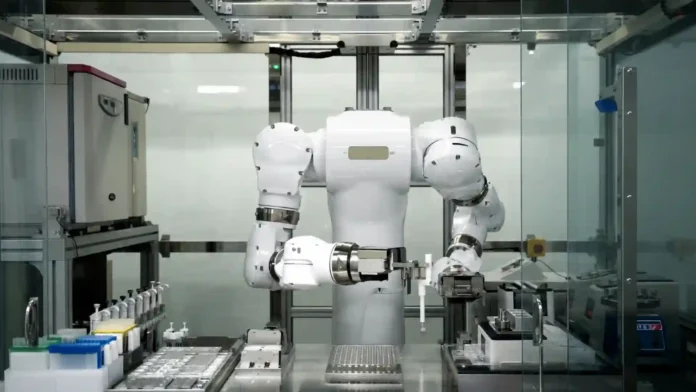
The Robotics Innovation Center at the Institute of Science Tokyo has launched an automated biological laboratory where dual-arm robots equipped with artificial intelligence perform experiments instead of humans.
According to an article published in the authoritative scientific journal Nature, the center’s long-term goal is to establish a global-scale “manufacturing facility” by 2040–2050. This facility will house thousands of independent robots and will be accessible to researchers from anywhere in the world.
Genki Kanda, a researcher at the center, stated that the laboratory’s robots do not merely perform mechanical tasks; thanks to embedded software, they make decisions independently, analyze data, and optimize experimental methodologies.
For instance, during one study, the AI tested 144 different conditions over 111 days to select the ideal environment for culturing human stem cells. In another case, the robot successfully predicted the cell growth trajectory and determined the precise timing for harvesting. They were even able to independently and continuously maintain cell cultures for 8 days while the scientists were away on vacation.
Experts agree that fully autonomous laboratories are still a distant prospect. In their assessment, robots will not take away scientists’ jobs, as they are not yet capable of executing complex, multi-step chemical syntheses, such as the production of the oncology drug paclitaxel.
At this stage, human intervention remains essential for preparing reagents, cleaning equipment, and correcting errors made by the robots. However, for Japan, which faces a labor shortage due to a declining number of doctoral students, this technology serves as an excellent solution to handle the workload of technical staff and graduate students.
The primary challenge remains the high cost. Even simple, single-arm robots available on the market cost between $20,000 and $30,000, excluding the cost of accessories. In the case of the Tokyo Institute, the cost of each robot reached 1 million USD. Due to this colossal price tag, scientists see the solution in creating shared centers where researchers from different countries will have equal access to expensive equipment.
