


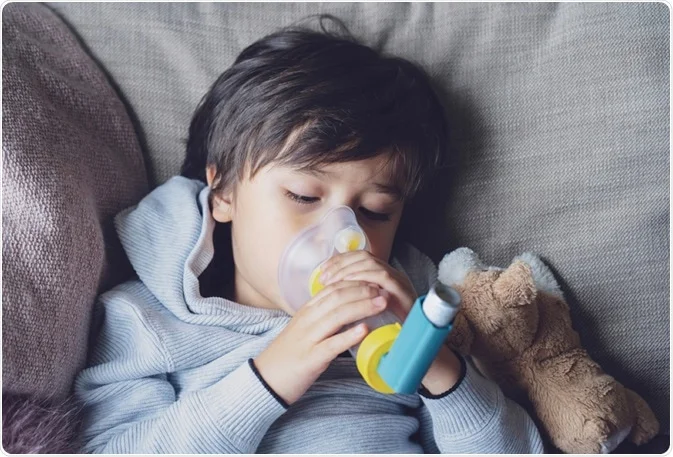
A child with asthma is brought in for a routine check-up. Their spirometry numbers are normal, yet the child continues to suffer from wheezing, wakes up at night, avoids physical activity, or experiences disease exacerbations. While reassuring spirometry results are important, they do not always convey the full picture—especially when the pathological process involves the smallest airways located deep within the lungs.
Researchers increasingly refer to these peripheral regions as the lung’s “silent zone.” Small airway dysfunction can cause symptoms and poor asthma control even when traditional spirometry parameters (such as and ) register no obvious airflow limitation.
The Hidden Side of Asthma?
The small airways are generally defined as conduits with a diameter of less than 2 millimeters. They originate approximately at the seventh or eighth generation of branching in the bronchial tree and extend toward the lung periphery.
These airways can develop inflammatory processes, mucous plugging, wall remodeling, and premature closure. Under normal conditions, they contribute very little to total airway resistance because they are arranged in parallel throughout the lungs. Consequently, severe abnormalities can develop in peripheral structures long before standard spirometry detects obvious deviations.
The term “silent zone” does not imply that these airways are impossible to examine. Rather, standard spirometry is simply less sensitive to isolated or early peripheral dysfunction. The and parameters reflect the overall dynamics of airflow during expiration, but they are primarily influenced by large and medium-sized airways.
This distinction is of essential importance in children, whose asthma symptoms may fluctuate, and whose ability to properly perform a forced expiratory maneuver is highly dependent on age, proper technique, and test quality.
How Common Is This Pathology?
The prevalence of small airway dysfunction varies significantly depending on the population studied, the test utilized, and the established threshold values.
In a retrospective study of 851 preschool children with asthma, 19.5% of participants met the spirometric criteria for small airway dysfunction based on parameters such as , , and . These abnormal airflow changes were associated with more severe airway obstruction and hyperresponsiveness. However, this study did not establish a universal pediatric definition for small airway disease. Because the diagnosis was made based on spirometric data itself, it could not prove that these impairments remain entirely invisible to traditional spirometry.
Studies conducted in older children showed a different picture. In a cohort of school-aged children, small airway abnormalities were detected in:
63% of participants evaluated by oscillometry;
54% of participants evaluated by the multiple-breath nitrogen washout (MBW) method;
44% of participants evaluated by the parameter.
At least one abnormality was recorded in 77% of the children. Comparing these data directly to preschool figures is not valid, as the studied populations, methodologies, and definitions differed sharply.
According to studies in adults, approximately 50–60% of individuals with asthma exhibit small airway dysfunction, though these figures also fluctuate considerably. While adult data provide important biological context, they cannot be directly generalized to children.
Why Spirometry Can Miss It
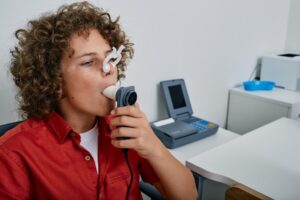
During spirometry, the patient must inhale deeply and then exhale forcefully and continuously into the machine. It is an indispensable, first-line test for diagnosing and monitoring asthma, but it was not designed to examine the smallest peripheral airways in isolation.
To form an indirect impression of small airway function, clinicians sometimes evaluate late-expiratory flow parameters (including , , and ). In some children, these parameters may correlate with airway hyperresponsiveness, but they are heavily influenced by effort, lung volume, test quality, and the shape of the patient’s expiratory curve. Furthermore, there is no universally accepted threshold value for diagnosing small airway dysfunction based on these parameters.
Therefore, it is more accurate to conclude not that spirometry evaluates only large airways, but rather that standard spirometric parameters may fail to detect isolated or early peripheral airway pathologies.
A complementary test
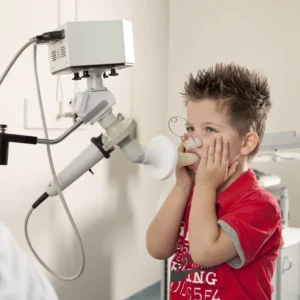
Impulse Oscillometry (IOS): A method for evaluating lung ventilation mechanics during quiet breathing. The device sends small pressure-wave vibrations into the patient’s mouth and subsequently analyzes airway resistance and reactance. Because it does not require a forceful or prolonged exhalation from the child, this method is particularly effective for preschool children who cannot perform a spirometry test properly. IOS can provide additional information regarding peripheral airway mechanics that might go unnoticed using or alone. Pediatric studies have demonstrated a link between abnormal oscillometry parameters and poor asthma control (or subsequent loss of control), while adult data indicate that small airway dysfunction detected by IOS is associated with symptom expression and exacerbation risk. However, IOS does not simply show “what spirometry missed.” The two tests measure different physiological characteristics, and a deviation in one does not automatically imply an abnormal result in the other. Furthermore, comparing study results is complicated by the fact that different devices use individual reference equations and threshold values.
Body Plethysmography: Makes it possible to detect air trapping and lung hyperinflation, which point to premature closure of the small airways.
Multiple-Breath Nitrogen Washout (MBW): Evaluates the distribution of ventilation during normal breathing; uneven distribution serves as a potential sign of peripheral airway dysfunction.
High-Resolution Computed Tomography (HRCT): Can detect indirect signs such as expiratory air trapping and mosaic perfusion, though it generally cannot directly visualize the smallest airways. Moreover, due to radiation exposure, the use of CT in children is strictly limited, particularly when the diagnosis is otherwise clear.
Exhaled Breath Analysis: Measures volatile organic compounds; it remains an emerging research tool rather than a standard clinical test.
Each of these methods carries its own limitations related to equipment availability, cost, technical expertise, and the absence of standardized pediatric reference values and diagnostic thresholds.
Who Might Need Further Evaluation?
In adult cohorts, small airway dysfunction is associated with high fractional exhaled nitric oxide () levels, female sex, tobacco smoking, age, obesity, nocturnal symptoms, and exercise-induced signs. It remains unclear to what extent these predictive factors apply to children; in particular, adult data regarding age and active smoking cannot be automatically generalized to pediatric patients.
For clinicians, the most notable flag may be a mismatch between the child’s clinical presentation and their spirometry numbers. Persistent symptoms, nocturnal awakenings, activity limitations, frequent exacerbations, or signs of poor disease control—despite seemingly satisfactory spirometry results—can justify additional testing. This applies particularly in specialized centers where IOS or MBW is available.
However, this does not mean that every symptomatic child with normal spirometry has small airway dysfunction. Symptoms may instead be driven by:
Incorrect inhaler technique;
Poor adherence to the treatment regimen;
Dysfunctional breathing or vocal cord dysfunction;
Allergic rhinitis or gastroesophageal reflux;
Obesity, infection, or other comorbid diagnoses.
What This Means for Families
A normal spirometry result is by no means insignificant. Spirometry remains the primary tool for assessing and monitoring asthma, and test quality and clinical context are paramount when interpreting results.
A more cautious approach, however, suggests that a normal spirometry value does not automatically rule out ongoing symptoms. When a child continues to experience wheezing, shortness of breath, nocturnal symptoms, exercise limitations, or disease exacerbations, clinicians should consider whether additional investigations are warranted.
Currently, there is insufficient evidence to recommend altering an asthma treatment course solely because a child exhibits small airway dysfunction. Because most studies are observational, rigorous clinical trials are still required to determine whether treatment strategies guided by impulse oscillometry, MBW, or other testing methods actually reduce exacerbations or improve long-term lung function.
Source: The Lancet
