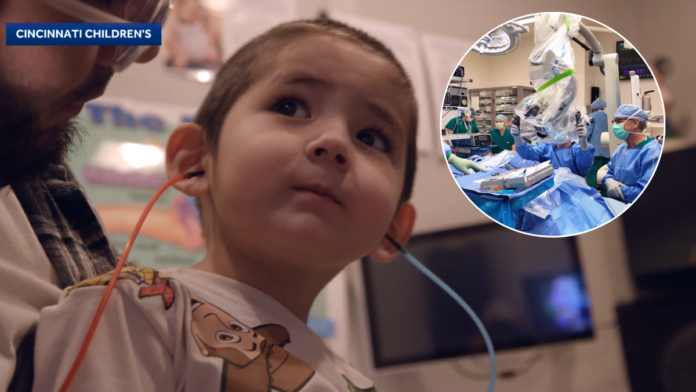
According to Cincinnati Children’s Hospital (Ohio, USA), an innovative gene therapy has restored hearing in children with congenital hearing loss for the first time. Developed at the medical center, this approach enables patients to hear sounds naturally, without relying on electronic devices such as cochlear implants.
Two young siblings from Uzbekistan—3-year-old Abdu and 1-year-old Sumaya—enrolled in the clinical trial for the new therapeutic. According to the hospital, both children were diagnosed with profound sensorineural hearing loss caused by a rare mutation in the OTOF gene. This gene encodes otoferlin, an essential protein that plays a critical role in auditory processing.
Clinicians note that children with this specific genetic variant cannot perceive even intense sounds, such as a lawnmower operating just a few meters away. Historically, surgical cochlear implantation—which bypasses damaged inner ear structures to transmit auditory signals—was considered the only viable intervention for such severe hearing deficits.
In contrast, otolaryngologist Dr. John Greinwald Jr. has been working on a novel gene therapy designated Otarmeni to treat hereditary hearing impairment. Both children precisely met the trial inclusion criteria: confirmed OTOF-associated hearing loss, preserved outer hair cell function, and no prior cochlear implantation.
In April 2025, 3-year-old Abdu became the first to receive this investigational therapy. According to Greinwald, the surgical procedure mirrors cochlear implant placement: surgeons access the inner ear (cochlea) through the mastoid bone behind the ear and deliver the gene therapy vector directly into the target site.
Hospital reports indicate striking results: four weeks post-procedure, Abdu—who previously had essentially no functional hearing—began perceiving sounds. Today, his auditory thresholds fall within normal ranges, and he is actively developing speech skills. Following this marked progress, physicians administered the same therapeutic regimen to his 1-year-old sister.
“For us, it was a moment of sheer awe, because throughout our careers we never anticipated seeing this—that children could achieve hearing without external assistive devices. There were virtually no complications, and both patients demonstrated phenomenal improvement,” noted Dr. John Greinwald.
Notably, broader findings from this clinical trial have already been published in The New England Journal of Medicine. Data show that 9 out of the initial 12 participants regained the ability to detect sounds at or below 70 decibels in less than six months following surgery. Consequently, these patients will no longer require cochlear implantation.
While investigators continue longitudinal follow-up of the cohort, the team emphasizes that these clinical trial outcomes demonstrate the immense potential of gene therapy for individuals with hearing impairment. Greinwald underscored that this milestone reflects the collaborative dedication of hundreds of researchers and clinicians, calling it “a kind of miracle” in modern medicine.