


In an era when medical progress often outpaces the structures meant to support it, determining how to train doctors effectively has become more crucial than ever. Postgraduate medical education reflects this ongoing change and must strike a balance between cutting-edge science and the practical demands of healthcare systems, policy, and real human needs.
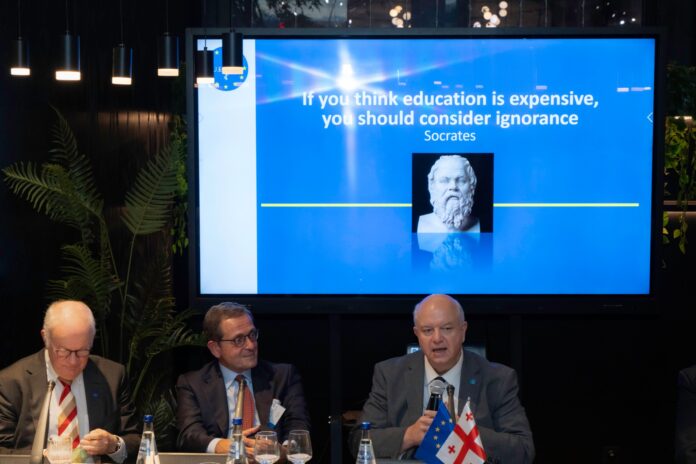
These very challenges guided the GAMS-UEMS Symposium on Postgraduate Medical Education and Continuous Professional Development in Tbilisi, creating a space to bridge knowledge gaps and promote Georgia’s progress toward European standards and best practices.
As a psychiatrist, educator, and UEMS Officer for European and International Affairs, Dr. Marc Hermans brings a unique perspective to this delicate challenge. In the interview, he explains that meaningful change is less about making grand announcements and more about steady, careful reform. Reflecting on the diverse approaches to medical governance across Europe and the benefits of collaboration across borders, Dr. Hermans highlights that true progress stems from patience, honest conversation, and mutual respect, rather than from haste or top-down mandates.
How does UEMS engage with European lawmakers to prioritize medical education reforms and professional development in countries that have issues in the structure of their postgraduate systems, ensuring that their health professionals can meet international standards?
This office within UEMS was established about two years ago. After serving in other positions within the union, I subsequently took on this position. To understand our work, it’s important to recognize that the field of European Union-wide medical education reform has long been overlooked. UEMS has always aspired to actively participate in discussions with policymakers to provide valuable expert input, but historically, getting health issues placed firmly on the EU’s agenda has been increasingly challenging.
The COVID-19 pandemic, however, brought a critical awakening. It exposed the lack of a cohesive European health policy and highlighted the vast diversity between national systems. Every EU country operates distinct training programs, healthcare delivery models, and professional roles, with fundamental differences in how primary care physicians are educated and integrated into the healthcare framework. Despite Western Europe’s traditionally high standards, we’ve witnessed a remarkable exchange of best practices where Central and Eastern European countries, and more recently others such as Ukraine, are not only adopting valuable Western innovations but also preserving and exporting strengths from their own models.
Yet, UEMS remains far from a politically powerful entity. We have no political affiliation or formal influence. Roughly two years ago, the Enlarged UEMS Executive Committee recognized the pressing need to deepen engagement with European policymakers. While we had minimal contact with the European Commission before, it was often superficial and symbolic. Actively initiating and cultivating relationships with Members of the European Parliament (MEPs) became my first task.
Initial outreach was met with polite interest but little follow-through. Invitations were mostly limited to events focusing on mental health, a field I know well from my previous leadership roles within UEMS. Recent tightening of access to the European Parliament has made meaningful interactions even more challenging, requiring invitations and limiting entry, especially under heightened security concerns. Despite these hurdles, I seize every opportunity to meet MEPs involved in health and education, our two core focus areas.
Beyond direct political engagement, UEMS benefits from the efforts of colleagues such as Isabelle Dumaine, who maintains ongoing contact with the European Commission and tracks initiatives relevant to our work. For example, participation in forums like the European Pain Federation’s recent event helps us understand emerging scientific insights and raise our visibility, even if public relations efforts in healthcare are often limited.
One of the biggest frustrations I encounter is a pervasive skepticism among policymakers about health professionals’ expertise. This skepticism became very clear to me through a personal experience.
When I once discussed the dire shortage of child psychiatrists with a Minister of Health, she dismissed my concerns as self-interest. I replied that the parents of children on waiting lists shared the same urgencies.
Sadly, it highlights a broader challenge we face with policymakers, who often do not believe or fully understand the healthcare community’s realities. Patients and their families wield far greater influence with politicians because they are voters. That observation motivated UEMS to strengthen its collaboration with the European Patients’ Forum (EPF). Although EPF primarily focuses on medicine access and regulation rather than training, working alongside them enhances our combined impact by delivering scientific evidence.
Unlike some groups receiving industry funding, UEMS remains free from such financial ties, preserving our independence and dedication solely to advancing postgraduate education, continuous professional development, and quality of practice and professional standards.
What are the biggest challenges UEMS faces in lobbying for medical specialists’ interests at the European level, especially given diverse national healthcare systems?
A key challenge for UEMS is ensuring our perspective is heard and considered among the many competing voices in European healthcare. Various interest groups and political parties have their own agendas, priorities, and established networks. Navigating this complex landscape while advocating for medical specialists remains difficult.
Two critically underfunded areas within the EU compound this challenge: healthcare training and scientific research. Training shortages affect a broad spectrum of healthcare professionals, including psychologists and nurses, contributing significantly to workforce deficits across Europe. Meanwhile, Europe lags in major healthcare research initiatives, many of which are headquartered in the United States or Asia and driven by large pharmaceutical companies. This limits Europe’s influence on the healthcare innovation agenda.
Additionally, healthcare systems in several countries can become “landing zones” for politicians nearing the end of their careers, offering them positions on hospital boards or insurance committees. While some bring genuine expertise and a desire to improve healthcare, others may use these roles to advance party lines or affiliated research interests. This layering of political and institutional complexity often muffles consistent, focused advocacy for specialist training and development.
Despite these obstacles, we remain optimistic. History shows that crises often act as catalysts for meaningful reform. Increasingly, patients are becoming powerful agents of change, their voices resonating more strongly with policymakers. By aligning with patient organizations and demonstrating the essential role of medical specialists in delivering quality care, UEMS seeks to harness this momentum to influence policy and funding priorities effectively.
How is UEMS addressing the challenge of healthcare workforce migration from countries with lower training recognition, like Georgia, ensuring fair opportunities for those professionals?
Healthcare workforce migration is a well-recognized and complex challenge across the European Union. Numerous studies and EU-funded projects have highlighted the issue, with support from the medical workforce itself.
Recently, the World Health Organization identified Georgia as one of the leading source countries for migrating healthcare professionals, a noteworthy fact given Georgia’s relatively small size but unusually high density of accredited medical schools. The rapid expansion of medical education in Georgia raises concerns about both the capacity for clinical training and the overall quality of its healthcare system. Consequently, Georgian healthcare professionals who seek to practice abroad – often in countries like Germany – face limitations in having their qualifications and competencies fully recognized.
This situation is not unique to Georgia. Within the EU, medical diplomas are technically recognized across member states, as well as in the UK, Norway, and Iceland. However, recognition of a medical degree does not always guarantee the right to practice without conditions. For example, many countries require proficiency in local languages, which poses a significant barrier.
In Belgium, where I serve on the Flemish recognition committee for psychiatrists, linguistic challenges are pronounced. Brussels alone hosts professionals from over 180 nationalities. We receive applications from candidates who lack fluency in the local languages (Dutch, French and German) which hinders effective assessment and patient care. While applicants often present strong academic endorsements from their home countries, the legal frameworks governing licensure ultimately prevail to ensure public safety.
Migration issues also extend to medical students. Belgium, for instance, limits the number of new medical trainees each year, with quotas for Dutch- and French-speaking candidates. Successful exam results do not guarantee admission due to these caps. Many students circumvent these restrictions by studying in other countries, such as Romania, and returning later to continue training, creating additional regulatory challenges.
Migration trends commonly involve movement from Central Europe to countries like Germany or Austria, from France to French-speaking Canada, and from Northern Europe to English-speaking countries such as England, Australia, or the United States. Despite these observable flows, UEMS does not have the authority to control migration patterns or trainee numbers within specialties.
While studies have explored incentives to retain healthcare workers in source countries, such initiatives remain largely unimplemented. For Georgia, financial considerations also play a role: international students pay higher fees, providing universities with income and stimulating local economies, creating a complex balancing act between retaining students and welcoming international learners.
One of the three major principles of UEMS is actionable projects, not just ideas or themes of conversation. Could you elaborate on what this principle entails?
When Professor Vassilios Papalois discusses actionable projects, he refers to tangible initiatives that UEMS actively launches and carries through to completion. For example, we now organize examinations across different medical specialties to standardize and elevate training quality. Looking ahead, we have our Congress scheduled for 2026 in Leuven, which will showcase many such concrete achievements.
Vassilios brings a hands-on, Mediterranean approach shaped by his surgical background. He believes UEMS should demonstrate clear, visible results – highlighting what we have accomplished, much like showing how a transplant has improved a patient’s renal function. This contrasts somewhat with the European political scene, where visibility and assertiveness are key to influence, sometimes more than outcome.
Historically, the Standing Committee of European Doctors (CPME) has been more politically proactive than UEMS, benefiting from assertive leadership that cultivated strong ties with the European Commission. Their approach combined British pragmatism with German assertiveness – making it seem to policymakers that CPME’s projects and voice might be indispensable.
UEMS, by contrast, was traditionally more modest, focusing on its roots as a clinicians’ organization rather than a political powerbroker. While this means we lack a “big mouth” or overt political clout, it also allows us to make slow yet meaningful impacts grounded in clinical expertise.
What concrete step, realistically achievable by countries with weaker educational systems, do you see as having the most impact for long-term change in postgraduate medical education?
One fundamental principle from psychiatry training that applies broadly to postgraduate medical education is summed up in the advice: “go low, go slow.” This means starting with small, manageable steps and increasing efforts gradually while carefully monitoring results.
When seeking reform, medical educators and policymakers should be encouraged to look beyond initial impressions. Visiting other countries to learn from their experiences and gathering feedback is essential. Importantly, reforms should consider the readiness of training institutions, including faculty preparedness and infrastructure.
Engagement with government educational departments is crucial, especially those overseeing financial aspects such as healthcare reimbursement. Without this, reforms risk becoming fragmented or ineffective.
For example, when general practitioners deliver primary care but lack formal recognition as family doctors, this might lead to inconsistent practice levels and reimbursement policies. This exemplifies the pitfalls of hastily implemented reforms without comprehensive stakeholder involvement.
Therefore, adopting a gradual, stakeholder-inclusive approach is key. Set a realistic timeline, ensure all parties are prepared, and avoid superficial measures that merely create the appearance of progress without substantive improvement.
Could you discuss any ongoing or upcoming EU projects that focus on continuous professional development and competency standardization?
To give a short and honest answer – currently, there are no major EU projects that I am aware of directly addressing these goals in a comprehensive way.
One noteworthy example is the Panacea study group, whose work I find particularly interesting. They provide training that helps healthcare professionals better understand placebo and nocebo effects – their mechanisms, how to recognize them, and their clinical impact. This kind of initiative shows promise but remains relatively unknown outside specialist circles.
A broader issue affecting awareness and engagement with EU healthcare initiatives is the limited financial contribution from member countries. Many invest only modestly – roughly 300 euros per capita annually – into European institutions. Within Belgium, my colleagues often question why there is criticism of European policies, given that this modest investment yields significant institutional efficiency, sometimes surpassing national governments.
Regarding continuous professional development more broadly, the EU supports it and acknowledges its importance. However, ambitious initiatives, such as creating a pan-European professional register, face substantial hurdles – primarily around privacy regulations and data protection.
Policymakers generally trust that physicians pursue continuous medical education independently. Yet, in practice, some colleagues only meet minimal requirements, indicating a gap between intention and implementation.
It is encouraging to have faith in UEMS’s influence, but realistically, many of the challenges fall within the responsibility of national governments. What advice would you give to countries struggling to have their voices heard and to drive meaningful change at the governmental level in postgraduate medical education?
You are absolutely right – most challenges in postgraduate medical education fall squarely within national governments’ authority. Because these issues often lie within national competence, it becomes very difficult to achieve harmonization across Europe or to ensure that countries with weaker systems can effectively make their voices heard and promote meaningful reforms.
When it comes to advice, I prefer to address individuals rather than countries. For those trying to be heard, I firmly believe the most powerful voices come from patients. Mobilizing patient advocacy can significantly influence policymakers, who ultimately respond to their constituents.
Another practical, if somewhat informal, consideration is the influence that personal connections with government officials can have. For example, about twenty years ago, healthcare for physically disabled children improved dramatically in one country after it was revealed that the then Health Minister had a child with disabilities. This personal connection brought attention, subsidies, and renovations that were otherwise lacking.
Unfortunately, such targeted advocacy has often bypassed psychiatric care, which lacks the tangible outcomes that specialties like cardiology or nephrology can showcase. Yet, psychiatry’s importance remains critical.
Involving influential societal actors, such as universities, alongside patient groups and government ministers, can create a powerful coalition. Once academia and government align in support, initiatives gain momentum and become nearly unstoppable. This synergy is already evident in some countries where meaningful progress is being made.
Beyond long-term strategies, what practical, near-term steps can Georgian medical institutions undertake with UEMS support to enhance training quality, assessment, and accreditation swiftly?
The first practical step, I would say, is to invite me, let’s have a tour in Georgia. There is no substitute for firsthand experience. Advice given from a distance, such as “why don’t you do this?” or “have you thought of that?” can only go so far. A true understanding of the local context emerges only by observing healthcare and educational practices on the spot.
Never underestimate the intellect and dedication of the people working in medicine – students, doctors, and educators alike. Experience tends to come late, often after one reflects and thinks, “We should have approached it differently.”
To deepen my understanding, I recently bought a book, The Making of the Georgian Nation by Ronald Grigor Suny. I thought it would help me learn more about your country. What struck me is that the impact of any reform – whether in education or healthcare – depends greatly on local beliefs, attitudes, and everyday practices.
For example, in Croatia, they use a net placed over a patient’s bed instead of rigid wrist and ankle restraints, a practice that surprised my Croatian colleagues when they learned about Belgian methods. These different approaches arise from cultural mindsets rather than medical efficacy alone.
Similarly, perceptions around interventions, whether an injection or physical restraint, carry different meanings depending on personal or cultural experience. One person’s distress might be another’s comfort.
